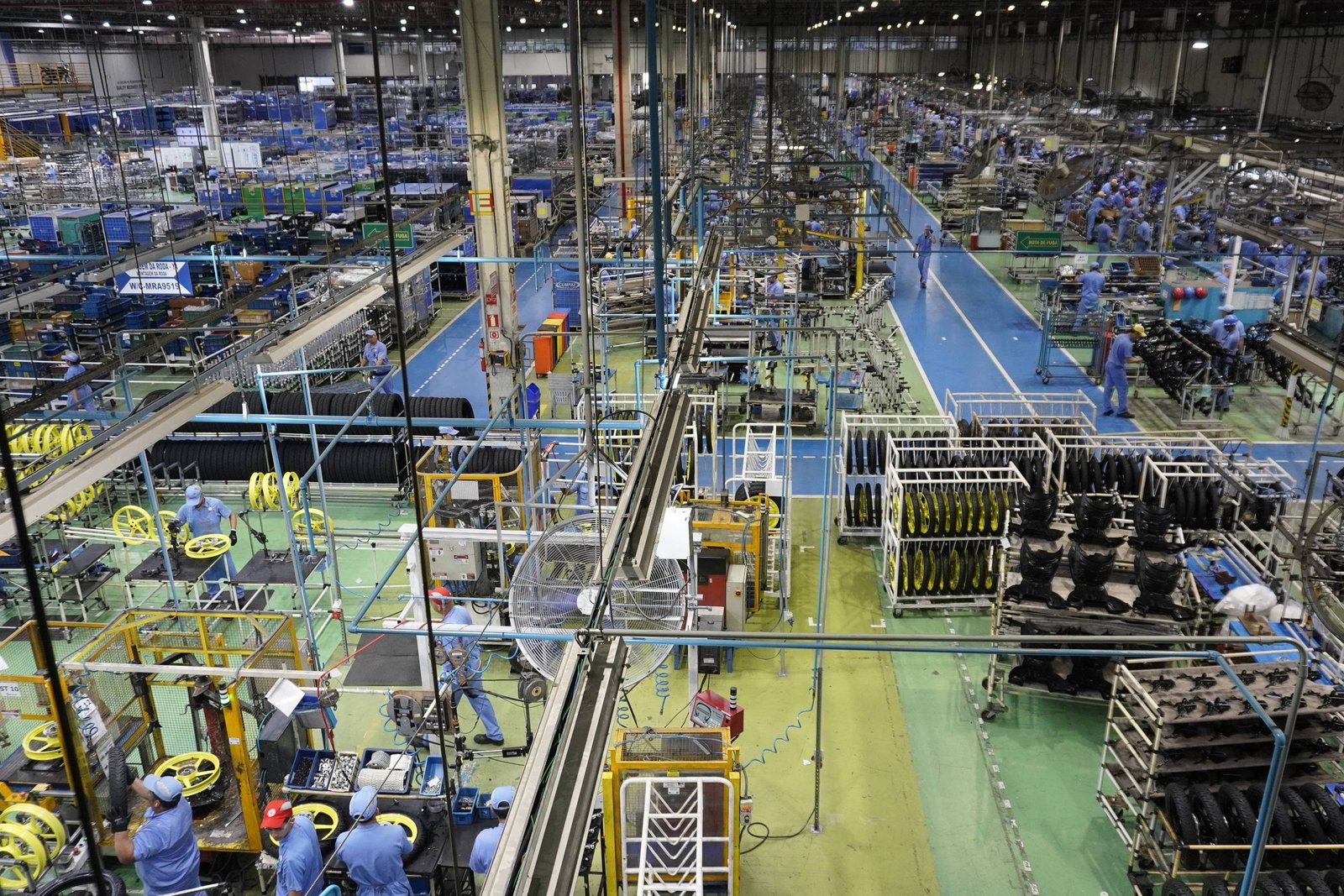
THE tax reform increased the number of companies interested in operating in ZFM (Zona Franca de Manaus), according to the federal agency that manages tax incentives in the region.
According to the superintendent of Suframa (Manaus Free Trade Zone Superintendence), Leopoldo Montenegro, more than 200 new factories have projects approved for installation in the region over the next three years, which would generate a 30% increase in the total number of industries of the region, which today is around 600.
“Some companies are going there because of the tax reform. Many that already have a base in other regions are going there because of this issue, taking into account the (tax) credit, to make the product more competitive”, says Montenegro in an interview with Sheet.
The reform ends state tax benefits across the country until the end of 2032. The exception is ZFM, the only place with an incentive supported by the Constitution.
According to the superintendent, the increase in demand involves different industrial subsectors, such as electronics, motorcycles and air conditioning, with emphasis on the medicineswhich has become one of the main recent bets in the region.
Until 2025, there was only one factory in the sector installed in the Free Zone. Now, there are more than six projects approved. “It is an important subsector for us, because it has to do with bioeconomywith the industrialization of our things.”
The industrial hub of Manaus currently has federal import and export tax incentives, IPI (tax on industrialized products), PIS and Cofins, in addition to the state ICMS benefit. The last three will be abolished with the reform and replaced by CBS (Contribution on Goods and Services) and IBS (Tax on Goods and Services). Therefore, there was a need to create new benefits — credits linked to new taxes, which reduce the burden of these products.
SÃO PAULO ALSO WINS
This movement occurs amid legal dispute opened by Fiesp (Federation of Industries of the State of São Paulo), which questions the rules created by the reform to maintain the benefit in the region. The entity says that the new mechanisms increase the competitive differential and can stimulate the migration of industries to the Amazon.
Montenegro says that the ZFM does not represent direct competition for the São Paulo industry, but a complementary production chain. According to him, many companies already maintain operations in both locations. Now, others will be able to produce part of the components in Manaus and complete manufacturing in other states, taking advantage of the credit system provided for in the reform.
“Most of these large factories in the Free Zone, like SamsungLG, Foxconn and Tectoy, which drive revenue, have factories in Manaus and São Paulo”, he says.
“We are not going to remove factories from other regions. We are going to give an increase, which is (tax) credit, so that this product, when finished in other regions, will have an even greater competitive advantage.”
Montenegro claims that the reform benefits both the ZFM and states like São Paulo. The new taxation system transfers the revenue that currently remains at the place of production to the place of destination of the merchandise. “Amazonas is a producing state. São Paulo is a consuming state, so there will be a gain in revenue”, he states.
São Paulo would also benefit from currently being the main supplier of inputs to ZFM. There are more than R$35 billion per year, a value higher than what the region purchases from other countries.
The superintendent also highlights the importance of the Free Zone for environmental preservation of the Amazon. According to him, the industrial model helped to avoid predatory economic activities in the region over the last few decades. For him, with the reform, the region’s industry will need to be more technological, sustainable and productive.
“The Free Zone needs to prove itself and further strengthen this model, not just being dependent on tax incentives, but industrializing things in the Amazon so that in the future we can survive on our own.”
Created by a 1967 decree, the Free Zone has constitutional protection until 2073.
NONCONFORMISM
Jeanete Portela, member of the Superior Council of Cieam (Center for Industries of the State of Amazonas), states that the tax reform has increased the perception of legal security for companies located in the region. As a result, sectors that do not yet have many companies in the Free Zone are evaluating the possibility of operating in the industrial hub.
For Portela, the questioning made by Fiesp repeats a strategy adopted by the state for many decades: resorting to the Judiciary to create a feeling of insecurity in relation to these ventures, based on arguments with little — or no — chance of success. “This seems to me more like non-conformity with the result of the democratic process”, he says.
Luiz Augusto Barreto Rocha, president of the Superior Council of Cieam, states that Amazonas represents just over 2% of the GDP industrial (Gross Domestic Product) and 0.66% of the number of establishments in the sector in the country.
Even if there is a relevant increase in these numbers, there would be no possibility of deindustrialization in other regions of the country. “(The new model) will not be a threat to the national industry”, he states.
The two claim that companies outside the region will also benefit from the reform, which will reduce the burden on the industrial sector, through measures such as the end of the IPI for 95% of industrialized products.
TAX INCENTIVE
The Manaus Free Trade Zone and other Free Trade Areas in the North represent around 5% of the tax incentives classified by the Revenue as tax expenditures. In 2025, this waiver was estimated at around R$30 billion.
Representatives of the region argue that the value is lower than the federal government’s collection of taxes generated by the various activities in the region. For every R$1 that the state receives, R$1.72 returns to the Union.
A ranking prepared by the TCU (Federal Audit Court) placed the benefit among the four most problematic, pointing out issues such as gaps in monitoring and evaluation and difficulties in changing the rule.