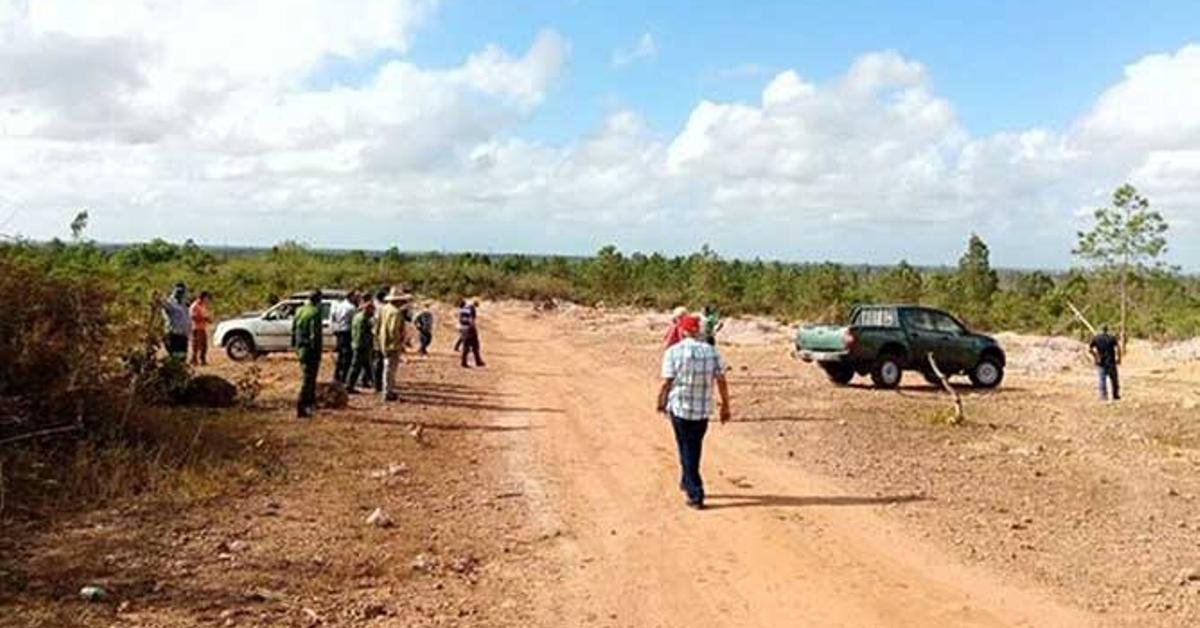
Havana/The Australian mining company Antilles Gold asked the Sydney Stock Exchange this Friday to suspend the trading of its shares while it prepares an announcement on the impact of the sanctions recently imposed by the United States on La Victoria Miningthe joint company that it created in Cuba with the state-owned GeoMinera to exploit the Nueva Sabana deposits, in Ciego de Ávila, and La Demajagua, in Isla de la Juventud.
The mining company has not yet detailed the extent of the blow. It limited itself to asking the Stock Exchange for a temporary suspension of its shares while it prepares a statement to its shareholders about the consequences of the sanctions. The stock market pause will last until that report is published or, at most, until the start of trading on June 10.
For William Pitt Wasmer, a Cuban-American businessman and heir to a family that owns mines confiscated by the Cuban Government after 1959, the episode confirms the deterioration of a sector that Havana was trying to present as a future source of foreign currency. “Now to the problems of nickel and cobalt mining gold mining is added,” he tells 14ymedio.
Antilles Gold participates in Minera La Victoria, a 50/50 joint venture with GeoMinera, the state mining company
Pitt considers that the Antilles Gold case cannot be read in isolation and must be analyzed within the context that has forced the departure of the Canadian Sherritt, which exploited the nickel mines in Moa. “The other mining companies that work in Cuba are experiencing very similar problems,” he says.
The sanction fell at a particularly delicate moment for Antilles Gold. Just one day before the stock market halt, the company reported that the construction of Nueva Sabana was continuing and that the Chinese company Xinhai Mining Technology & Equipment was advancing in the manufacture of the mine’s concentrator. The company itself described Nueva Sabana as “the first stage of its association with GeoMinera”, while La Demajagua remained the second project planned for 2027-2028.
The structure of the deal shows the extent to which the project was designed to avoid the Cuban risk. Antilles Gold participates in Minera La Victoria, a 50:50 joint venture with GeoMinera, the state mining company. He engineering, purchasing and construction contract of Nueva Sabana, awarded to Xinhai, amounted to 29.5 million dollars and covered around 85% of the pending development costs. Xinhai also offered a line of credit of 17.1 million dollars, deferring part of its collections.
The Nueva Sabana project was to exploit gold and copper. Antilles Gold presented it as a relatively small open pit mine, but one that quickly entered production. The company calculated that the two Cuban projects, Nueva Sabana and La Demajagua, could generate more than 2,500 million Australian dollars (1,763 million US dollars) of surplus cash for the portion corresponding to Antilles Gold between 2027 and 2037, according to their own estimates adjusted to recent metal prices.
In addition to the enormous control that Gaesa has over mining, the closure is also due “to the economic situation of Cuba, with its total lack of electrical resources and fuel necessary to work mining.”
La Demajagua, located on Isla de la Juventud, added the attraction that, in addition to gold and silver, it included antimony, a mineral considered strategic due to its industrial and military use. In Antilles Gold’s plans, this second project was to produce gold and arsenic concentrates, as well as antimony concentrates or cathodes.
For a small company, dependent on external financing, Chinese contractors and international concentrate buyers, being associated with a Cuban entity included on Washington’s blacklist may be enough to freeze banks, insurers, suppliers and potential investors.
Pitt himself links the episode with the Cuban structural crisis. In addition to the enormous control that Gaesa has over mining, the closure is also due “to the economic situation in Cuba, with its total lack of electrical resources and fuel necessary to work in mining,” says the expert.
Pitt also links the case with Sherritt, which, in addition to exploiting nickel and cobalt, participates in Energas, key to the processing of natural gas and electricity generation. “Apparently, only oil mining continues and even so we are already seeing that Energas and Sherritt are beginning to have problems bringing natural gas to the city,” he warns.
“It remains to be seen if Antilles Gold will take a direction similar to that of Sherritt or if they simply, not having a significant investment, will let the water run without doing anything else,” Pitt summarizes.