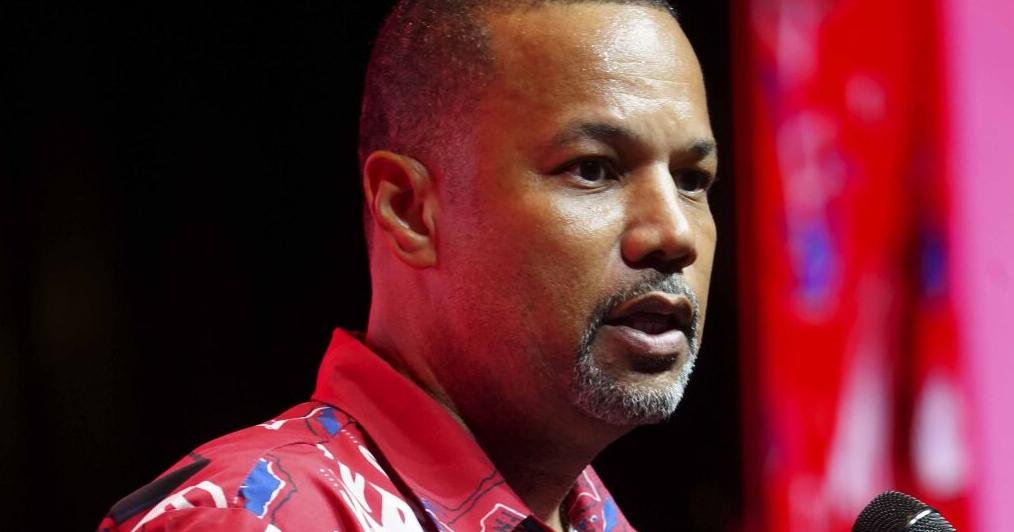
Long Island MP Dr. Andre Rollins yesterday accused the Davis administration of attempting to sneak in changes to the Bahamas Nationality Act without seeking to have a transparent debate on the issue.
The amendment to the Bahamas Nationality Act would allow the minister of immigration to, for a $500 fee, grant permanent residency to people whose citizenship applications have been denied.
It would amend section 7 of the act, which sets out the circumstances under which individuals who are not entitled to Bahamian citizenship at birth may apply to become citizens.
These cases include women who marry Bahamian citizens, individuals born in The Bahamas to non-Bahamian parents, and individuals born outside of The Bahamas to a Bahamian woman who is married to a non-Bahamian man.
The amendment was tabled last Wednesday along with nearly a dozen other bills as part of the government’s budget exercise.
Rollins, in a statement, noted that Free National Movement (FNM) Leader Michael Pintard urged the government to establish a select committee on immigration to “transparently address numerous concerns pertaining to our country’s worsening immigration crisis”.
“Despite this recommendation, the government is attempting to use the upcoming budget debate exercise as an opportunity to introduce by stealth a significant amendment to our nation’s immigration laws, which potentially will create a dangerous loophole for future exploitation,” Rollins said.
“We strongly advise the government against seeking to bury something as significant as the conferral of permanent residency — at a cost even cheaper than that of an annual work permit — and its attendant consequences within a budget debate.
“We stand on our party’s earlier stated position that matters as weighty as permanent residency and citizenship must be addressed in isolation at the level of a select committee, where they can be comprehensively fleshed out to avoid any undesirable or unintended consequences.”
Currently, section 7 of the Bahamas Nationality Act reads, “Any person claiming to be entitled to be registered as a citizen of The Bahamas under the provisions of Article 5, 7, 9 or 10 of the constitution, may make application to the minister in the prescribed manner and, in any such case, if it appears to the minister that the applicant is entitled to such registration and that all relevant provisions of the Constitution have been complied with, he shall cause the applicant to be registered as a citizen of The Bahamas.”
Under the act, the minister may refuse the application for several reasons, including if the applicant has, in the five years prior, been convicted of a criminal offense and sentenced to death or imprisonment for a term of more than a year; is not of “good behavior”; has engaged in activities that would jeopardize safety or the maintenance of law and order in The Bahamas, has been adjudged or otherwise declared bankrupt under the law in any country; or has insufficient means to maintain themselves and is likely to become a public charge.
It also provides that the minister may refuse the application “if for any other sufficient reason of public policy, he is satisfied that it is not conducive to the public good that the applicant should become a citizen of The Bahamas.”
The Bahamas Nationality (Amendment) Bill, 2026, would add a new section 7A, which says, “If the minister refuses an application under section 7, the minister may, upon payment by the applicant of the fee of $500, grant the applicant a certificate of permanent residence subject to such terms and conditions as the minister thinks fit.”
The limited circumstances under which people are entitled to Bahamian citizenship at birth have been a topic of controversy for decades.
Two failed referendums, one in 2002 and another in 2016, attempted to provide equality for married Bahamian women who have children outside of The Bahamas with non-Bahamian men.
Under the current legislation, the children of those Bahamian women are not entitled to citizenship at birth, but may apply for citizenship after their 18th birthday, but must do so before turning 21.
The budget debate begins on Monday.