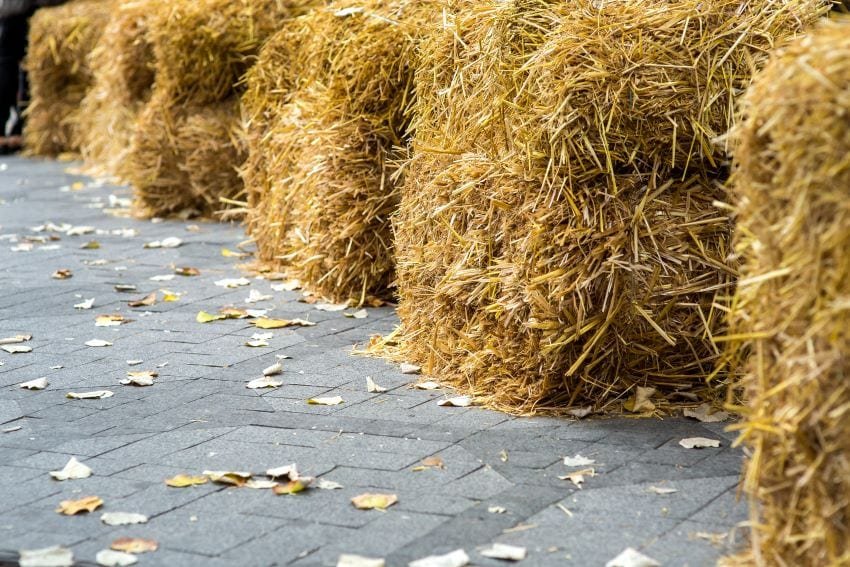
Livestock farmers are worried that prolonged dry conditions could threaten milk production and animal health amid a shortage of hay – the fundamental nutritional fodder on which animals rely for good health and wellbeing, Barbados TODAY can reveal.
While Ministry of Agriculture consultant Dr Leroy McClean acknowledged a shortage, he insisted that the issue had not reached a critical stage.
But President of the Beef and Dairy Producers Association McDonald Stevenson urged the government to provide a solution quickly, especially with weather forecasters and climatologists predicting a heatwave and drought during the Atlantic hurricane season and towards the end of this year.
If the predicted dry period persisted for any length of time, animals would start dying, he warned.
He also urged Barbadians to brace for a possible milk shortage if the hay is not replenished in short order.
Stevenson told Barbados TODAY exclusively: “I have been getting a lot of calls from people about the availability of hay. There is a shortage, there seems to be. It has some serious implications for livestock farmers. Hay is a critical component for feeding the animals. Without hay, the animal would not be able to thrive as it should. So, that is a critical situation.
“Being that the stage we are at right now, and the time span that you are looking at for the drought period, that is certainly a real cause for concern. If you don’t have hay on the island and we want to be able to sustain the animals, we have to get it from somewhere.
“In terms of importing, I don’t know how the government is going to look at that in terms of …because there is always a concern of disease and so on. The government would have to be in the forefront of that particular aspect. To me right now, that is the only likelihood. I don’t see any other way around it.”
Stevenson then turned his attention to the chain effect of a prolonged unavailability of adequate amounts of fodder, which he warned could impact milk production.
“Cows must chew their cud. You need roughage, you need fibre in order for cows to produce milk; and if the cows are not getting that fibre and that roughage to function, obviously we are going to suffer in terms of milk production. The cow’s condition will deteriorate without the consumption of hay; and when it starts to happen, it affects the whole immune system, and then, you might be looking at animals dying…because if you can’t feed them obviously they will die, and it will hurt the milk production aspect.
“So it’s a serious-looking situation right now.”
Stevenson acknowledged he had not reached out to the agriculture ministry, but suggested that officials were aware of the situation and were examining how to address the hay shortage.
But, he said: “Somehow, we move kind of slowly with these things; we wait until crisis situations to come to solutions. There has to be some situation where they reach out to farmers to see how best we can move forward. But if something is going to happen, I would suggest it happens fairly quickly.”
Ministry advisor Dr McClean revealed that a truckload of hay had been dispatched from St Lucy on Wednesday for distribution to the livestock farmers.
“I know that at this time of the year, generally you have a bit of a shortage, but I have not heard that it is at a critical stage, because we are still getting hay,” he told Barbados TODAY, while conceding that the predicted dry period could pose a challenge.
The consultant said it was because of issues such as these that the government had embarked on a pilot project in which grass is being pelletised when in abundance so it can be stored in cases of dry spells.
While the venture is not yet ready to have an impact on farmers across the board, it will be rolled out shortly on a semi-commercial scale, he pledged.
Dr McClean disclosed that the ministry was also waiting on a special energy supply from Barbados Light and Power to power the pelletiser.
“We are not yet at a scale where we can make an impact. We have done a few bags to show that it can be done, but the machine that we were using is a small machine for a pilot programme. We have a big semi-commercial size machine now that we are waiting on Light & Power to get the power supply to get it running. Once we get that up and running, then we can tell the public this is what we are doing.
“We have done the preliminary trials, we did the feeding trials with the sheep to see how they would respond to it, and we have had very positive results. The way that we envisaged it having an impact on the livestock sector is that we would provide farmers with the know-how, so that a farmer could actually buy the equipment, the sort of level of equipment that we use for the pilot programme…when we got that equipment for the programme just over a year ago, all of the equipment cost just over $8 000.
“So, we are hoping we could provide farmers with the knowledge of how to do it, as well as how to make pelletised feed from local inputs,”
For the Barbados Agricultural Society’s (BAS) Chief Executive Officer, James Paul, the main implication of a hay shortage is a decline in production.
Since the animals require nutrients from hay, a lack of it would be a problem for them and the industry.
While there may be farmers who have adequate supplies stored, the current decline in rainfall will present issues, especially for farmers accustomed to tying out their animals to graze, Paul said.
He told Barbados TODAY: “One of the things we have done in the past was to encourage farmers to do harvesting of hay. And again, we talk a lot about the whole question of grasslands, and the need to maintain those grasslands. Many people around the country look at grasslands as unnecessary, and they don’t think sometimes, that the grasses that are there, are very important.
“This is when we recognise the importance of managing our grasslands properly; of harvesting and putting up the forage, so that when you have these periods of a prolonged absence of rainfall, that you have stored enough forage to tide you over this period.
“But yes, if this period of low rainfall continues it will have implications for those farmers who especially are accustomed to grazing and seeing the levels of production declining and achieving the normal growth rate for the animals.”
(EJ)