Authorities, friends, dear Rubén Blades, a joy to be here.
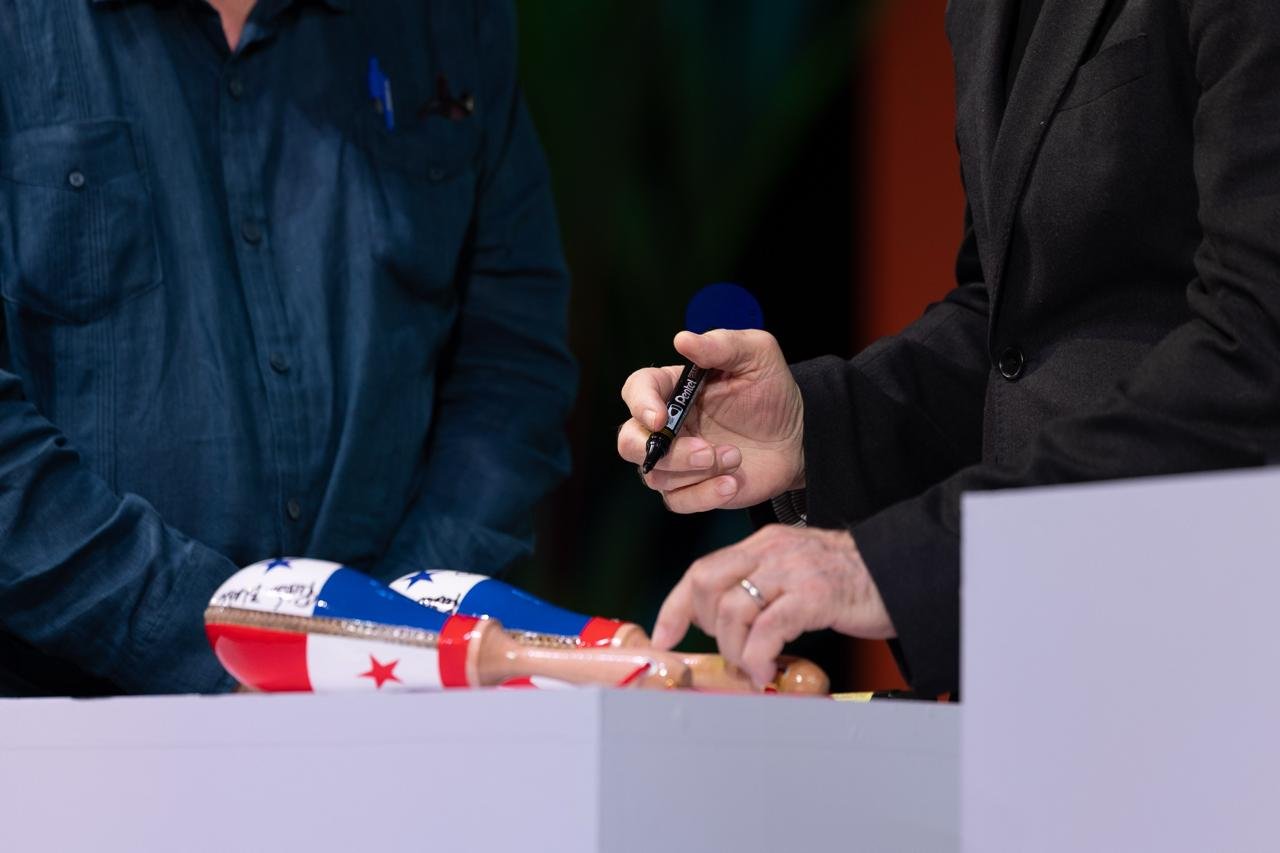
There are artists and writers who not only create works but also create spaces of shared consciousness. And perhaps that is one of the deep reasons why we are here today, in Panama City, within the framework of Central America Counts, to receive the legacy that Rubén Blades deposits for the Caja de las Letras of the Instituto Cervantes.
Our Caja de las Letras, the old vault of the Banco del Río de la Plata that is now our headquarters building, no longer keeps money or jewelry, but things with true value. It guards voices, ways of understanding the world, heritages that a culture decides to preserve to converse with the future.
And under so much noise, few voices have been able to narrate the urban, moral and sentimental heartbeat of Latin America like the voice of Rubén Blades.
But I would also like to begin by recognizing the importance of this meeting space promoted by Sergio Ramírez. Central America Account has achieved something extraordinary: placing Central America and the Caribbean at the center of the contemporary Ibero-American cultural conversation, not as a periphery, not as a side note, but as a fundamental territory of creation, thought and memory. Because for too long certain international cultural narratives looked at the Caribbean and Central America only from exoticism, violence or geopolitical simplification. And yet, some of the most powerful literary, musical and ethical voices in the contemporary Hispanic world have emerged from these lands.
I also remember with emotion Sergio Ramírez’s intervention at the previous International Congress of the Spanish Language held in Panama in 2013. Many of us remember it as something deeper than a conference. It was a truly passionate defense of the Spanish language and the freedom of speech. And I also think of the presence here today of Gioconda Belli, whose poetry and whose career also represent that Central American tradition where literature is never separated from the body, from memory, from justice and from hope.
In times of simplification, noise and polarization, literature continues to remind us of the complexity of the human experience. And Sergio Ramírez has always defended, even in difficult circumstances, the right of the word to resist fear, authoritarianism and oblivion. This same defense of complexity also runs through the work of Rubén Blades.
Because Rubén Blades not only wrote songs, he expanded the narrative and cultural possibilities of Caribbean popular music. From Panama, from the Caribbean and from the Latin New York of the diaspora, he turned salsa into an urban chronicle, historical consciousness and transnational emotional community. With Fania Records, that extraordinary musical constellation that turned the Latin experience of New York into a language shared throughout the continent, salsa ceased to be solely a dance music to position itself internationally as a story, memory and collective reflection.
And in that process, songs like Pedro Navaja They forever changed the cultural horizon of popular music in Spanish. Because Pedro Navaja was not just a song. Here in Panama, and outside of here, Pedro Navaja was a literary character, a cinematographic scene, a popular philosophy of destiny and, above all, a way of understanding that everyday language and popular culture can also contain literature, irony, social criticism and collective memory. “Life gives you surprises…”, generations of Spanish speakers have sung. One of the great surprises of contemporary Hispanic culture may have been discovering that a song, born from the Caribbean rhythm, could also contain the narrative density of the great Latin American urban novel. It is no coincidence that Gabriel García Márquez said that he would have liked to “write Pedro Navaja.” Nor that later generations, from Joaquín Sabina to Bad Bunny, have dialogued with that imaginary.
Because the great cultural figures survive their works and Pedro Navaja It stopped belonging only to salsa a long time ago to settle in the Latin American collective imagination.
But perhaps the most admirable thing about Rubén Blades’ career is that he never separated art from ethical responsibility. In songs like Plastic (Sowing1978) denounced the emptiness of consumerism and the loss of cultural identity long before these discussions occupied the center of contemporary debate. In Disappearances (Searching for America1984), turned the pain of Latin American dictatorships into collective memory and a still open moral question. In Father Antonio and the altar boy Andrew (also from the album Searching for America1984) brought to popular music the ethical echo of Archbishop Óscar Romero and those who defended human dignity in the face of violence (…The father was found by war on a Sunday at mass/ Giving communion in his shirt sleeves/ In the middle of our father the matador/ And without confessing his guilt he shot him…).
In Love and control (song from the album of the same name, 1992) recalled that fragility, illness, family and care are also part of the social experience of our people. And in songs like “Patria” he taught us to feel the ties of our community. Here, together with Claudia Neira, Gioconda Belli, Sergio Ramírez and Tulita, I like to remember these sung words: “Homeland is so many beautiful things, it is the walls of the neighborhood, it is its brown hope, do not memorize lessons from dictatorships or confinements, the homeland is not defined by those who suppress a people.”
Rubén Blades’ ethics never gave up the pleasure of music, dancing, shared celebration. As he himself said in an interview in Rolling Stone: “Even if we don’t agree… we can enjoy.” Perhaps therein lies one of the most profound lessons of his work: culture as a conversation, as a common space even in disagreement; music and literature as places where it is still possible to recognize each other.
That is why this legacy also has an extraordinary symbolic value for the Cervantes Institute. The Spanish language does not live only in dictionaries, in books or in epidemics, horrible blasphemies of the academies, as another Rubén, our Darío, wrote. The language also lives in songs, in popular orality, in neighborhoods, in shared stories and in the emotional memory of those who find in culture a form of community.
Dear Rubén, thank you for having turned music into a form of moral conversation with our time. Thank you for having brought Panama, the Caribbean and all of Latin America to the cultural heart of the contemporary Hispanic world. And thank you for entrusting part of that memory today to the Caja de las Letras of the Cervantes Institute, so that it continues to dialogue with the future through words, through music and through emotion.
*Words from the director of the Cervantes Institute upon receiving the legacy of Rubén Blades at the Caja de las Letras in Panama, May 24, 2026.