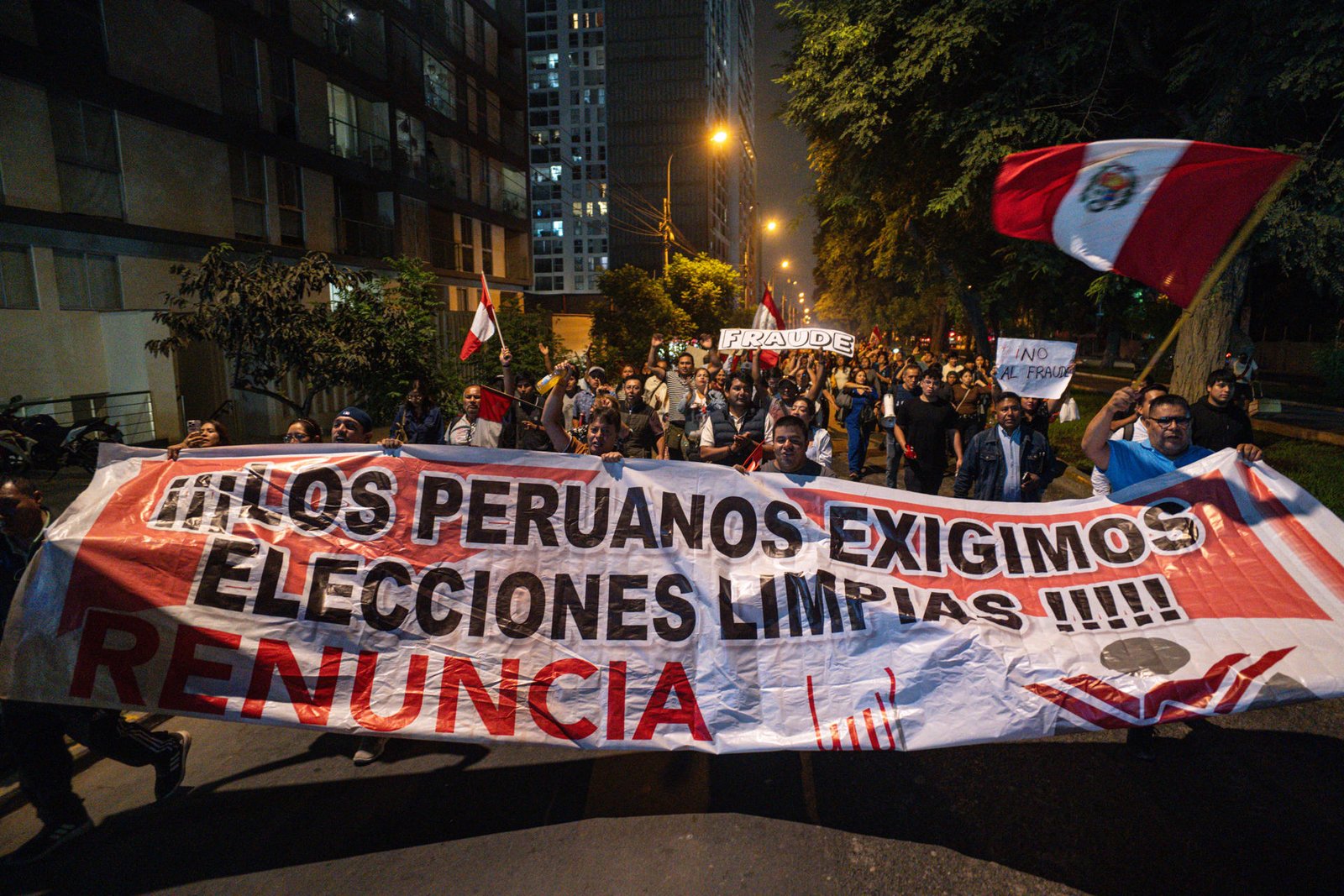
The turbulent Peruvian elections seemed to result in two candidates for the second round, that of Keiko Fujimori Higuchi, with about 17 percent of the votes, and that of the former mayor of Lima, Rafael López Aliaga, with less than 13 percent. Both claimed to occupy 30 percent of the votes, a limited performance that reflects the dispersion of a political field in which dozens of parties and candidates intervene.
In the last hours, the count verified a significant rise in Roberto Sánchez Palomino, one of the few left-wing candidates, former Minister of Foreign Trade and Tourism of the Pedro Castillo government, between 2021 and 2022. If Sánchez Palomino surpasses López Aliaga, the turn to the right in Peru would not be assured, but would depend on Sánchez’s alliances and his victory in the runoff.
Fujimori Higuchi and López Aliaga are two well-known right-wing leaders, aligned with harsh policies of security, migration, freedom of trade and rejection of all Latin American lefts, democratic and authoritarian. Both have shown sympathies with the advance of Trumpism in the region and have promised foreign policies that are part of the horizon of the new rights.
Peru’s privileged relationship with China and the Asia-Pacific region will be one of the critical points of the presidential campaign in the second round. There may be nuances in the position of both candidates, but both will seek a priority relationship with Donald Trump’s government, which does not alter China’s powerful ties and investment and credit projects in the Andean country.
Looking at the region, if Sánchez does not go to the runoff, the new government will promote the conservative displacement, resuming good ties with Ecuador, Bolivia and Chile.
After these elections, the entire Andean region will be in the hands of the right and that should be reflected in the diplomatic games and pressures within Latin America.
It should not be ruled out that the advance of this conservative cohesion in the Andes seeks a relaunch of ties with Argentina and Paraguay, two South American countries also governed by the right. In South American forums, such as Mercosur, the confluence of so many governments along the same line will be notable, which, despite some points of pragmatic agreement with Brazil and Uruguay, will make clear their rejection of the BRICS and geopolitical alternatives to the United States.
With Peru, the advance of the right will put pressure, fundamentally, on Lula’s Brazil and Petro’s Colombia. It would be difficult for these governments not to explore various forms of persuasion in favor of Flavio Bolsonaro, in Brazil, and the candidate who is definitively the winner to face Iván Cepeda in Colombia.
Both elections, the Brazilian and the Colombian, will not only show a greater degree of interventionism on the part of the United States, but also from that new Latin American right that now projects itself as a regional actor.
*This article was originally published in The reasonfrom Mexico.