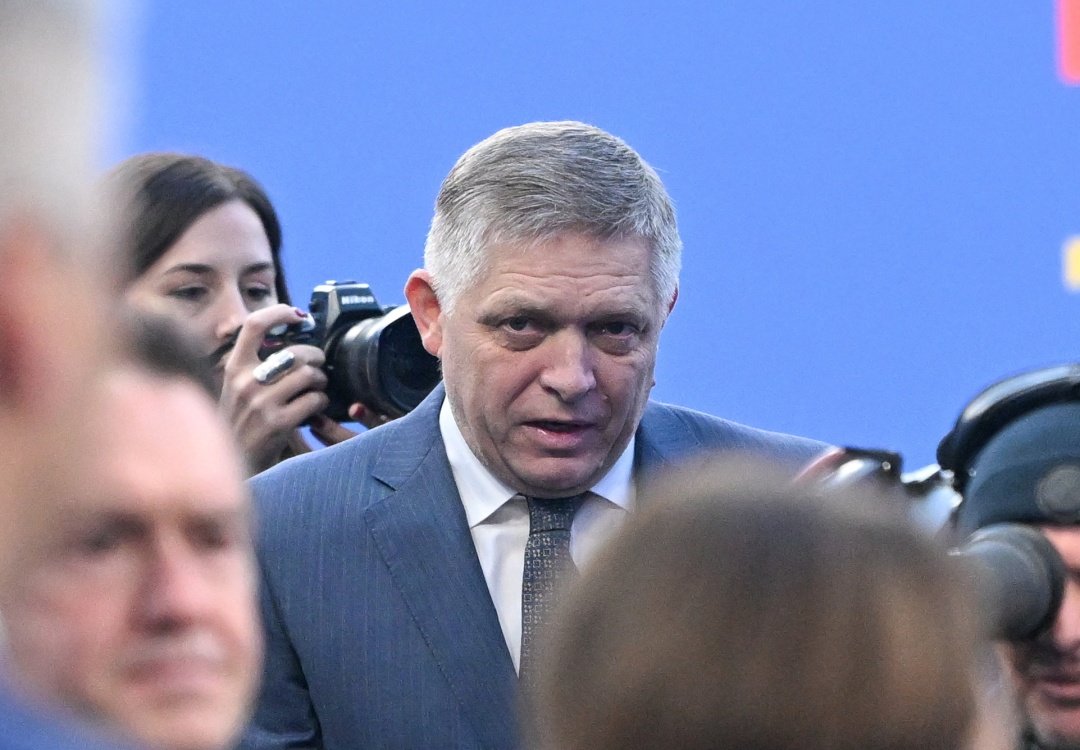
Slovak Prime Minister Robert Fico
Péter Magyar has positioned himself as a champion of Hungarian minority rights in Slovakia ever since the nationalist government of Robert Fico fast-tracked an amendment criminalizing those who question the validity of the post-World War II Beneš Decrees. However, for the new Hungarian prime minister, minority rights are only a prop — a means to a different end.
Why did Fico criminalize the questioning of the 80-year-old decrees?
The decrees issued by former Czechoslovak President Edvard Beneš declared, among other things, the collective guilt of the German and Hungarian minorities in Czechoslovakia. As a result, the private land and property of many were confiscated, hundreds of thousands were deported, and members of national minorities were assigned collective guilt for the decisions of their political leaders. In recent years, the Slovak National Land Fund has started confiscating private land belonging to Hungarian owners on the basis of these decrees — despite the fact that in 2020 the European Court of Human Rights (ECHR) in Strasbourg ruled such practices illegal. Out of purely political calculation, Prime Minister Robert Fico’s main rivals, the Progressive Slovakia party, seized on this illegal practice and called on the government to end the confiscations. The government responded by introducing legislation in 2025 that criminalizes any questioning of the Beneš Decrees, effectively silencing criticism of the seizure of Hungarian-owned private land. The ultimate aim was most likely to appease nationalist and far-right voters represented by their coalition partner, the Slovak National Party (SNS). In practice, however, they unwittingly walked into a political trap set by the Slovak radical left.
Viktor Orbán’s Reaction
Contrary to expectations, the Hungarian Prime Minister’s reaction was muted. He expressed scepticism regarding the effectiveness of such legislation and said he would wait and see how it played out in practice. Most commentators interpreted this as a tactical decision, given his efforts to maintain the alliance against Brussels — and to some extent against Kyiv — together with Mr Fico. However, Viktor Orbán was widely criticised, even among conservatives, for his somewhat ambiguous reaction to a clear violation of minority rights.
Péter Magyar Sees an Opportunity
It was not long before his challenger, Péter Magyar, recognized his chance in this debate. In the pre-election campaign, he was more than happy to raise his voice on behalf of Hungarians in Slovakia and to embarrass Prime Minister Orbán for his lacklustre reaction. He attended Stop-Beneš rallies and spoke to the media about how passionately he felt for our compatriots. He also promised to take up this issue with Prime Minister Robert Fico immediately after the elections.

Stop Beneš Demonstration in Budapest that Péter Magyar has attended. Photo: Hungary Today
The Twist
What motivated Péter Magyar to posture as the savior of the Hungarian minority, despite the fact that some three-quarters of Hungarians living in the surrounding countries consider themselves conservatives and do not trust his motives for standing up for them?
The current Slovak government is no natural ally of Magyar. Interior Minister Robert Kaliňák, a nationalist hardliner, called his views on the Beneš decrees “utter nonsense.” President Peter Pellegrini, for his part, objected to the use of the term Felvidék (Upper Land), the historic Hungarian designation for the territory of today’s Slovakia, in Magyar’s open letter to the Slovak government. Ordinary Hungarians in Slovakia are therefore understandably worried that, after Orbán’s muted response, they will once again suffer a flawed intervention from Budapest — one that will only escalate the situation instead of bringing a long-term resolution.
Because of his seemingly hard-line stance on the issue, the Hungarian left has hailed Magyar as a hero of minority rights. Even some on the conservative side have pinned their hopes on his apparently resolute intervention. They will, however, likely be bitterly disappointed.
Knowingly or unwittingly, Magyar is being drawn into an open conflict with the Slovak government. The ultimate goal is not the protection of minority rights, but rather to help Progressive Slovakia (PS) into power.
Maidan Slovakia
The TISZA Party’s list of EU and American mentors or sponsors is essentially the same as that of Progressive Slovakia’s. Meanwhile, Robert Fico remains a thorn in the side of exactly the same European and global elites who have invested so much in removing Orbán from power. Furthermore, should the current Slovak government fall, the celebrations east of Slovakia’s borders in Ukraine would be just as loud as they were after the April elections in Hungary. The European left’s goal is likely to exploit Magyar’s confrontational style to escalate the emerging conflict between Budapest and Bratislava into a full-blown rift, thereby undermining Fico’s position in Central Europe. This would directly benefit the radical left in Slovakia. Progressive Slovakia already leads Fico’s Smer by two points in the polls, and the TISZA Party — which has emerged as a radical liberal force after the appointment of Magyar’s rainbow cabinet — appears to be its natural ideological ally.

Prime Ministerial hopeful, Michal Simecka, leader of Progressive Slovakia. Photo: Facebook Progressívne Slovensko
Worryingly, the leaders of the largest political party representing the Hungarian minority in Slovakia, the Hungarian Alliance, seem content to play their role in this political brinkmanship. They have already erected a post-election cordon sanitaire around Fico’s SMER and the nationalist party Republika. However, they have not distanced themselves from the possibility of cooperating with the Progressives, nor have they ruled out an alliance with the left-leaning Christian Democrats (KDH). Should they form a common platform with the left, they are unlikely to reach the 5% parliamentary threshold. Despite TISZA’s success in Hungary, there is very little appetite for another liberal Hungarian party in Slovakia.
Under the pretext of a struggle for human rights, a new color revolution is in the making. Although not as consistently as Viktor Orbán’s previous governments, Slovakia is still regarded as one of the last obstacles to the EU elite’s euro-federalist grand plans, as well as their goal of bringing Ukraine into the EU. Magyar is set to play a crucial role in advancing this agenda, while the main victims of the coming clash will be the members of Slovakia’s 400,000-strong Hungarian minority. They will be the ones left to pick up the bill for Brussels’ colonial ambitions and Magyar’s quest for power.
Featured Image: MTI/Koszticsák Szilárd