The movie AIwhich Steven Spielberg made at the beginning of this century, was a tearjerker about a robot who wanted to be a real boy. Pinocchio, but not made of wood and not based on sorcery, but on the most modern technology. An attempt to imagine what AI could lead to.
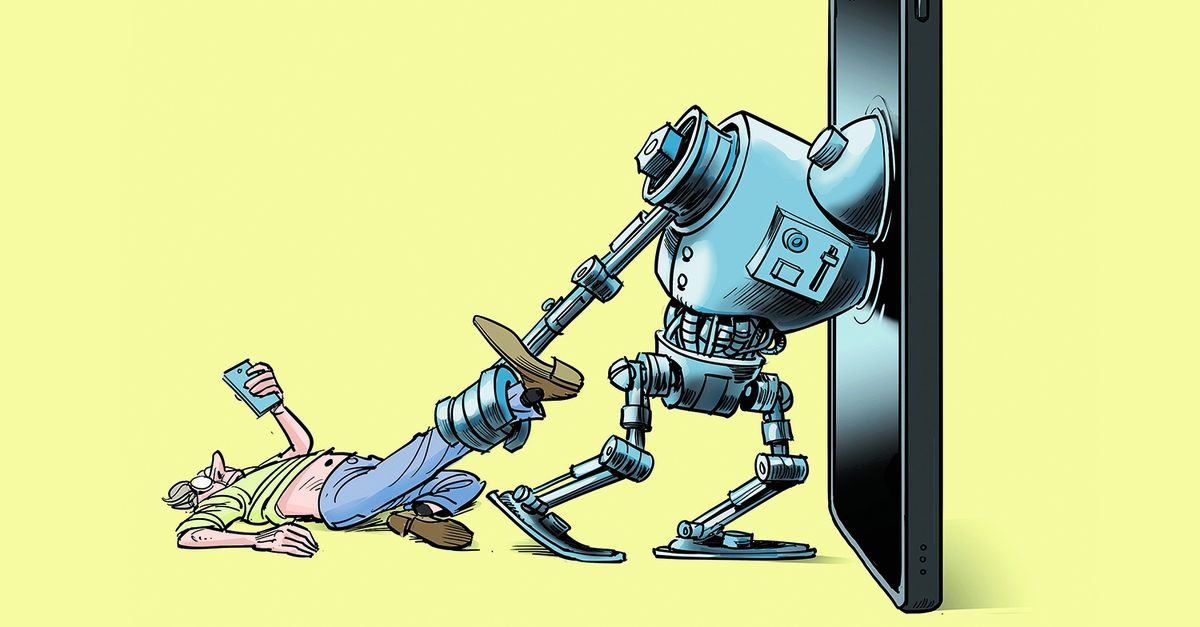
A quarter of a century later, the risk appears to be that technology is pushing people towards machines, rather than the other way around. The smartphone, with which we seem to have become fused (and on which I am also typing this during a conference), increasingly determines how we see the world. The algorithms that fill this worldview are intended to give us what we ask for so that we buy what they give. It is an extreme form of self-assertion that undermines critical thinking and will ultimately destroy our capacity for empathy.
People without empathy are becoming more and more like machines. By doing what those machines propose, we line the pockets of the few people who make and operate these machines. And these are people who think democracy is nonsense and believe that the world would really improve if they were in charge with their machines. Read it again, in the recent one Palantir Manifestoand think of the statements of great technology entrepreneurs such as Peter Thiel and Elon Musk.
The AI race between the US and China is reminiscent of the Cold War arms race. Then the US and the Soviet Union came to their senses just in time to prevent a catastrophe and initiate arms control through multilateral negotiations. Such awareness is completely lacking in AI. This week I again heard Maga-Americans at a conference in Athens shouting that there can only be one winner, the US or China, as if we were in an episode of Highlander have ended up.
Meanwhile, AI threatens to run amok. Even in Silicon Valley there are voices saying that technology is literally becoming inimitable and perhaps uncontrollable. Every word of warning, every plea for precautionary delay, is brushed aside out of fear of a Chinese advantage. Nowadays, in the US alone, more than $1 trillion invested in AI and the boom on the American stock market can almost entirely be traced back to this.
Serious diseases
The potential of AI is beyond our imagination. It can already be established that it can provide a tremendous boost to the development of new medicines and medical treatments. Early diagnosis of serious diseases at the cellular level may save millions of lives, but the rapid development of new vaccines can save the world from mass graves and untold economic damage in the next pandemic. The refined modulation of an unimaginable amount of data can accelerate the energy transition and make sustainable energy much more efficient and, above all, more reliable.
It can also help us to identify and combat biodiversity loss and associated major health risks in time, and it can help us prevent crop failures and food shortages. And everyone who needs to get from A to B will be able to move much more safely using means of transport without human operation. In the future, driving yourself, except on a bicycle of course, will be a major exception.
There are plenty of examples of the misery that can arise when vulnerable children build a deep emotional bond with algorithms
The risks and danger to people decrease exponentially and that is a blessing in these applications. This also partly applies to military applications, but these can also be a curse if the threshold for violence is lowered, because soldiers run no or less risk than opponents with less autonomous weapon systems. Operating drones and other unmanned systems from a great distance in a safe location is different from looking the enemy directly in the eye. Not to mention that there are now systems active on the battlefield that are given a single assignment, such as clearing mines or taking prisoners of war, and then make plans completely autonomously to complete that assignment – sometimes with astonishing results.
Inequality
Every industrial revolution has produced new machines and technologies that make life easier for people and that replace us in one place so that we can do finer, less demanding and better-paid work in other places. Or having to work much less. It is an open question whether this will by definition also be the case with AI. The influence of AI is potentially greater and will also materialize more quickly than previous technological leaps forward. AI can therefore lead to very large economic and social inequalities that can quickly escalate tensions within societies and between countries and continents.
Smartphones, the internet and social media threaten to turn modern man into a Narcissus: constantly staring at our reflection on the screen without knowing that we are only presented with ourselves in endlessly different guises by increasingly smarter algorithms. We are sucked into an echo chamber of sameness that makes us increasingly insensitive and eventually distrustful and fearful of anyone who is different.
Our inventiveness dulls, our curiosity is lost and our capacity for empathy disappears completely. By allowing algorithms into the most intimate parts of our lives, we risk losing interpersonal intimacy. There are now plenty of examples of the misery that can arise when vulnerable children, in particular, build a deep emotional bond with algorithms that have taken the place of personal relationships.
The erosion of solidarity and social cohesion is a direct consequence of the loss of confidence in a good future. When retrograde thinking dominates, the willingness to share falls prey to the desire to keep what you have. The other person’s concerns will then be your concern. The other becomes a threat and a danger that must be kept at bay. This situation is exacerbated by the internet bubbles we are in, and could become even more pronounced due to AI.
Limit and direct
But the reverse must also be possible. Algorithms are not an uncontrollable natural phenomenon, the Silicon Valley multi-billionaires are not untouchable gods, the AI arms race is not an irreversible process.
If we let everything take its course, the risks cannot be estimated, but it is certain that they are large. That is why a fundamental principle of responsible politics must be guiding here: the precautionary principle. Preferably at a global level, limit, direct and initiate a process of ‘arms control’ with confidence-building measures, as during the Cold War, but now with the aim of sharing the advantages of AI with the entire world, and also jointly controlling the disadvantages with the entire world.
Many of the raw materials and energy sources necessary for the development of AI are located outside the US and China. A purely transactional approach, as now adopted by both the US and China, falls short in a world that will no longer become bipolar. It could lead to a mess, but also the revival of a world order based on multilateral approaches. Working on this is certainly worth it, if we can still muster some empathy with future generations.
Also read
AI was once allowed to do its own thing, but that is no longer possible
:format(webp)/s3/static.nrc.nl/wp-content/uploads/2026/05/30155125/090526-OPI-Toekomstvisies-AI-Sheikh-FI.png)