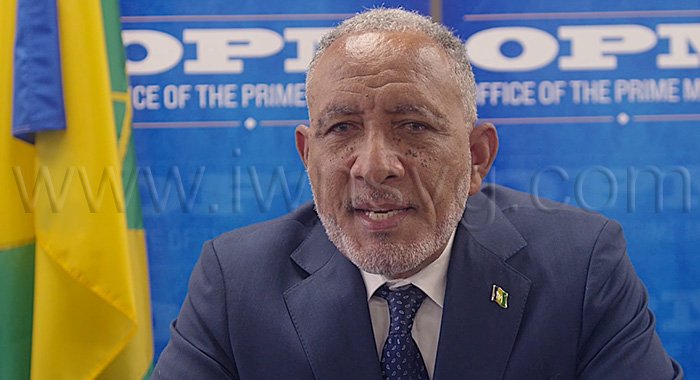
Prime Minister Godwin Friday has urged Vincentians to “act now” to prepare for the 2026 Atlantic hurricane season, warning that the country faces a convergence of natural and man-made hazards, including a prolonged drought and limited funding for disaster recovery.
In a national address marking the official start of the hurricane season on Monday, the prime minister said parts of St. Vincent and the Grenadines (SVG) are enduring a “prolonged and harsh drought,” even as expert predictions point to an increasingly dry Caribbean in the years ahead.
“Despite a few showers over the past couple of weeks, parts of St. Vincent and the Grenadines continue to suffer through a prolonged and harsh drought,” Friday said
“The effects of global warming, this is our reality. It requires us to adapt and to do all we can to mitigate the effects.”
Drier years, fewer storms but stronger hurricanes

Citing Met Office data, the prime minister said SVG has seen a steady decrease in annual rainfall over the last eight years, noting that 2025 set a record for the lowest annual rainfall, breaking the 2022 record.
The prime minister said the negative trend aligns with expert predictions that the Caribbean region, including SVG, is expected to become increasingly dry in the years ahead.
“This means that dry spells will become more frequent and will last longer.”
Friday described the 2025 season as “mixed”, with the total number of tropical storms and hurricanes falling below average, while the number of major hurricanes — category 3 and above – was above average.
“In total, there were 13 tropical storms; five intensified into hurricanes, of which four were characterised as major hurricanes.”
He said SVG was spared direct impacts in 2025 –one year after Hurricane Beryl devastated the Southern Grenadines.
“We pray we are as fortunate this year,” the prime minister said.
Friday referenced forecasts from Colorado State University (CSU) and the US National Oceanic and Atmospheric Administration (NOAA), saying both institutions are predicting a slightly below-average season in terms of the number of storms.
“CSU forecasts 13 named storms and six hurricanes, of which two are expected to become major hurricanes,” he said.
“Likewise, NOAA forecasts between eight and 14 storms, producing three to six hurricanes, of which between one and four could become major hurricanes. While predictions may vary, and the paths of the potential storms are yet unknown, we must nevertheless prepare for whatever this hurricane season brings.”
‘Multiple hazards’ and limited funds
Friday stressed that SVG enters the 2026 season with “high uncertainty” and “multiple hazards,” including financial constraints.
“We enter the 2026 hurricane season facing high uncertainty with multiple hazards, both natural and man-made, and with limited available funding for disaster recovery and disaster management programmes,” he said.
“The potential convergence of multiple crises makes it urgent that we prepare our responses and heighten our vigilance to address all possibilities.”
The prime minister linked the wider economic climate to high oil prices stemming from the Gulf War, saying his administration has already taken steps to cushion the impact, as outlined in a national address on Thursday.
Friday said his government “stands ready” to support citizens in both preparation and response.
Shared responsibility and lessons from past hurricanes
The prime minister repeatedly framed disaster management as a shared responsibility, urging Vincentians not to be complacent.
“Fellow Vincentians, I urge you to do your part to ensure that as a country we are prepared for this hurricane season,” he said.
“We pray we will not need all of the measures and the preparations that we have put in place, but we cannot take the chance, and we must do what we can. Please act now.”
Friday warned that failure to prepare would increase vulnerability, noting that disaster management is a shared responsibility.
“Failure to prepare for hurricanes or other weather events will make us more vulnerable to the ravages of nature. We cannot allow that to happen. So together we must act and encourage one another to prepare.”
He invoked past storms Hurricanes Thomas, Elsa and Beryl as “painful lessons”.
“We have heard it said that those who fail to learn from history are doomed to repeat it, so let us take the painful lessons learned from Hurricanes Thomas, Elsa, and Beryl as a call to action, ensuring every family is secured and ready for the 2026 hurricane season.”
Five key actions for households
Friday distilled his message into practical guidance for the public, outlining five main areas of action.
1. Stay informed
He first urged citizens to rely on official sources, particularly NEMO and the Met Office. “Please listen to official sources of information on any impending storm, hurricane, heavy rainfall, rough seas, and strong wind events.”
2. Make a plan
Friday called on households to develop written emergency plans covering the period before, during and after any weather event.
The prime minister said the plan should begin with inspecting one’s home to ensure it is safe.
He urged urgent roof repairs, trimming overhanging trees, and cleaning drains around homes and communities to reduce flooding.
“Before a storm, homeowners should undertake urgent repairs to the roofs of your homes and other shelter facilities, where necessary, trim overhanging trees near your buildings, and clean drains around your homes and in the community to avoid clogging and resultant flooding.”
The Prime Minister said the plan should involve all family members and clearly set out roles and responsibilities:
“Your emergency plan should have input from all family members. The plan should include the roles and responsibilities of all family members before, during, and after a weather event. Be sure to discuss all preparations and responses at school, work, and play.”
He also recommended keeping a comprehensive emergency contact list, including local and national services.
Friday told residents to assess the structural safety of their homes and make contingency plans to stay with relatives, friends, or at an emergency shelter if necessary.
He cautioned strongly against late evacuations, saying, “Do not wait until storm conditions affect the country to evacuate. Delay will put you and your family at greater risk.”
3. Gather emergency supplies
Friday reminded Vincentians that essential services may be disrupted for extended periods after a storm, urging them to secure adequate food, water and personal supplies “for at least a week”.
He stressed the importance of personal hygiene items and medications, particularly for those going to shelters.
“If you are coming to an emergency shelter, bring your medication and food and water to last a few days,” the prime minister said.
4. Look out for vulnerable groups
Friday appealed to both individuals and the corporate community to support vulnerable groups, highlighting people with disabilities, the elderly, children, and women.
“Look out for others, especially in emergencies. We have to be our brother’s keeper,” he said.
“The last five years have underscored the importance of partnership and in enhancing social networks, primarily the provision of support services for vulnerable groups, including persons with disabilities, the elderly, children, and women.”
5. Report damage and hazards
The prime minister urged residents to promptly report damage and hazard observations to NEMO using any available communication channel, including telephone and social media.
“This will enable NEMO to get an accurate location of the community and household that is impacted,” he said.
“Residents are encouraged to share observations and information of natural hazards and their impacts on the environment,” the prime minister said.