Updated ,first published
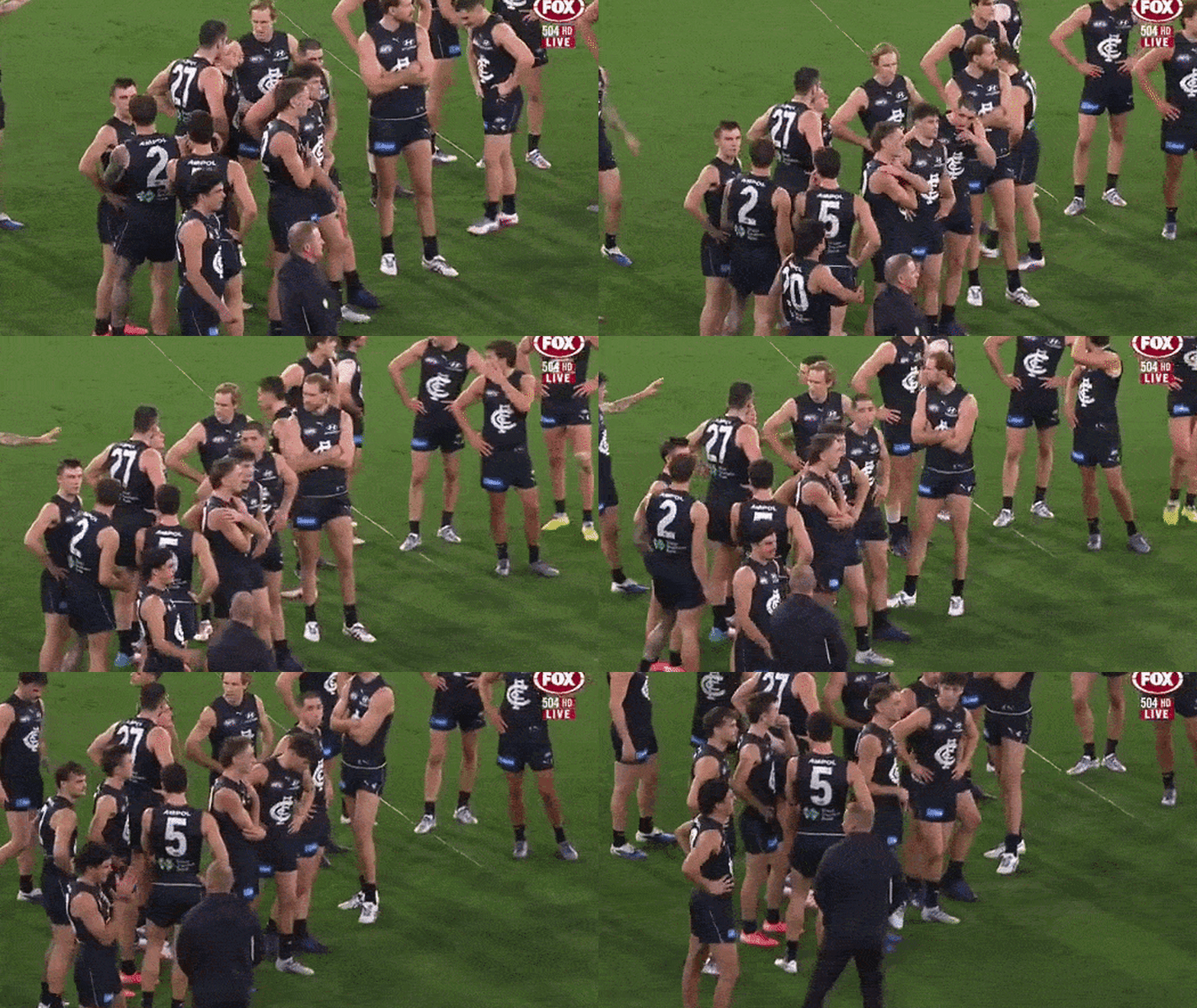
Carlton have ruled out substance abuse as a factor in Elijah Hollands’ unusual movements on the field on Thursday night, with the club explaining he had experienced a “mental health episode” during the narrow loss to Collingwood.
As vision emerged of Hollands’ seemingly erratic behaviour, the incident prompted criticism from some of the game’s greats of the Blues’ handling of the situation.
A source familiar with the incident, not authorised to speak about it, said the 23-year-old Hollands was aware he was having issues during the match but that in the past he had been able to work through similar episodes.
Hollands is being monitored by the club, AFL experts and the players’ association, with his health as the primary concern.
“The Carlton Football Club is continuing to provide close and ongoing care to Elijah Hollands, who suffered a mental health episode on Thursday night,” the Blues said in a statement released late on Friday afternoon.
“The 23-year-old is continuing to receive the appropriate level of medical and wellbeing support, with Hollands’ welfare remaining the number-one priority. The club also remains in contact with the AFL and the AFLPA, given the complicated nature of what occurred on Thursday night.
“While the club acknowledges the public interest, it asks that Hollands’ privacy be respected, with the primary focus on ensuring he receives the level of care he needs, before a further update can be provided at an appropriate time.”
Hollands spent 60 per cent of the match against the Magpies on the field for a solitary kick. But his unusual behaviour generated concern for his wellbeing at the end of the Magpies’ thrilling win at the MCG.
The defeat piled even more pressure on Carlton coach Michael Voss, whose side has consistently coughed up late leads to have a 1-5 record through their first six games to sit 16th on the ladder.
Hollands, who told the Blues he had struggled to sleep the night before the Pies match, finished the game with just one disposal – a kick. He rarely went near the ball, and when he did, he looked lost, prompting former players to question whether the Blues should have allowed him to be on the field.
The Blues said post-match they had monitored Hollands’ heartbeat in the second half of the game.
The Blues, the AFL, AFL Players’ Association and mental health experts had discussions on Friday. The investigation included examining Hollands’ movements leading into the marquee clash.
The AFL said: “We continue to have ongoing discussions with the club”.
The AFLPA, who have also dealt with Hollands’ manager, did not wish to comment.
Hollands, who spent time away from the club last year and was delisted, before reclaiming his spot, has previously spoken to this masthead about his struggles with anxiety and alcohol.
He spent the final part of the last term on the bench in a game the Blues once again led at three-quarter-time but lost.
Footage posted on social media depicted Hollands running backwards towards goal and flailing his arms in an erratic manner. He was also filmed looking disoriented in the background as Magpies champion Scott Pendlebury conducted a post-match TV interview.
Hollands played about 8½ minutes in the last quarter, according to Champion Data. He started the term on the bench, coming on at the 12-minute mark and staying on the field until almost the 21-minute mark. He spent the rest of the match on the bench. He had played 23 minutes of the first quarter – during which he straddled Collingwood player Dan Houston until he was pushed off him – 25 minutes in the second quarter and 15 in the third.
“Was this man fit to start? What gave you [Carlton] the confidence he was OK to play the game when all the vision speaks to the contrary?” said former Port Adelaide premiership player Kane Cornes on SEN on Friday.
“It’s an unfortunate set of circumstances and one the club has to confront.”
Former North Melbourne champion David King also expressed concern.
“We have to support the kid; he is clearly in a bad place,” King said on SEN.
“From a football point of view, the responsibility of the line coach or head coach to see this problem in real time and the fact it was unchecked for three quarters alarms me.
“I don’t understand how so many people in the stadium can see he is not contributing to this game. He was not assisting his team, he couldn’t get his hands on the footy, he was rattled, he was out of position, why did he play three quarters?”
After the clash, Voss said Hollands was “pretty shattered” with his game.
“I spoke to him after the game, and he was really disappointed with how he started the game. You know, really upset,” the Blues coach said.
“He sort of feels like he’s let me down. So I had a good chat with him. He was pretty emotional after the game.
“He didn’t play a great game, and he struggled to get his way into it, and feels obviously, clearly, really disappointed with his performance.
“Obviously with the importance of the night, he sort of feels like he’s let people down, but we’ve just got to keep supporting people through those situations.”
Voss was asked if he was worried about Hollands when he was on the bench at the end of the game.
“He was clearly disappointed with himself, and he was disappointed with how he was playing,” Voss said.
“So, you know, [when] it comes to the last quarter, you have obviously got to work out what mix you’ve got with five minutes to go, about what you want on the field.
“He wasn’t having a great night. So, yeah, [there were] constant conversations with him. But you know, obviously, we thought the best mix was not having him out there.”
In an interview with The Age’s Peter Ryan in October last year Hollands spoke about asking for help after using alcohol to cope with anxiety.
He was delisted at the end of last season and this masthead reported that Carlton consulted players before he was invited back onto the list.
“In some of the darker times, I turned to alcohol to cope with some of the stresses I had been putting myself under, and the mental fatigue and battles I had been going through.” Hollands said in the October interview.
“It very much has been a thing I have done in isolation, which is obviously a battle. It hasn’t been a thing where I have been out with mates and taking things too far in public areas – it’s been in isolation and at home.”
He also detailed a match against the Swans when he felt lost.
“I was not doing any of the things I would usually do typically well, which was playing with me,” Hollands said.
“I remember just feeling like a complete pedestrian out there. In the last quarter I came off the ground and I just could not breathe. I went to the bench and told our psychologist I could not breathe – I could not settle down, [and] my head was spinning.
“I was almost having a mini-panic attack, which I had never experienced before out on the field.”
Support is available from Beyond Blue on 1300 22 4636
Josh Daicos felt ‘sick’ after giving away free kick
As the Blues were left to contemplate yet another win that got away, Josh Daicos was breathing a huge sigh of relief. He almost ruined the script for his younger brother Nick, who was clearly the best player on the ground in his 100th game.
After Collingwood overcame an 18-point three-quarter-time deficit – as much about their ability to manufacture a comeback as it was about Carlton’s ability to choke – the elder Daicos gave away a last-minute free kick with his side leading by a goal.
Daicos was ruled to have pushed Talor Byrne in the back, handing the 18-year-old Blue in just his fourth game a shot at goal seconds before the siren sounded. If Byrne could kick truly, the game would end in a draw. He missed to the left.
“I feel sick a little bit talking about it right now,” Josh Daicos told this masthead after the game.
“You know, we worked so hard all night to get back in the game, and unfortunately for me, you know, he gave me one [and] I gave him one back. You just can’t do that in today’s game.”
Josh stood the mark as Byrne took the shot.
“It felt like an eternity,” he said. “I was watching him the whole time, [and] kind of watched his ball drop.
“I thought it was no good, but I thought the wind was going to be left to right, so I had a look, and it just stayed left.”
As Josh was overcome with relief, the Carlton players rushed to console a shattered Byrnes.
“It’s not all on the young man’s shoulders,” Voss said of the missed kick.
“He didn’t quite get the job done, but the boys rallied. You win together, you lose together. In that particular moment, it was good to see the players get around him as strong as what they did.
“He was a pretty upset young man, but he needs to know he doesn’t need to own all that.”
At three-quarter-time, Voss didn’t share the Carlton faithful’s feeling of dread.
He said the Blues were up for the challenge. This night was different.
The Blues had found new ways to score, showing they no longer relied on a stoppage game but could kick goals by moving the ball from defence into attack.
Voss didn’t count on two things: Nick Daicos being spoon-fed silver service by ruckman Oscar Steene to dominate centre clearances, and losing key forward Harry McKay to concussion midway through the final term.
Voss had sent Ollie Hollands to Daicos in the last term after assigning Sam Walsh the task for the first three quarters. Daicos was too clever for his new tag.
The new ploy sparked confusion among the Carlton players during the last term.
As they tried to work out who was playing where in the reshuffle to shut down Daicos, they conceded a crucial centre clearance by breaching the six-six-six rule.
At three-quarter-time, Collingwood coach Craig McRae knew the game was still up for grabs. Like the Carlton faithful, he understood the wonky, last-term Blues were vulnerable.
He told his Magpies to take some risks and ramp up the pressure. It was music to Nick Daicos’ ears.
Collingwood kicked six goals for the first three quarters, and came home with seven in the final term.
“I think our pressure was through the roof in the last quarter, particularly the first half of it,” McRae said.
“It was a good version of us. It’d be nice to get that going again.”
The aggressive approach not only sparked a Magpies revival, but also inspired small forward Jamie Elliott, who returned to form with three goals.
By the end, it was left to Josh Daicos to praise his brother at the end of his milestone game. “To see him grow as a footy player and then an individual off the field has been the most amazing thing about it,” he said. “I love playing with him every week, and it’s something that I never take for granted.”
Collingwood expect to get Jordan De Goey (concussion) and Steele Sidebottom (hip) back for their annual Anzac Day clash with Essendon.
Keep up to date with the best AFL coverage in the country. Sign up for the Real Footy newsletter.
 Jon Pierik is a sports journalist at The Age. He covers AFL and has won awards for his cricket and basketball writing.Connect via X or email.
 Jake Niall is a Walkley award-winning sports journalist and chief AFL writer for The Age.Connect via X or email.