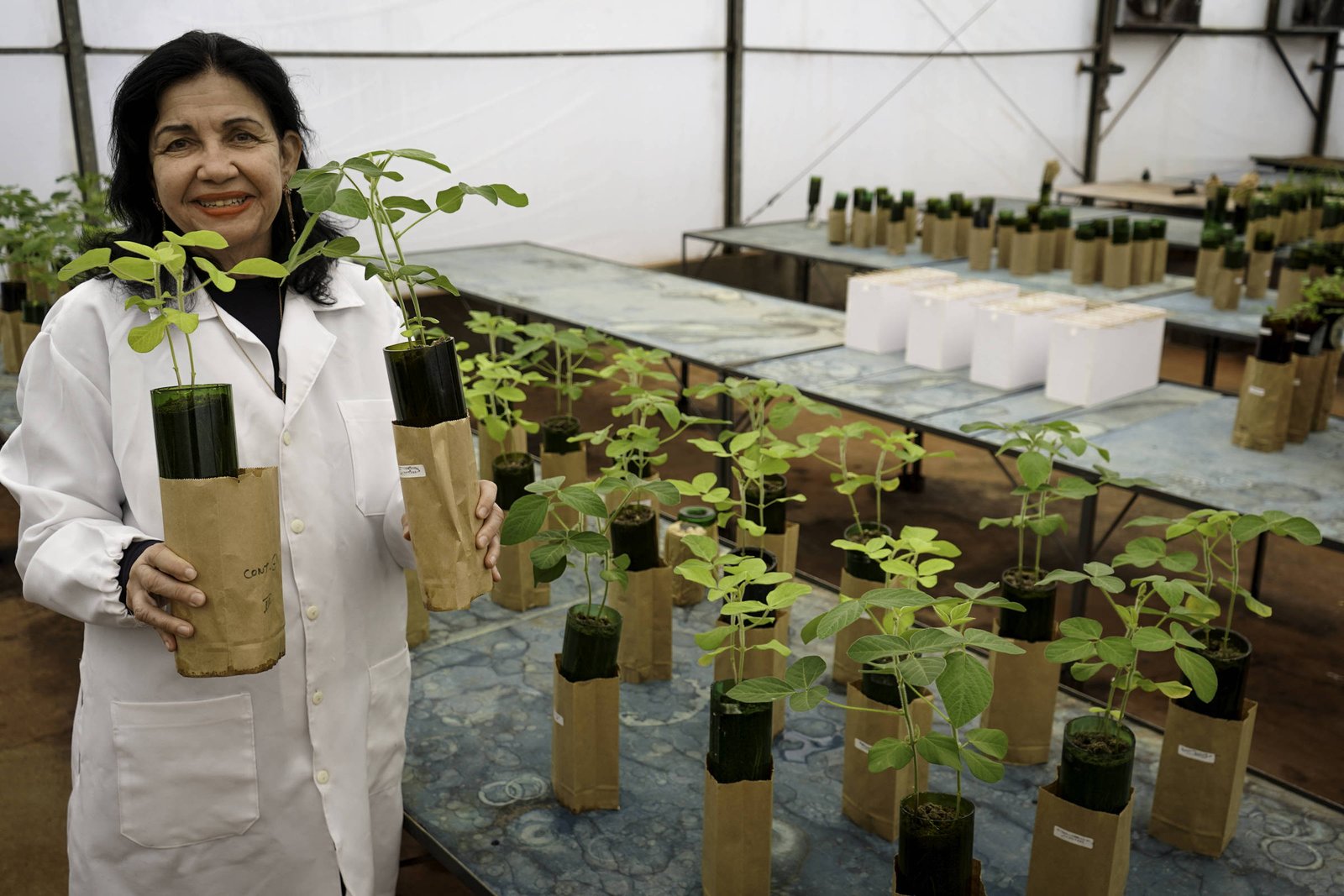
The Brazilian scientist Mariangela Hungaryfrom Embrapa (Brazilian Agricultural Research Company), was included in the list of the one hundred most influential people in the world by Time magazine, published this Wednesday (15).
Winner of the World Food Prize, the “Nobel of Agriculture” last year, the researcher appeared on the list alongside names such as those from Pope Leo 14from the president of United States, donald trumpand the Chinese leader, Xi Jinping. THE actor Wagner Moura and the researcher Luciano Moreira are also on the list.
Moreira leads the bigger biofactory Aedes aegypti that carry Wolbachia bacteria, a mechanism that has been used successfully to combat dengue.
At Embrapa for 43 years, Mariangela has been recognized for her recent awards for her career dedicated to the development of technology in soil microbiology. This allows rural producers to obtain high yields with lower costs and mitigate environmental impacts.
“Today, thanks to his work, 85% of Brazilian soybeans are grown with these microorganisms instead of synthetic fertilizers. His scientific innovations, used around the world, have helped Brazilian farmers save around US$25 billion per year (R$124.75 billion) and avoid the emission of 230 million metric tons of carbon dioxide equivalent,” Kyla Mandel, the magazine’s senior editor, wrote in Time.
When the World Food Prize placed Mariangela in its sights for the award, it took into account the work of a microbiologist and scientist who developed dozens of biological treatments of seeds and soil that help the plant obtain nutrients through soil bacteria. This action increases the productivity of important agricultural crops and reduces the need for synthetic fertilizers.
Its work aims to increase food production and quality, by replacing chemical fertilizers with microorganisms that have properties such as biological fixation and solubilization of phosphates and potassium rocks.
From ExpoLondrina, an agricultural fair in Londrina (PR), where she gave a lecture this Wednesday morning — and where she will give another one at the end of the day —, the researcher told Sheet that his plans for the day included working on his laptop during the break, which was not possible after the Time publication emerged.
According to the scientist, the repercussion of winning the World Food Prize, in 2025, had already been “outstanding”, due to the fact that Brazil is a country in which agriculture is very important.
“I’m impressed by the repercussion, the positivity, people saying ‘look at the biologicals’, ‘look at the women'”, she said.
The scientist stated that she knew in advance that she would be included on the list, but she didn’t want to believe it, so as not to create expectations. He thought it was a pre-list that, in the end, would not have his name.
“I knew, I was told that I was (on the list), but you know that thing where you’re in such a big rush, you say ‘oh, wow, that’s cool’. Then, today, when I received it, I had no idea, but then I said ‘wow, really’. Being there, you know, with Luciano Moreira, with Wagner Moura, who I’m a huge fan of. It’s really an opportunity, another great opportunity to promote biological products.”
According to her, the support received from Embrapa in recent decades is essential for the development of studies.
“I always say that I owe everything to Embrapa, a public institution, that a private institution would never invest like Embrapa invested in me in four decades, studying biologicals since a time when no one believed. When I started I was just a chemist, chemist, chemist. Embrapa believed, it always financed. Research doesn’t pay off in two, three years, it takes ten, fifteen years. In my case, 40 years to get that return.”
Graduated in agronomic engineering from Esalq (Escola Superior de Agricultura Luiz de Queiroz), from USP (University of São Paulo), with a doctorate in agronomy from UFRRJ (Federal Rural University of Rio de Janeiro), Mariangela worked at Embrapa Agrobiologia between 1982 and 1991 and, since then, has been at Embrapa Soja.
In addition to soybeans, Mariangela’s work contributes to the productivity of wheat, corn, rice, beans and improvements in pastures.