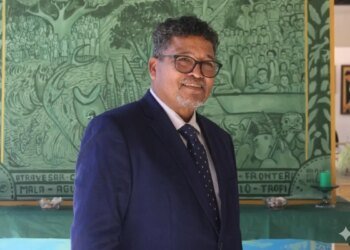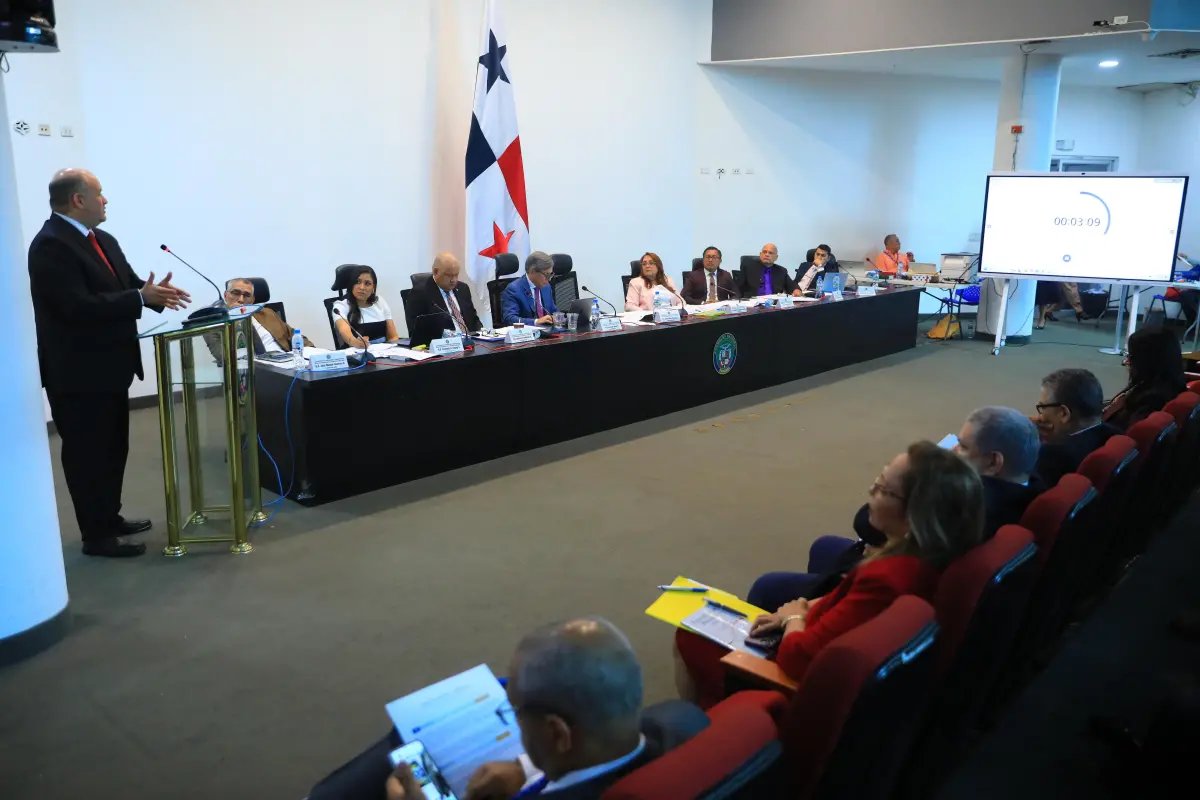
The election of the next magistrate of the Electoral Court, who will replace Alfredo Juncá for the next 10 years, entered a crucial stage this Tuesday, April 14, with the questionnaire process by the deputies members of the Commission on Credentials, Regulations, Parliamentary Ethics and Judicial Affairs of the National Assembly.
A total of 27 people appear on the initial list of candidates for the position of magistrate or substitute magistrate. Juncá himself appears on the list, seeking re-election. During his presentation, the magistrate spoke about the pressures he has faced during his tenure.
He spoke specifically of a case of electoral jurisdiction, when a prosecutor decided to open a case against a candidate to occupy a position within a local government. “The prosecutor opened the case because so-and-so told so-and-so that when he was in a taxi, he found some papers and that it seemed to him that this could be inappropriate behavior on the part of this person. In other words, a joke. He opened an investigation and was going to lift his immunity,” Juncá said. Upon investigating a little, he realized that the complainant was from the same political party, in the same electoral circuit. “It was obvious what was happening there,” he said.
Initially, the Court’s ruling was in favor of the accused. “All of this person’s supporters loved us as a court. Everyone on the other side hated us, including the media. In other words, there was pressure of all kinds. They called your relatives at home,” Juncá said.
Later, when new evidence was presented, the Court changed its ruling. Then the pressures came from the opposite side. “What I want to tell you with this is that if you think that you are going to come to the Electoral Tribunal to make friends, you are wrong,” he concluded.
Juncá explained that he is seeking re-election to “protect the institutionality” of the Electoral Court. He highlighted the technological advances achieved, particularly with the ID, the potential of using the ID as an international travel document and his plans to develop the digital wallet for all Panamanians.
Among the 14 candidates who answered questions on Tuesday before the Credentials Commission, the figure that attracts the most discussion is Jaime Barroso, former mayor of Arraiján and current Accounts Attorney.
Representative Yamireliz Chong asked him point-blank what his response was to the assertions in the halls of the Assembly and outside it that described him as “the anointed one” for the position.
“When you are a candidate and you have the votes, everyone tries to invent something to try not to win with votes but to diminish the image of that person,” Barroso responded. “For me it is disrespectful to the National Assembly that they say that I am an anointed because this is a decision of the Plenary. I have spoken with the majority of the deputies, not with all, time is not enough for either the deputies or me, but I have tried to speak with all of them. But that anointed thing because the truth is I neither feel like the anointed nor do I want to be, I do want to be the candidate for the Plenary of the Legislative Assembly,” he added.
His response precipitated a follow-up question, asking if he was already sure he had the votes to be elected.
“Well, I have not met a candidate for something who feels that he does not have the votes. I feel that I have them. If I feel that I do not have them, believe me, I will withdraw my application,” was Barroso’s response.
The current Accounts Prosecutor was a member of the Panameñista Party until 2019. Sources consulted within the Assembly consider that he is the candidate of the current president of the Legislative Body, the Panameñista, Jorge Herrera.
During the session of the Credentials Commission, Barroso remained in communication with several deputies, and sat next to Luis Eduardo Camacho.
Camacho took the opportunity to ask Barroso a series of questions during his presentation, especially related to cases of electoral fraud and political manipulation.
“I will never be an accomplice, as you just said, in a fraud. Not for a representative, not for a mayor, not for a legislator, not for a president of the Republic. I did not come here for that. I came here to do things right,” said Barroso. He added that his guarantee is his resume.
The Credentials Commission has a maximum of 3 business days for the interview process. On the first day, 14 were interviewed. In addition to Juncá and Barroso, there were the administrator of the Authority for Consumer Protection and Defense of Competition (Acodeco), Ramón Abadi; the vice mayor of the capital, Roberto Ruiz Díaz; and Garrit Genetau Real, regional director of the Comptroller General of the Republic in Western Panama.
The president of the National Bar Association, Maritza Cedeño, communicated in writing that she declined her aspirations.
The interview process is expected to end on Wednesday, after which the commission will prepare a list that will be sent to the plenary session of the National Assembly where the nomination and election process for the next magistrate will take place.