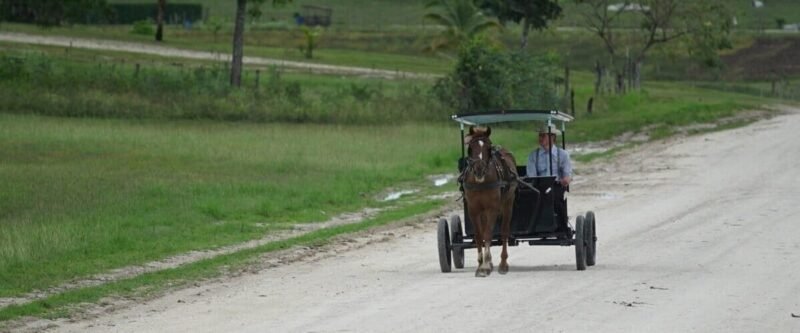
The Mennonites from Belize who want to settle in Suriname are driven above all by their faith. Because there have been rumblings between the various communities in the Central American country for some time, where they have been living for more than 65 years. The conservative wing no longer feels at home within the Belizean religious community, which in its view does not sufficiently adhere to the age-old traditions based on its interpretation of the Bible. In Suriname, they especially hope to be able to continue their lifestyle.
Text Armand Snijders
Image Mike Rodriques & AFP
Relatively prosperous Belize is sandwiched between Mexico and Guatemala and is located on the Caribbean Sea. A somewhat idiosyncratic country and actually an odd one out within the Caricom. In 1959, the first three thousand Mennonites arrived in the country from Canada and Mexico. There they cling to their culture, which is based on the fundamentalist religious ideal of maintaining closed communities, based on the principles of the New Testament.
“Just like elsewhere in the world, fellow believers are now divided into two movements and although they share the same origins, they live very differently“
In 2026, according to conservative estimates, around sixteen thousand Mennonites live there. These figures are based on the 2010 census, when around 11,500 were counted. In contrast to communities elsewhere in the world, most of them can be considered conservatives, such as those living in Bolivia, Mexico and Paraguay.
By the way, more than 2.1 million people around the world call themselves Mennonites. But the majority of them live among the ‘normal’ population and you would not recognize them if you met them on the street. They are fully integrated into modern society and usually have a job.
In contrast, just over 10 percent (approximately 250,000 people) live in traditional, isolated agricultural colonies, such as in Belize. They now also want to set up this system in Suriname.
Many freedoms
In Belize, based on agreements with the government, they have many freedoms that other citizens do not have. For example, members of the colonies are exempt from military service and do not have to pay certain types of taxes. At the same time, the farmers have received the ‘blessing’ from the government to practice their own distinctive form of Protestantism within their closed communities. This arrangement also gave them the freedom to set up their own form of local government and run their own schools, businesses and banks.
Although Mennonites separate themselves from Belize’s other cultures, they participate in the country’s trade, light industry and agriculture and are fairly integrated into the local economy. They also have to to keep their colonies running. They specialize in the production and sale of poultry, dairy products and agricultural crops to the local population. Some communities are also involved in the manufacture of wooden furniture that is sold in all corners of the country.
Not a homogeneous community
It goes far too far to say that Mennonites in Belize are a homogeneous community. Just like elsewhere in the world, fellow believers are now divided into two movements and although they share the same origins, they live very differently. The real conservatives don’t want to know anything about modern technology – such as telephone and internet – and don’t even have electricity. They apply the Bible rules very strictly and still wear traditional clothing: dungarees and straw hats for the men and wide dresses for the women. They also refrain from using modern agricultural machinery and driving horse-drawn carriages.
The more progressive communities are sometimes seen as too worldly by the conservative groups. Conversely, more progressive Mennonites find the conservatives’ rules too rigid and not Biblically substantiated. And between these two groups there are all kinds of divisions, each with their own interpretations of the Bible and the rules applied to it.
Opportunity in Suriname
Amid this alienation, the move to Suriname is seen as necessary, to find a place where the community can live without the influences of modern society and technology. In their view, there is still enough room in sparsely populated Suriname to establish colonies on large tracts of land and build a traditional farming life for future generations within the community. At least, that’s what they assume. They see Suriname as an opportunity to start over in an environment where they can strictly enforce their faith and rules of life.
“They want to leave Belize and be left alone in Suriname, where they want to live their lives in their own way. So without prying eyes.”
The groups now looking to move to Suriname are part of Shipyard – the largest and most conservative Mennonite settlement in Belize – and the nearby and much more moderate colony of Indian Creek. Shipyard is said to be in the process of purchasing 14,800 hectares of land in Para district, while families from Indian Creek are eyeing approximately 9,400 hectares in the same district, according to maps provided by the news site Mongabay have been viewed.
Very traditional way of life
The fact that the two separate communities are now working together is special, because the residents of Shipyard are known for their very traditional way of life. They use horse and carts for transportation and steel-wheeled tractors for farm work, as rubber tires are prohibited within their religion. Although they avoid modern technology, they have been called an economic engine for Belize; they produce the majority of the national supply of dairy, poultry and grains such as corn and rice there.
Indian Creek, on the other hand, is known as a group that integrates more easily and also embraces modern technology and communication tools. The residents use cars, trucks and tractors with rubber tires. The fact that they will also come to Suriname is seen as a smart tactical move to keep the closed conservative group from Shipyard somewhat out of the wind of public opinion. Because it is certain in advance that there will be resistance.
The Mennonites from Indian Creek will have to pave the path to Surinamese society. And because they are more modern, they are expected to be able to set up the necessary infrastructure, such as roads and warehouses, faster than the traditional group. Moreover, they integrate more easily with local suppliers and the government through their use of modern technology and communication tools. For the more conservative families, a move to Suriname offers a way to preserve traditional practices while taking advantage of the country’s largely underdeveloped agricultural sector.
No work permit
Because the Mennonites come from a Caricom country, it will be easier for them to obtain permanent residence and work permits. They must then demonstrate that they are highly educated or… skilled national (competent citizen), so they can obtain a Caricom certificate and the obligation for a work permit in Suriname is no longer required.
They quickly receive such a certificate as, for example, ‘specialized craftsmen’ in the field of agriculture or as furniture makers. This is in contrast to the Bolivian Mennonites who are now working in the Tibiti area and have to go through the same difficult procedures as any other foreigner from outside the Caricom.
That is an advantage for the Belizeans, who only want one thing: to get away from Belize and be left alone in Suriname, where they want to live their lives in their own way. So without prying eyes. This allows them – guided by a rock-solid faith – to maintain their culture and traditions.