Al Maryah Island Expansion Masterplan
The Dh60 billion-plus expansion is planned to add about 1.5 million square metres of mixed-use space, including offices, homes, retail and hospitality. The project is closely tied to the growth of Abu Dhabi Global Market and the emirate’s push to attract financial institutions, investment firms and global capital.
The development is expected to increase prime office and residential supply in one of Abu Dhabi’s most important business districts, while supporting demand from banks, funds, family offices and professional services firms.
Ahmed said financial hubs such as DIFC and ADGM remain central to the UAE’s long-term growth.
“In parallel, the continued evolution of financial hubs such as DIFC and ADGM can further strengthen the UAE’s role as a stable gateway for capital, supporting sustained FDI inflows and high-value economic activity,” he said.
Group 42 Project Stargate UAE
2029 to 2030 for Phase 1, with the wider campus under development
The first phase is expected to deliver a 1-gigawatt AI infrastructure cluster, forming part of a wider 5-gigawatt UAE-US AI campus. Green said the 26-square-kilometre campus has an estimated budget of US$40 billion and is backed by major US technology companies including OpenAI, Oracle, Cisco and NVIDIA.
The project is designed to support AI model training, large-scale inferencing and sovereign data management. It is also expected to attract technology companies, create demand for specialist talent and strengthen the UAE’s position in the global AI economy.
Green said the project is already under construction and could position Abu Dhabi and the UAE as a global leader in AI and data centres.
Nakheel Palm Jebel Ali Masterplan
The development is planned to accommodate more than 35,000 families and include more than 80 hotels and resorts. It is expected to support tourism, hospitality, luxury residential demand and long-term land value in Jebel Ali.
The project also creates a new urban growth corridor and is aligned with Dubai’s broader economic and population growth ambitions.
Ahmed said large-scale tourism and residential-led developments should be delivered with care if regional conditions take longer to normalise.
“At the same time, it would be prudent to adopt a measured and phased approach to large-scale developments that are primarily driven by tourism and residential sales, such as waterfront and lifestyle-led masterplans. Should regional conditions take longer to fully normalise, buyer and visitor sentiment may remain selective in the short term, which could moderate absorption rates,” he said.
Wynn Al Marjan Island
Green described it as the UAE’s first large-scale gaming-led tourism development. The project is expected to raise Ras Al Khaimah’s profile as a tourism destination and attract new visitor segments to the northern emirate.
The integrated resort is also expected to support demand across hospitality, retail, food and beverage and entertainment.
Green said the Disney Resort in Abu Dhabi and Wynn Al Marjan Island together could have a major effect on UAE tourism.
“Together, these projects are expected to be transformational, significantly increasing the scale and depth of the UAE’s tourism sector, diversifying source markets and guest profiles, and supporting higher-value demand across the hospitality, retail, F&B, and entertainment ecosystems,” he said.
Why these projects matter
The UAE’s project pipeline shows a clear split between infrastructure that improves productivity and lifestyle-led developments that support tourism, investment and population growth.
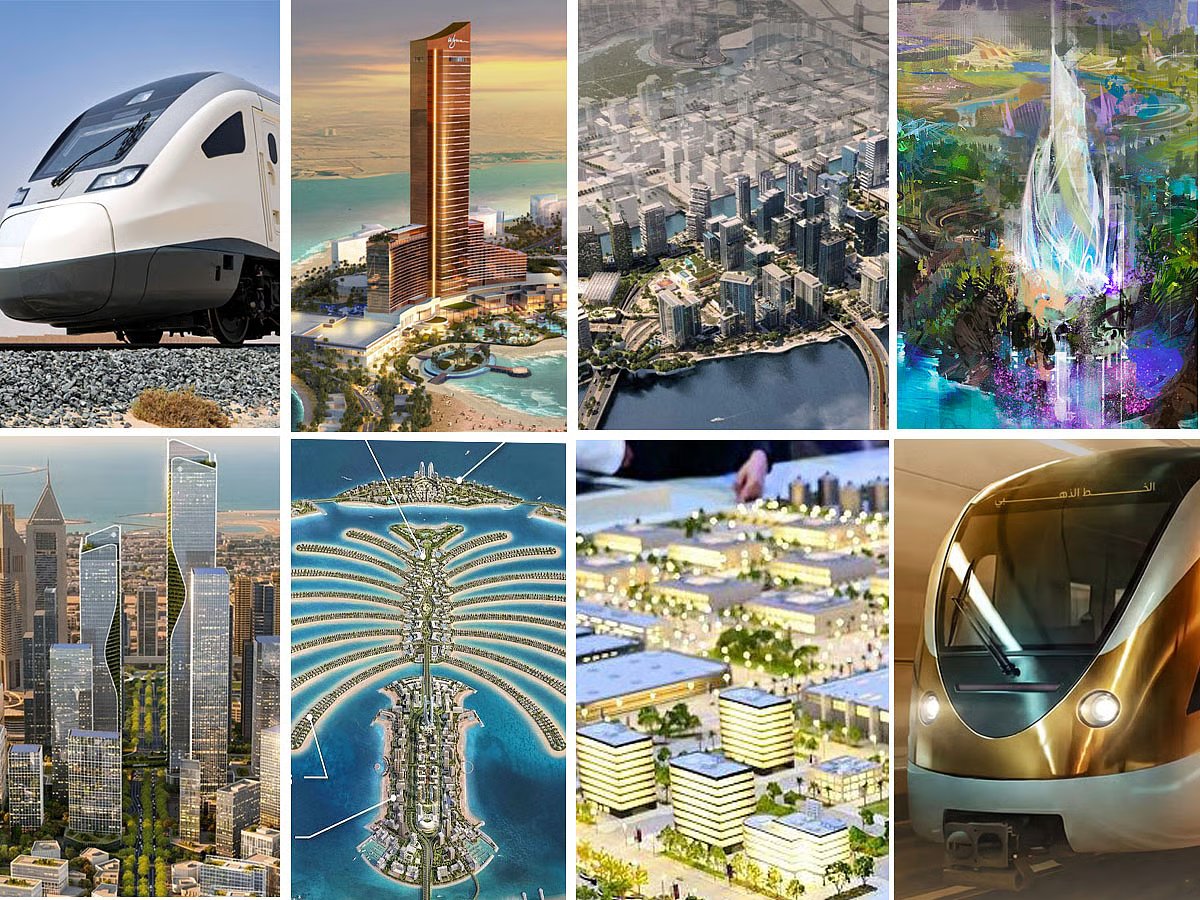
Transport projects such as Etihad Rail and the Gold Metro Line are expected to improve connectivity and reduce pressure on existing networks. Financial district expansions such as DIFC Zabeel and Al Maryah Island are aimed at attracting companies, capital and skilled workers. Technology projects such as Stargate are designed to place the UAE deeper into the global AI infrastructure market.
Tourism and waterfront projects such as Palm Jebel Ali, Disney Abu Dhabi and Wynn Al Marjan Island add another layer by supporting visitor growth, residential demand and hospitality investment.
Ahmed said the key will be matching supply with real demand.
“In this context, aligning supply with demonstrated demand and maintaining flexibility in delivery timelines would help preserve value while continuing to reinforce the UAE’s long-term positioning as a leading global destination,” he said.
Nivetha Dayanand is Assistant Business Editor at Gulf News, where she spends her days unpacking money, markets, aviation, and the big shifts shaping life in the Gulf. Before returning to Gulf News, she launched Finance Middle East, complete with a podcast and video series.
Her reporting has taken her from breaking spot news to long-form features and high-profile interviews. Nivetha has interviewed Prince Khaled bin Alwaleed Al Saud, Indian ministers Hardeep Singh Puri and N. Chandrababu Naidu, IMF’s Jihad Azour, and a long list of CEOs, regulators, and founders who are reshaping the region’s economy.
An Erasmus Mundus journalism alum, Nivetha has shared classrooms and newsrooms with journalists from more than 40 countries, which probably explains her weakness for data, context, and a good follow-up question.
When she is away from her keyboard (AFK), you are most likely to find her at the gym with an Eminem playlist, bingeing One Piece, or exploring games on her PS5.