
Silently, little by little, it was taking place in the Western world a “revolution”: women entered the labor market, began to study for more years, rose to decision-making positions.
The inequities that persist continue to be signs that appear, no longer silently, every March 8. And all this combined—plus the scientific evidence on the relevance of the presence of both parents in children’s neurodevelopment—was building the idea that In Uruguay, childcare is being distributed in those homes where both parents live together..
He Master in Demography Santiago Pelufo knows that the scientific literature speaks of this increase in the participation of men in care. But how involved are parents really?
This question, among others, triggered his graduation thesis in which he focused on studying the classic configuration of a family home: there is a father, a mother and at least one child of pediatric age (up to 15 years old).
To begin to unravel his doubts, he went to the depth of the most complete survey there is on these matters: the Gender and Generations Survey which is replicated from time to time in Uruguay and other countries. And the first thing he went to consult was the parents’ (male) response to the question of who is best for childcare.
That result already caught his attention: About half of the dads answered that women are better at that. The majority of the rest responded that both equally (women and men), and a minority (which was so small that the sample was not even enough to make too many crosses) said that it was only men.
“There I was already seeing what the literature talks about as gender roles, how fathers themselves saw in a significant number that women were better at child care.” And that’s when he took another leap: does that perception of who is better at caring translate into how much they get involved in some daily tasks with their children?
The survey asks about some tasks. Pelufo, after seeing the incidence of variables, was left with three basic ones: taking care of the child when he is sick, helping him get dressed (if he doesn’t do it alone) and homework (school or high school). And he verified that “The probability of being involved in all three tasks is significantly higher in those parents who consider that both (women and men) are suitable for caring for the children.”
1
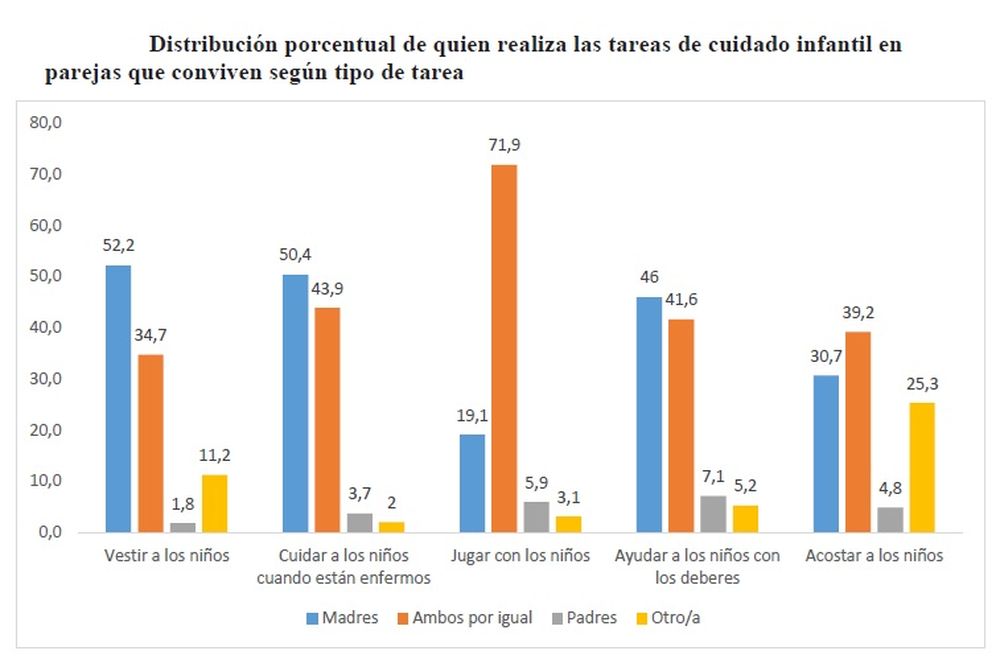
With a statistical model that allowed him to score the involvement in these care tasks, he arrived at a number that in Uruguay was until now a mystery: “40% of Uruguayan fathers (who live with their partner, wife and children) do not participate in child care”.
Who are the parents involved in care?
What happens to that other 60%? What about those who do get involved? Pelufo could see that they are quite similar to each other. Age, unlike what some of the scientific literature thinks and says (such as that younger generations distribute more than older ones) does not change the results much. But other behaviors are key.
When the father is the one who goes out to work on a paid basis and the woman stays at home for unpaid work, the probability that the men will be responsible for the care or share it is very low.
In his defense, Pelufo defined it like this: “The participation of the couple in the labor market affects the probability of involvement, in the majority of the activities considered.” If we add to that that it also affected considering who is best to care for (roles), it can be said that “in homes with more traditional characteristics, male participation tends to be lower”.
Does that alone influence involvement? Pelufo went further and confirmed another key third leg: “The participation of men in household chores (issues such as cooking, washing bathrooms or other domestic tasks) increases involvement in child care.” She noticed it especially in dressing the child and doing his homework, not so much in staying to take care of him when he is sick.
The study carried out by the academic within the Population Program of the University of the Republic suggests that we may or may not be at a pivotal moment, “of consolidation of a masculine identity in the domestic sphere.”
Finally, the thesis states that when compared with other countries or cities such as Buenos Aires, “Uruguayan parents show levels of exclusive participation (in childcare activities) similar to those observed in the majority of the countries analyzed, although below those recorded in Nordic countries.”
In Denmark or Finland, to cite two examples, the percentage of parents who take care of their child when they are sick almost doubles. And that can be linked to cultural factors and also incentives: such as work flexibility or more extended and equitable parental leaves. But in that, Pelufo acknowledges, “There is much left to explore and know for sure.”