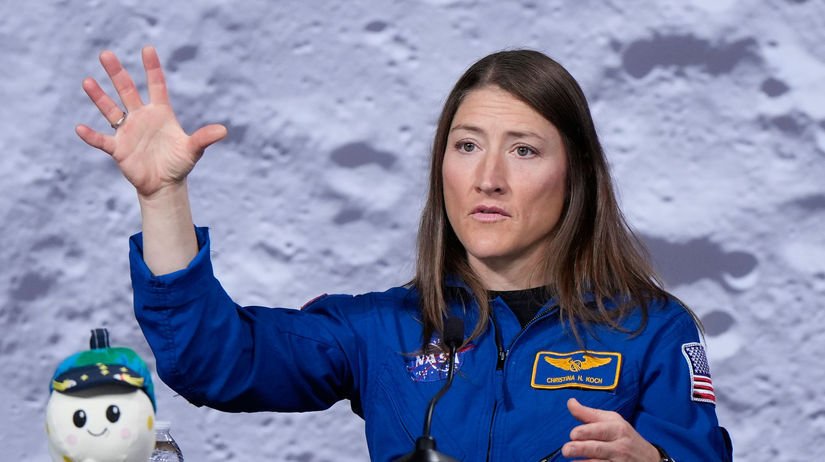
Christina Kochová made history as the first woman to fly around the moon. However, after 10 days in weightlessness and a historic landing in the Pacific Ocean, returning to Earth’s gravity and reality is quite a challenge. She shared a video on social media where she struggles with balance. The footage immediately went viral.
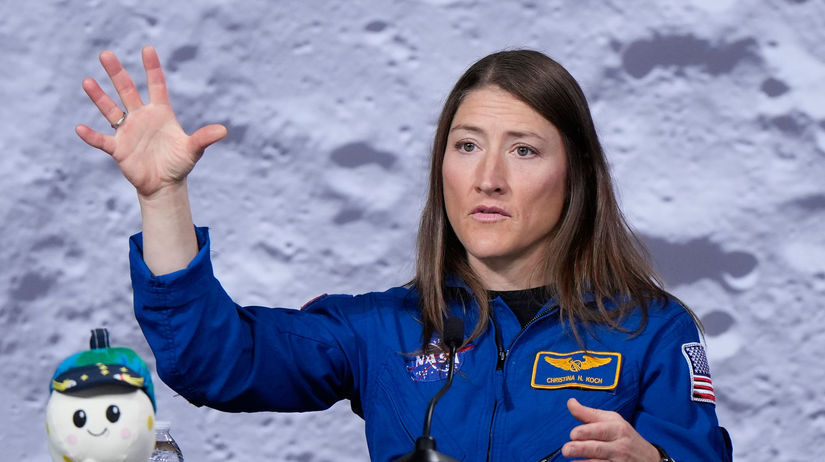
Photo: SITA/AP, Ashley Landis
NASA astronaut Christina Koch, member of the Artemis II crew, during a news conference Thursday, April 16, 2026, in Houston.
Just less than two weeks ago, the whole world watched with bated breath as the Orion module successfully landed off the coast of California. The four-member crew of the Artemis II mission, which included NASA record holder Christina Kochová, became the first people to see the far side of the moon up close in more than 50 years.
But the celebratory fanfare and applause in the control center was replaced by the harsh reality of everyday life – or rather, the harsh reality of Earth’s gravity. Christina Kochová posted on her Instagram a video from the rehabilitation center, which shows that even the most trained people on the planet feel like toddlers after returning from space, she notes refresher.
“I’ll have to wait for the surf”
In the video, which immediately went around the world, an astronaut can be seen attempting the so-called “tandem walking” (walking in one line where the heel touches the tip of the other foot) with eyes closed. The result? Koch had to be secured by two assistants because her body simply forgot where it was “up” and where it was “down”.
“I guess I’ll have to wait another minute before I go surfing again,” Christina joked in the caption of the post. She added that although the mission lasted “only” 10 days, going from zero gravity back to 1G (the standard gravitational acceleration on Earth’s surface) is a huge shock to the brain.
Why does the body “forget” to walk?
The science behind this phenomenon is fascinating. In a state of weightlessness, our vestibular system (the inner ear responsible for balance) stops receiving the signals it is used to. The brain adapts and begins to ignore these “confusing” messages, relying almost exclusively on sight for orientation.
However, upon returning to Earth, the inner ear suddenly feels gravity again, but the brain is still set to “space mode”. The muscles and joints thus receive information about the weight of the body, which they did not feel for 10 days, but they are simply too lazy.
Closing your eyes (as in the video) will cause a total loss of orientation, because the brain will lose the only sense it trusted during the mission, which is vision.
Preparing for Mars
These tests are not just to entertain fans on social networks. NASA uses them to understand how quickly the human body can adapt after landing on another space body.
“We are learning how to treat vertigo, concussions and other neurological conditions here on Earth,” Koch explained. Data from the Artemis II mission will be crucial for future astronauts who will have to disembark after a long flight to Mars and immediately function in Martian gravity without medical assistance.

Christina Koch is currently on day 13 after landing and, according to her own words, feels better every day. Together with colleagues Reid Wiseman, Victor Glover and Jeremy Hansen, they will now undergo a series of medical examinations that will help pave the way for the Artemis III mission – the actual return of humans to the surface of the Moon.
However, is it possible to induce something similar to what Kochová experienced in earthly conditions?
The answer is simple: Yes, but you would probably be bored to death.
1. Dry immersion Scientists in Russia and ESA (European Space Agency) use Dry Immersion.
- How it works: A volunteer lies down in a tub of water, which is covered with a special waterproof fabric (like very loose plastic). Thus, a person is “immersed” but remains dry.
- What happens: The water presses evenly on the entire body, simulating weightlessness. The brain stops receiving signals about pressure on the feet or back.
- The result: After just 3 days in such a bath, people have trouble keeping their balance. After 10 days, you would be like Christina Koch – your nervous system would be “out of tune” and when you try to stand up, you would feel that the floor is floating under you.
2. Bed Rest Studies (in other words, an extreme Netflix marathon) NASA regularly pays volunteers thousands of euros to spend, for example, 60 days in bed.
- However, there is a catch: the bed is tilted by minus six degrees (the head is lower than the legs). Why the tilt? To simulate the transfer of body fluids to the upper body, exactly as it happens in the cosmos (that’s why astronauts in space have “swollen” faces and thin legs).
- What happens: The muscles in the legs and back that keep us upright (the so-called anti-gravity muscles) begin to weaken over the course of days.
- Back to reality: When these people first stand up after a month or two, they often pass out (the blood rushes to their legs and the brain remains dry) and their gait resembles someone after a very wild party.
3. Long-term cast or illness. Perhaps you or someone close to you has experienced it.
- If your leg is in a cast for 6 weeks and you don’t use it, this is what happens after it is removed: Muscle atrophy: The muscle is visibly thinner.
- Sensorimotor failure: Your brain momentarily “forgot” how to precisely control that leg. You feel like you have a wooden stake instead of a leg.
- Why is it different for astronauts? The main difference is in the inner ear (vestibular apparatus). On Earth, even if you lie in bed for 10 days, gravity still pulls your “ear stones” (otoliths) down. So the brain still knows where the ground is. However, in space, this sensor fails completely.
- When Christina Koch returned to Earth, her inner ear said, “Hey, we’re falling down! But” her eyes said, “No, we’re standing still.” But her muscles were confused: “We feel some pressure, but we don’t know what to do with it.”