Loading Text-to-Speech…
“I collect books by artists whose work I don’t appreciate,” Urs Fischer tells us. Very early in the conversation, you understand that he does not like definitive judgments and easy assumptions; doubt sharpens his thinking. “I want to understand what other people see that I can’t see.”
Born in Zurich in 1973, Fischer has been among the most important artists of his generation for two decades. His work – exhibited three times at the Venice Biennale and included in major public and private collections – is notable for its constant transformation, from melting wax sculptures to painting collages and installations. The Greek public got to know him better in 2013, with the participatory project “YES” that he presented at the Old Slaughterhouses of Hydra, upon the invitation of the DESTE Foundation.


He goes on to tell me about his “weird” collection, about Warhol, Hockney and Cézanne, while I try to catch a certain grimace from him that betrays arrogance in these statements. He catches up with me: “It often takes me 10-20 years to appreciate an artist.” He begins with gusto to “delete” the historical avant-garde in totality, almost… to recall after study and observation. Chagall initially seemed horrible to him, Kandinsky incomprehensible, Klee horrified him as a child, Duchamp, although he admired him, caused him grief. “I was looking at Miró again recently. The way I grew up made me almost associate it with advertising. His language was everywhere: in graphics, labels, images of all kinds. A blue background, a line, a small red shape. It influenced entire generations of artists and, with them, ignited some very bad art. You look at all this and think, what an awful thing, but then you stand in his ceramics, take your time, and realize that some of them are truly amazing. The difficult thing, then, is to separate Miró from what he inspired in others.”
Eugene Atze
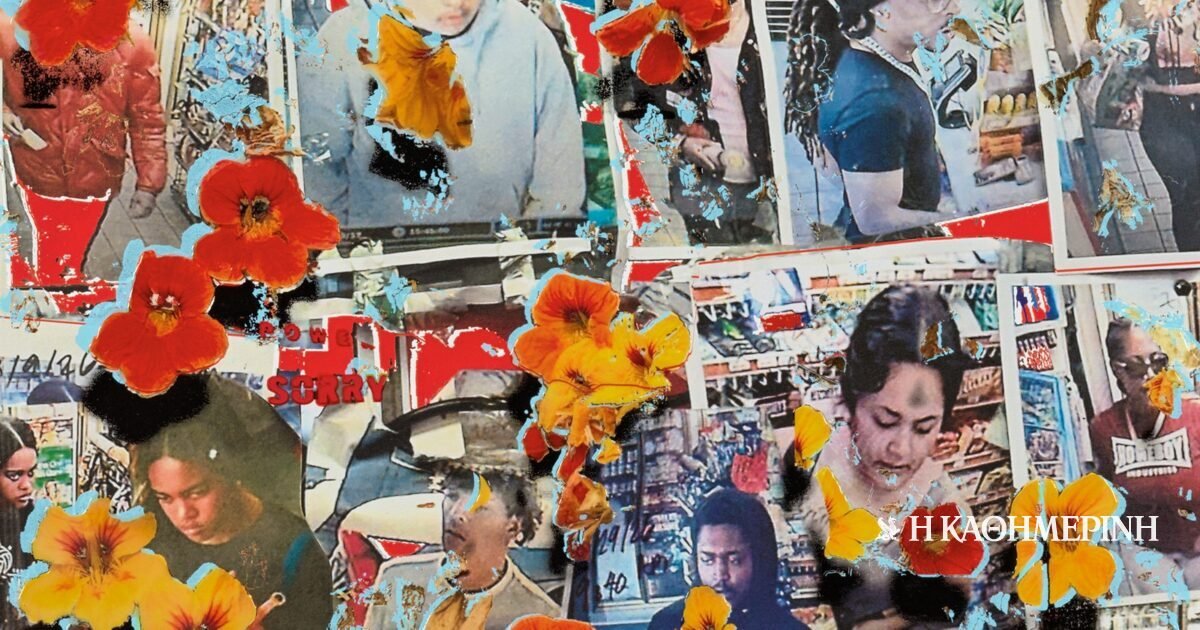
For Eugene Atze, he didn’t need to revise; he always loved him, which is why he gave the title to his first solo exhibition at the Athenian Gagosian the name of the French photographer: “Eugène Atget”. “What I discovered is that he was taking photographs as reference material for other artists. A tree, a door, anything. That’s how I use photography too.” Atze was not concerned with the aesthetic value of his work, he wanted to compile an archive of images, he claims. “I also photograph things – storefronts, streets, signs, people –, I’m not interested in beautiful photography, I collect visual information and then merge it into paintings.” I comment that the two capture two completely different worlds, Paris in the late 19th century has nothing to do with chaotic Los Angeles in the 21st, the speeds at which things happen are not comparable. He disagrees. Agee carried glass plates and set up tripods all over Paris, documenting a violently changing world. “I think his era was more like ours than we realize.”
I wonder what it is that has drawn him to the city where he has lived permanently with his family for the last few years, to dedicate a body of work to it. He explains that Los Angeles dominated his adolescent conversations. In the evenings he worked as a “doorman” in Zurich, together with a friend, they had endless discussions about the city of action movies, Terminator but also the underground culture, the wide avenues and the sun. In 1994, at the age of 21, he visited Los Angeles for the first time. In 1999, when he started spending longer periods in the city, he started taking pictures from inside the car, on the move. “I remember how vividly this place had made an impression on me. In Zurich, a medieval city, you turn a corner and immediately arrive somewhere, in Los Angeles you felt like you were getting nowhere, the horizon was always open,” he says. However, even today, his open spirit, sense of unpredictability and ingenuity are what win him over in the city. “A lot of that ingenuity was born out of hardship and loneliness. People arrived in a new land with nothing, music cost nothing; you could sing or play an instrument. Through these circumstances, enormous creativity was born.”

Comparing America with Europe, he insists on the concept of tradition. “In Europe there is so much culture everywhere. Every city, every food, every habit carries a story. Think of a traditional dish, you didn’t invent it yourself. At best you are his guardian. If you try to tamper with it, someone will be found to tell you: “This dish is made like this.” Why do you want to make it different? This is the dish.”
I used to think that artists are only a few people who have achieved something really big. Now, if someone says they’re an artist, I think: Great. It’s something you can participate in, it costs nothing.
He seems to distance himself from Europe’s anchoring to the past; uncertainty is a better guide, he points out. “Sometimes it’s good not to know, to be uneducated, it leads you down different paths. I grew up in an environment where everything had its place, it didn’t benefit me. Even today I enjoy not knowing exactly where things belong.” I wonder if there was a specific moment when he understood for sure that his place is art. Maybe after his first exposure? After selling the first project? “No, I had my first exhibition at the age of 21, but even then I didn’t feel like an artist. Before that, I was just making stuff. For friends, for theaters, for anyone who needed something,” he says. For years he even struggled to use the word for himself. “I thought that artists are only a few people who have achieved something really great.” Today he sees it differently. “If someone says they’re an artist, I think: Great. It’s something you can participate in, it costs nothing. You don’t need an education, my only education is photography. You can just walk into this thing that’s been moving for thousands of years and be a part of it.”
Painter or sculptor
I look at the new works he will present in Athens – multi-layered collages of images, photographic fragments, painterly gestures and digital manipulations – and ask him to tell me how he presents himself: as a painter or as a sculptor? “Collage is the art form of the 20th century, it’s a way to condense different experiences into the same space. I grew up in the logic of the coexistence of disparate images. However, I think I work more in three dimensions. In sculpture you compete with reality. You compete for the physical space occupied by an object on the planet. Unlike a painting, where if it’s not good you can camouflage it with a background behind it or a vase of flowers to the side, with sculpture you’re irreparably exposed. If the sculpture is bad, it cannot be hidden.”
From 9/6 to 12/9, Gagosian, Apariron Polemo 22.