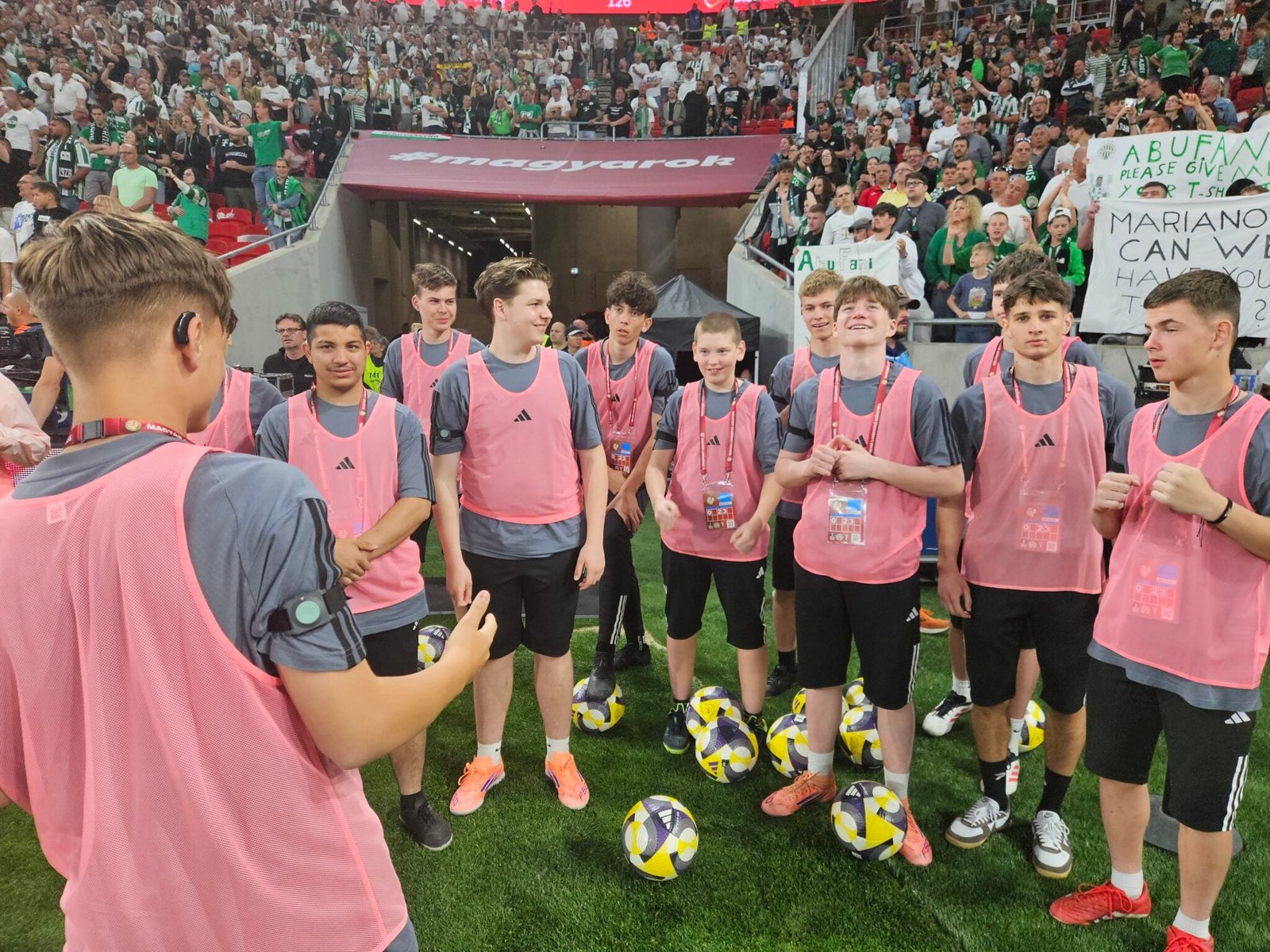

The upcoming Champions League final on May 30 at Puskás Aréna in Budapest between Paris Saint-Germain and Arsenal FC promises a top-class sporting spectacle. But away from the two star teams, a very special group is preparing intensively for the final: twelve hearing-impaired Hungarian youth footballers—eleven boys and one girl—will step onto the pitch as the first ball kids with disabilities in football history. We spoke with László Fekete Jr., the founder and director of the football school “Ezüstcipő” (Silver Boot), about this historic sporting milestone and the work behind it.
Can it be said that these Hungarian teenagers are paving the way for other hearing-impaired athletes worldwide through their participation in the Champions League final?
Absolutely. In international tennis—for instance at the Madrid Open or Wimbledon—we increasingly see neurodivergent youths or young people with Down syndrome being given the opportunity to serve as ball kids.
But in team sports, and especially in football, our Hungarian children have now achieved the most significant breakthrough. In the entire history of football, it has never happened that children with disabilities have taken on this role.
Behind this success lies enormous effort. After lengthy negotiations and hard organization that began in April 2024, I managed to convince UEFA and the Hungarian Football Federation (MLSZ). The deaf and hard-of-hearing students of our Ezüstcipő football school were approved to serve as official ball kids in Budapest. The official confirmation finally arrived this March.
Before talking about the final: could you tell us more about your football school?
The Ezüstcipő Football School—officially the Ezüstcipő Alapítvány a Hallássérült Fiatalokért (Silver Boot Foundation for Hearing-Impaired Youth)—is a unique project in Hungarian youth development. We are the first football school in Hungary dedicated specifically to the sporting development of deaf and hard-of-hearing children and teenagers. I founded the school in 2017. The name pays tribute to my father, László Fekete, a former Újpest player who won the “Silver Boot” in 1979 as the second-best goal scorer in Europe.
Our mission is far more than offering professional training three times a week to 48 hearing-impaired youths across three age groups. We aim to use the power of sport to foster social integration, strengthen self-confidence, and build a true community. Our organization even handles logistics for tournament participation. One early milestone came in 2019, when our kids were allowed to escort players onto the pitch at the opening of Puskás Aréna for the Hungary–Uruguay friendly.
The initiative has also gained international attention, right?
Yes, over the years the project has received significant recognition both domestically and abroad. With our support, the modern artificial turf pitch “Nagy Norbert” was built last year at the School for the Deaf in Budapest. In addition, the UEFA Foundation for Children included us in its support programs in 2023. With that funding, we were able to purchase a minibus, ensuring transport for children from boarding schools or rural areas.
Every day we prove that there are no limits on the football pitch. Love for the game and team spirit overcome all communication barriers.

László Fekete Jr. with a banner showing the faces of Hungarian footballers who won the “Silver Boot.” Photo: courtesy of László Fekete Jr.
How does training work with deaf children in practice? They cannot hear verbal instructions.
That is the key issue. On a normal pitch, a coach constantly directs the game with shouts or a whistle. With hearing-impaired children, that does not work. When a player is focused on the ball, they cannot see the coach’s face or hands—lip reading and sign language are not possible in that moment.
The solution we use is simple but brilliant.
In cooperation with Széchenyi István University in Győr, we developed an app called “Look at me.”
Its goal is to communicate with an individual player without disturbing the rest of the team. Before training or matches, the player wears a armband. When I press a button on my smartphone or tablet, the selected player’s armband vibrates intensely. Hearing-impaired individuals have extremely sensitive perception of vibration, therefore they immediately notice it even in the most intense moments.
What does this signal mean for the player?
The message is clear: “Pay attention to the coach now.” Once the child feels the vibration, they look up and receive visual instructions in sign language from the sideline. The advantage is that they can keep their eyes on the ball until the very last moment. It also trains them to play with their head up—which is crucial for football development.

Deaf and hard-of-hearing teenagers serving as ball kids at the final of the Hungarian amateur cup at the Illovszky Rudolf Stadium in Budapest. Photo: courtesy of László Fekete Jr.
What will the twelve youths do at the Champions League final?
UEFA uses a new system in its European club competitions, the “multi-ball system,” similar to the Premier League. Match balls are placed on cones around the pitch. In total, there are 15 balls in play: one on the field, one with the fourth official, and 13 on cones.
Ball kids are not allowed to directly hand or throw balls to players. When a ball goes out, professionals collect a replacement from the nearest cone themselves.
Only then do the ball kids act: they retrieve the original ball and place it back on an empty cone.
The only exception is behind the goal line—there they may directly pass the ball to the goalkeeper to speed up play.
Are there difficult situations or grey areas?
Yes. During a pitch inspection at Puskás Aréna, we discussed complex situations: for instance, when a player takes a ball from a cone but the previous ball is still near the sideline and play shifts into that area. The ball kid must not interfere with play, but the unused ball also cannot remain there. That requires quick thinking and sensitivity.

Deaf and hard-of-hearing teenagers serving as ball kids at the Hungarian men’s cup final at the Puskás Aréna. Photo: courtesy of László Fekete Jr.
How did they prepare for these stressful situations?
The children have already tested this in practice at four major matches: Hungary vs Greece at Puskás Aréna, the Hungarian women’s cup final, the men’s cup final, and the amateur cup final.
After these performances, I can confidently say they are fully ready for the Champions League final.
Will adults support them on the pitch?
Yes. I will be present the entire time. In addition, two supervisors—a man and a woman—will be assigned by the Hungarian Football Federation (MLSZ). Because one of the children is a girl, she will have a female supervisor according to regulations, and a separate changing room will be provided.

Deaf and hard-of-hearing teenagers serving as ball kids at the final of the Hungarian amateur cup at the Illovszky Rudolf Stadium in Budapest. Photo: courtesy of László Fekete Jr.
How old are the participants and how experienced are they?
They are between 16 and 17 years old. They have already worked together at many tournaments, including the Puskás-Suzuki Cup. It is a well-coordinated team.
It is important to emphasize: deafness is a purely physical condition and has nothing to do with intellectual ability.
These young people are just as intelligent as their hearing peers. As ball kids, their deafness is even an advantage: in a loud stadium, hearing children struggle to communicate, while sign language users can understand signals from up to 80 meters away.
What message does the Ezüstcipő Football School want to send?
We want to show the world that football belongs to everyone—including the more than 400 million hearing-impaired people worldwide. We want to tell them: look, it is possible.
We want to send a strong signal and create a model for the future. When people from Austria to Bangladesh watch the final, they should see that hearing-impaired children can play sport like anyone else.
It is not about everyone becoming elite athletes—the joy of the game is enough. But those with talent can reach the top even as deaf athletes. A great example in Hungarian professional football is Ákos Takács, who, despite his hearing impairment, reached the national team.
Is there anything else that is particularly close to your heart?
I am firmly convinced that hearing-impaired people represent a vast, hitherto untapped and hidden reserve for Hungarian sports. They are capable of achieving top performances in both inclusive and specialized teams. It is time for the spotlight to finally be turned on them as well.

Featured image: courtesy of László Fekete Jr.