“One of the reasons why I started collecting labels five years ago was the curiosity about the origin of things”, says the artist Stephanie Rizaj. And he doesn’t do this for collection reasons. Her approach to art is exploratory. Through labels it traces origin, movement, identity. It transforms labels into polyglots who, even with their silence in form, in essence speak loudly. I leave the reading to the “Silent Polyglot” exhibition. And he is multiple
Clothing labels usually identify the brand name, place of manufacture or material composition. In the “Silent Polyglot” exhibition, artist Stephanie Rizaj turns them into evidence of human stories, global movements or identities that transcend national borders.
On Thursday night at the National Gallery, the exhibition of the artist from Kosovo, but who works and operates between Vienna and Brussels, was opened. It is her first exhibition in Kosovo institutions. Curated by Austrian Vanessa Joan Müller, the installation specially commissioned for the GKK reflects on the global fashion industry and migration. Especially about how identities are shaped in the world more and more in the dynamics of people’s movement.
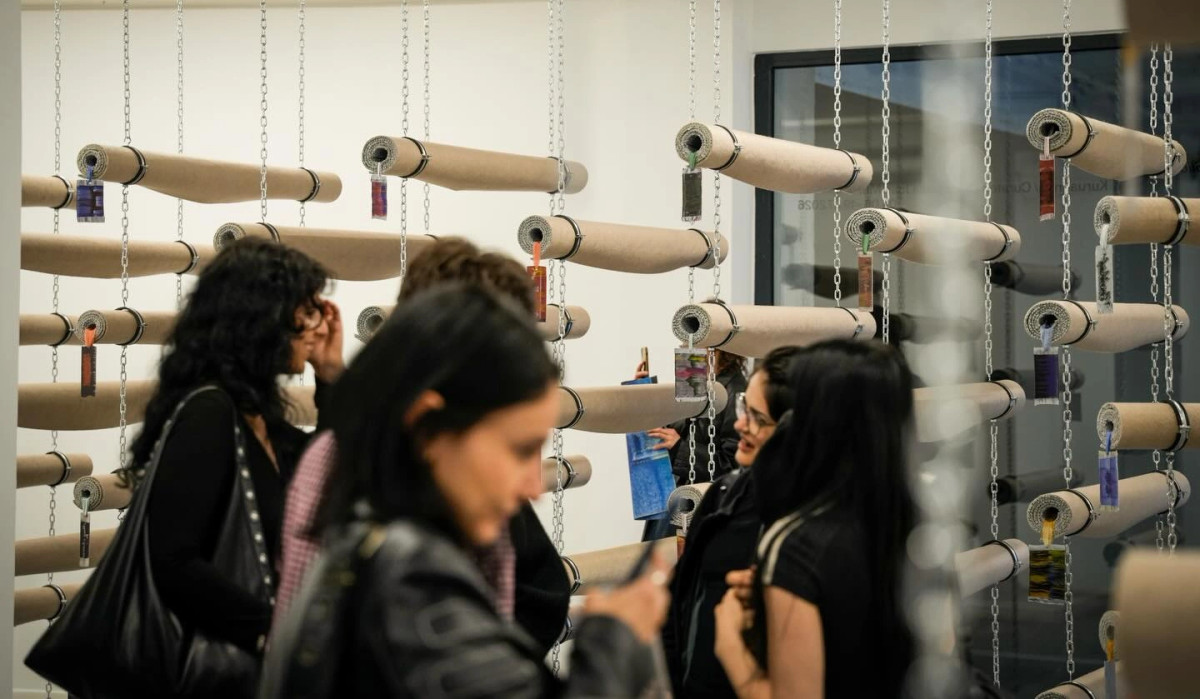
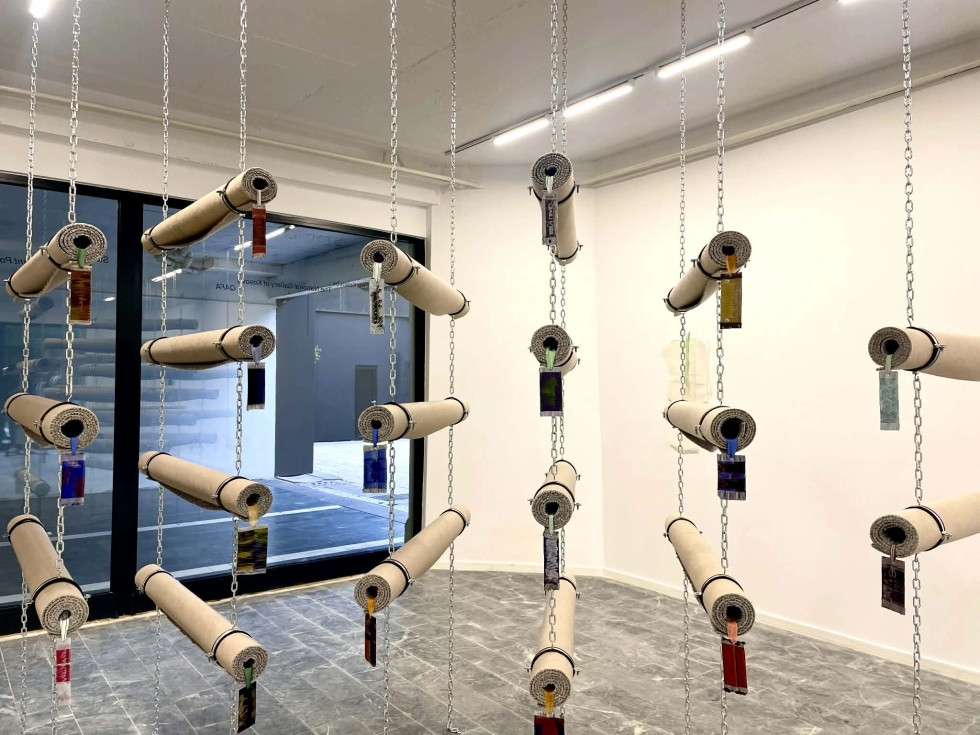
“Silent Polyglot” combines found objects and textiles, through a collection of old clothing tags that identify new carpets folded in a circular shape. Inside the gallery facility in the neighborhood “Qafa” where the GKK has temporarily moved, this combination changes the perception by highlighting the relationship between aesthetics, the market and the global circulation of objects and even people.
According to the biography, Rizaj’s multidisciplinary practice includes installation, sculpture, video and textile, drawing on reflections on identity, commodification and belonging. A recurring theme in her work is that of clothes and their production, circulation and “life after use”, as well as the process through which they gain and then lose value.
Artist Stephanie Rizaj has shown that the interest in labels started five years ago, as a search for the origin of things and the stories they carry.
“People’s stories have always interested me. Of course, this is also related to my personal history, as I come from different contexts and have lived in different places. This is something very present in my life. One of the reasons why I started collecting labels five years ago was the curiosity about the origin of things. When you look at a label, it tells you where a product was produced or assembled. But at the same time, I am interested in people’s individual experiences”, said Rizaj.
She said that behind every garment there are unknown stories, both of those who produced them and of those who wore them.
“If I wear something and you wear something else, we only see the garment. We don’t know the story of the person who wore it before, and we don’t know the story of the person who made it. These are things I think about often. Even when I find these labels, I ask myself: who was this person? Where did this come from? In a way, this installation is like the world itself. We all move within it. And when you get closer, you can stop at each element and hear the story that it can tell. show”, she told KOHEN.
She emphasized that this exhibition also has the freedom of interpretation.
“Someone can be attracted only by the colors, someone by the shapes, by the installation as a whole or by the meanings hidden behind it. In my work I like to create different layers of reading. You can experience the work from afar and get a general impression, but if you are curious and get closer, you discover other details – different colors, different textiles and different stories hidden behind them”, said Rizaj.
The installation dominates the gallery space with large textile tubes suspended in the air. Each accompanied by large labels. The curator of the exhibition, Vanessa Joan Müller, said that the idea came from the architecture of the space itself.
“The artist Stephanie Rizaj invited me to be the curator of this exhibition, but in this case she already had the idea for this large installation in the gallery. She wanted to develop something that was closely related to the space itself, a work almost specific to the place where it is exhibited. She liked the fact that the gallery has two large windows, making the space resemble a closet,” she said.
According to her, what the public sees is “a very abstract version of a shop that could sell clothes”. “We have these rolls of material – actually carpets – that look like they’re floating in the air, and each of them has a label attached,” she said.
According to her, the labels lead the exhibition to a reflection on globalism. The Austrian curator has emphasized that today there are clothes that pass through several continents before receiving the final label of origin.
“Today, every piece of clothing is produced in different countries. The fabric can come from Bangladesh, be processed in China, and then, when it reaches Europe and is labeled, a T-shirt can be called ‘made in Italy’. The idea of the exhibition was to create this large installation as a perfect metaphor for the diversity of contemporary life,” illustrated Austrian curator and writer Vanessa Joan Müller.
Beyond the fashion industry, the installation also extends to questions of identity and belonging. The curator has argued that the exhibition also corresponds to identity and that it is not a single and immutable category.
“We too, metaphorically speaking, carry a label – a nationality – but our lives are much richer than that. Each of us carries stories, travels and experiences different places. Stephanie is Austrian, but her family comes from Kosovo. She lived for several years in Belgium and only last year returned to Austria. She has an Austrian passport, but her life speaks of much more than a single national identity. The same applies to all of us”. she said further.
The curator of the National Gallery of Kosovo, Hana Halilaj, said that the exhibition is the result of a long research by the artist.
“We are very happy to have the opportunity to present the first institutional exhibition in Kosovo of Stephanie Rizaj in a commissioned installation that deals with the topic of consumerism through a convenience such as clothes. This is based on the labels where the name of the brands or companies that produce them is usually written”, said Halilaj.
According to her, the project is closely related to the professional training of the artist, who first studied fashion and architecture, then joining these fields in her artistic practice.
The exhibition will remain open until July 19, during which period the staff of the National Gallery of Kosovo plans to return to the former spaces of its facility, which have already been renovated.
Through silent labels that speak about different topics, in the exhibition “Silent Polyglot” they illustrate the movements of people, materials and stories themselves in the contemporary world.