The unusual high temperatures recorded in Peru a few weeks before the start of winter contribute to the possibility that a large Global El Niño Phenomenon will develop in the coming months. called ‘Super Child’. Senamhi reported that the Peruvian coast will continue to register temperatures above their normal values, at least until the fortnight of June. This situation will be felt more intensely on the north coast, even reaching approximately 36°C in the departments of Tumbes and Piura.
In the case of Metropolitan Lima, daytime temperatures between 23°C and 25°C are expected in the districts of western Lima and central Lima. Likewise, values close to 27 °C would be present in the jurisdictions located in eastern Lima and northern Lima.
In addition, records are expected between 24°C and 31°C on the coast of La Libertad, 24°C and 32°C in the Lima and Áncash region, between 25°C and 33°C in Ica, between 24°C and 33°C on the coast of Arequipa and between 21°C and 23°C on the coast of Moquegua and Tacna. Meanwhile, for the northern coast, values between 31°C and 37°C are expected in Piura and Tumbes, between 28°C and 33°C in Lambayeque.
Meanwhile, Enfen maintains the status of “Coastal El Niño Alert” and predicts that the event would last until February 2027, with a greater probability of moderate magnitude. This would favor the recording of temperatures above normal along the Peruvian coast, including Metropolitan Lima.
What international agencies say
The US Climate Prediction Center had announced that the El Niño weather pattern is “likely to emerge soon” and could reach “very strong” levels later. In addition, the National Oceanic and Atmospheric Administration of the United States (NOAA) indicated – in its recent monthly bulletin – that there is an 82% probability that Global El Niño will appear between May and July, and that it will last until next year.
He even highlighted that there is currently a greater than 50% probability that the phenomenon will become “strong” or “very strong” between September and November.

An extraordinary El Niño phenomenon could appear between December and January, indicated a specialist
Ricardo Bohl, geographer, researcher and professor of Geography and Environment at the Pontifical Catholic University of Peru (PUCP), told The Commerce that, according to reports from specialized agencies around the world, there are many possibilities that an extraordinary Global El Niño Phenomenon will occur in the coming months.
He explained that in the continents where the spring season is currently taking place, there is concern, since they have high temperatures and they predict that it will increase more in the summer season.
“All the (specialized) agencies are very upset about what is happening because, at this moment, they are in spring and if El Niño manifests itself with this power, it will affect them in their summer, then it will be an extraordinary summer for them,” said Bohl.
“Their concern is precisely that in May, which is their spring, they have summer temperatures. So, they wonder what June and July will be like. The concern comes from that fear because if that continues to rise it could be a problematic summer,” he added.

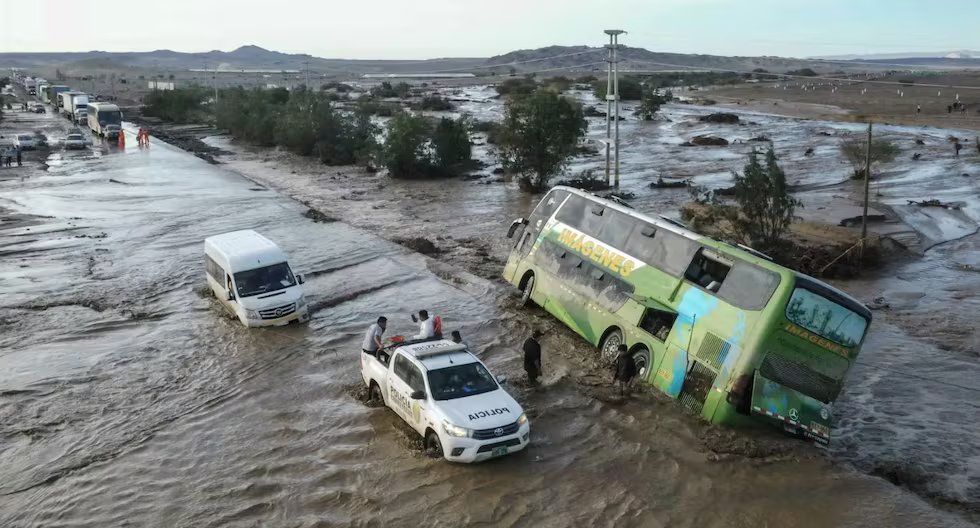
The northern coast of the country is affected by landslides during the El Niño Phenomenon.
In the case of Peru, the specialist explained that if the conditions currently reported are maintained, an extraordinary El Niño phenomenon could occur between next December and January.
“If El Niño extends and gains more strength in December or January, it could be an extraordinary El Niño Phenomenon. If it is occurring now, what it will generate is a mild winter, perhaps we will have some rains or storms, since as the sea is warmer there is more evaporation and, therefore, there could be rain. If these conditions persist or worsen, then in December or January we will have an extraordinary El Niño Phenomenon,” he stated.
LOOK HERE: The intrusion into Sismate under the magnifying glass: this was the violation of the alert system
He explained that with a strong El Niño Phenomenon there would be rain on the coast, some streams would be activated in the regions and there could be droughts in the south of the country.
In addition, he recalled that during large-magnitude El Niño events, more than a thousand kilometers of road are lost, nearly 800 schools are damaged, on average, as roofs or walls fall, and around 300 medical centers are affected.
He stated that the country is not prepared for an extraordinary El Niño Phenomenon. “I am surprised that, with the amount of El Niño that we have faced, we do not have the capacity to respond, I am not only referring to the response after the disaster, but also in the preparation,” he said.
Bohl pointed out that in recent decades the recurring occurrence of the El Niño Phenomenon has been accentuated and assured that it is due to the “interaction” with global warming. In this context, he pointed out that previously a small event appeared every four or seven years, a medium event every 15 years and an extraordinary event every 50 years.
El Niño phenomenon of 82-83 and 97-98 would be a reference of what could happen in Peru, indicated meteorologist
The El Niño Phenomenon of the years 82-83 and 97-98 can be a “reference framework” for what could happen in the country if the current conditions are maintained in the Pacific Ocean, whose temperature is above average, indicated Dr. Elizabeth Silvestre, Ph.D in Meteorology and professor at the La Molina Agrarian University.
“If this warming persists, we are going to have the beginning of rains in the months of October and November, in the northern region they would be abrupt and intense,” the specialist told The Commerce.
“The trend that is observed and how international agencies are evaluating the process of occurrence of the El Niño Phenomenon is that it would be extreme. The most recent extreme Niño that is remembered is from 97-98. 11 thousand homes were lost in that event,” he added.
YOU MAY BE INTERESTED: Work begins to connect Metropolitano with Line 2: this will be the work and detours in a critical area of Lima
However, he stressed that in the winter the magnitude of the El Niño Phenomenon could be determined. “Somehow there will be some impact in Peru. To be sure of the magnitude, intensity and what the impacts would be, we have to wait for the consolidated winter season to arrive; we are currently in the intermediate autumn season. When we are in winter, we can be more sure of what the intensity and behavior of this event will be,” he added.

Silvestre stated that the increase in the occurrence of El Niño in recent decades is related to climate change and that its periodicity has been reduced, since it previously appeared between four to seven years. “Climate change, due to its physical behavior and processes, has altered the frequency, intensity and periodicity of all extreme climatic and oceanographic events. El Niño is also known as an extreme event,” he stated.
Indeci warns that disorderly occupation of the territory aggravates disaster risks
The disorderly occupation of the territory and urban growth without considering risk areas continue to aggravate the impact of disasters in Peru, warned Sara Elena Quiroz Miranda, director of Policies, Plans, Evaluation and Statistics of the National Institute of Civil Defense (Indeci), during her participation in Country Risk 2026, a seminar on disaster management and prevention in Peru.
“When an earthquake occurs we have a problem related to the location and infrastructure of how cities have been built, without considering the conditions of occupation of the territory,” said the specialist.
During the meeting, Alex Salas Kirchhausen, CEO of R-Manager, maintained that crises and disasters do not fail due to lack of protocols, but rather due to lack of coordination between institutions and managers under pressure. He explained that, during an emergency, problems such as communications collapse, conflicts in the lines of command and decision-making with incomplete information usually arise.
For his part, Mark Kitchens, CEO of Apollo South America, emphasized the need to strengthen operational interoperability between institutions to improve response to emergencies and disasters. During his presentation, he warned that the main problem during a crisis is not only the natural phenomenon, but the breakdown of the social and operational system that prevents acting in a coordinated manner.
“The disaster is not the earthquake. The disaster is the breakdown of the social and operational system,” Kitchens said.
Mario Casaretto La Torre, Disaster Risk Management Manager of the Metropolitan Municipality of Lima, also participated in the event, who presented the main actions carried out between 2023 and 2026 to reduce risks in the capital, including cleaning and clearing work in the Rímac, Chillón and Lurín rivers, as well as interventions in vulnerable streams in Chosica and Cieneguilla.
Government strengthens preventive measures to mitigate the impact of the El Niño Costero phenomenon
The president of the Council of Ministers, Luis Arroyo, met last Tuesday with officials and representatives of entities to adopt the necessary preventive measures to anticipate the possible effects of the El Niño Coastal Phenomenon.
“As a Government we have to be prepared for contingencies, especially the National Institute of Civil Defense, not only supplied with what they need to support the population, but also to prepare their Rapid Intervention groups for Emergencies and Disasters. Added to this effort are our Armed Forces and the National Police of Peru (PNP), who will give the first response,” emphasized the head of the ministerial cabinet.
Along these lines, Arroyo emphasized that disaster management must cover everything from prevention to rehabilitation. Therefore, he urged those present to guarantee the completion of the repair work in the affected areas. Additionally, it demanded speed from the corresponding bodies to ensure local governments the availability of resources within a maximum period of seven days, when they require it.
The meeting, held at the facilities of the National Emergency Operations Center (COEN), brought together the ministers of Defense, Interior, Economy and Finance, Health, Housing, Construction and Sanitation, Production, Energy and Mines, Agrarian Development and Irrigation, Culture, and the vice ministers of the Transport and Communications and Education sectors.
Representatives of the National Center for Estimation, Prevention and Reduction of Disaster Risk (Cenepred), the Peruvian Sea Institute (Imarpe), the National Meteorology and Hydrology Service of Peru (Senamhi) and the National Water Authority (ANA) also attended.
As recalled, Enfen indicated in a statement from the fortnight of May that the “El Niño Costero Alert” status is maintained. The agency predicts a greater probability that the event will last until February 2027 with a weak magnitude, and warns about the possibility of reaching a moderate intensity between May and August 2026.