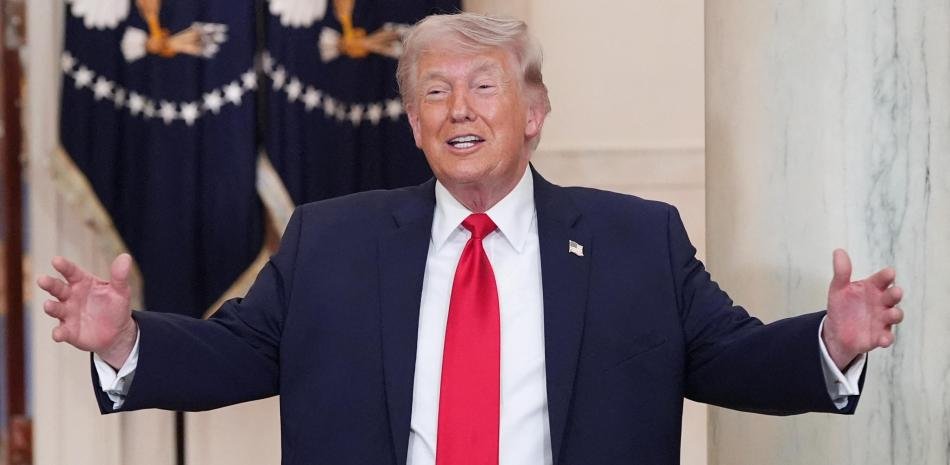
The president of the United States, donald trumpstated that the talks with Iran were progressing at a “fast pace“, despite the fact that on Monday the negotiations to end the war in Middle East appeared at risk with new threats from Iran’s Revolutionary Guards.
These words from the Republican came shortly after the Iranian news agency Tasnim claim that Tehran broke the indirect dialogue with Washington in retaliation for the Israeli offensive in Lebanon.
“Conversations continue, at a rapid pace, with the Islamic Republic of Iran,” the president wrote in Truth Social shortly after also announcing through his social network that Israel and Hezbollah They had promised to stop the military escalation in Lebanon.
Weeks of indirect negotiations between Washington and Iranmarked by threats and attacks, have failed to end the war or reopen the Strait of Hormuz, the sea route through which a fifth of the world’s hydrocarbon trade passed before the conflict broke out on February 28.
The last exchange of fire between United States and Iran During the night it coincided with a new intensification of the ground offensive of Israel in Lebanon.
The Israeli Prime Minister, Benjamin Netanyahuordered his armed forces to attack by land “terrorist targets” in the southern suburbs of Beirut.
Israel’s Arabic-language spokesperson posted on X that residents of the suburbs, or Dahiyeh, should evacuate “to preserve your safety“, and AFP images showed huge traffic jams as residents tried to flee.
Trump assured hours later that Israel and Hezbollah had agreed stop the fightingone of Tehran’s conditions for signing peace with Washington.
The United States had backed Israel’s operations against Hezbollah, but has tried to persuade Netanyahu to stop hostilities to put end to war in Iran and reopen the Strait of Hormuz.
“Breach of ceasefire”
Iran accused the United States of again violating the fragile ceasefire reached on April 8following the US attacks this weekend, which were followed by Iranian military retaliation.
The US naval blockade of Iranian ports and the escalation of violence in Lebanon are “clear evidence of non-compliance with the ceasefire by the United States”, as published in X by the head of the Iranian negotiating delegation, Mohammad Bagher Ghalibaf.
On Monday, Iran’s state television network Tasnim reported that Tehran was withdrawing from the negotiating table due to “crimes” that Israel “continues to commit” in Lebanon and the violations “on all fronts” of the truce.
“I don’t care” if the talks with Iran fail, Trump told the US network CNBC, in a telephone interview shortly before his publications in Truth Social.
“If they’re over, they’re over,” he said about conversations that were already beginning to seem “very boring.”
And in another interview, this one with NBC News, the Republican considered that they had already “been talking too much” with Tehran.
“Defensive” bombings
Another point of friction between Tehran and Washington in the peace negotiations is the Iranian nuclear program.
The Islamist government assured on Monday that its nuclear program was not part of “this stage“of the talks, contrary to the expectations of Trump, who stated Sunday night that a memorandum of understanding should stipulate “very clearly that Iran will not have a nuclear weapon“.
The US military announced that it had carried out a new wave of “defensive” bombings on Saturday and Sunday in southern Iran, the third in just over a week.
These bombings targeted radar and drone control systems in the city of Goruk and the island of Qeshm, in the Strait of Hormuz, the United States Central Command in the Middle East (Centcom) stated in X.
For its part, Iran’s Revolutionary Guards announced on Monday that they had attacked a base used by US forces to bomb Iranian territory, without specifying its location.
The conflict has caused thousands of deaths and is shaking the world economy, with a sharp increase in oil prices, which skyrocketed again this Monday due to the worsening of tensions.