Reciting the titles of films nominated in the main category at the 1990 Academy Awards, Kim Basinger did not stick to the script. “We have five great movies here, and they’re great because they tell the truth. But there’s one movie missing from this list that deserves to be on it because, ironically, it might tell the greatest truth of all, and that’s ‘Do The Right Thing,'” Basinger said.
Detractors might say that Basinger, star of “Nine and a Half Weeks,” found himself in a scene where the character Mookie (played by the film’s director Spike Lee) walks with ice cubes on the naked body of the mother of his child Tina (first role Rosie Perez)her forehead, neck, knees, hips and breasts, to cool her down during an extremely hot day and create a sexy atmosphere.
But kudos to the actress for bravely challenging the American Academy after ignoring “Do The Right Thing” (“Do The Right Thing”, 1989) in the categories of best film, director…, and nominated only for Lee’s original screenplay and supporting actor Danny Aiello. Then “Dead Poets Society”, “Field of Dreams”, “My Left Foot”, “Born on the 4th of July” and “Driving Miss Daisy” competed for the best film; the latter confirmed the nomination.
The Academy didn’t “do the right thing” and nominate “Do The Right Thing”, i.e. Lee at least in the director category. While “Do the Right Thing” didn’t spark mass, racially motivated riots, as some had predicted, it’s possible that members were afraid of the inflammability of Lee’s production and preferred to celebrate a peacetime film about racial tolerance between an elderly white Jewish lady and her black driver.
Exactly 30 years later, at a time of renewed post-Bam racial tensions, the Academy repaid Lee by nominating “Black Member of the KKKlan” in six categories, including film and directing, and awarding him a golden statuette for adapted screenplay. It is interesting that they are Barack and Michelle Obama on the first “date” we watched “Do The Right Thing” in the cinema, which remains as relevant as it was in 1989, and even more relevant.
With “Do the Right Thing”, Lee traced the “boom” of the so-called black films of the early nineties (“Tough Guys”, “Dangerous to Society”…) and anticipated the riots in LA in 1992, after the acquittal of four policemen responsible for the brutal beating of a dark-skinned Rodney King. From today’s perspective, it seems as if “Do The Right Thing” predicted the case as well George Floyd from 2020, who was killed by a policeman kneeling on his neck while the unfortunate man was moaning “I can’t breathe” and eventually died.
Let’s recall that at the end of Lee’s film, when racial tensions are escalating, a white policeman will suffocate a young man named Radio Raheem to death with a baton (Bill Nunn). A lot of it strikes the eye and the ear more strongly on a retrospective viewing of “Do the Right Thing”. For example, the owner of the Italian pizzeria Sal (Aiello), where Mookie works as a delivery boy, is considering giving up his restaurant in order to start a real estate business called “Trump’s Pizza” or “Trump’s Plaza”, alluding to the then New York real estate king and the later American president, during whose mandates racial tensions increased.
We also hear a visionary speech about climate change. “If this heat continues, it will melt the polar caps and the whole world,” three elderly black men talk, sitting in front of a red wall and taking on the role of a Greek chorus. All of “Do The Right Thing” takes place during one unbearably hot day in a Brooklyn neighborhood, when we are briefly introduced to a gallery of colorful residents of the neighborhood that Lee sketches deftly as Robert Altman in his ensemble films like “Nashville” and “Short Cuts,” from a radio DJ (Samuel L. Jackson), to the old Da Mayor (Ossie Davis).
Enhanced in red in an excellent brightly colored photograph Ernest Dickersonthe heat radiates from the screen and the characters cool off with water from a fire hydrant on the street. “Do the Right Thing” is one of the “hottest” films along with “Day of Madness”, “Carnal Passion” and “Hot Spot”, surpassing Lee’s “The Summer of Killing Sam”, so it makes sense that it is shown in the “Kineteca” in Split in the cycle of summer films.
The heat additionally ignites the spark of racial tensions in an apparently harmonious community where everyone knows everyone, so much so that at first it seems that violence will not occur after all, and it is, as it were, unexpected, considering that Lee lulls the viewer into everyday life and imperceptibly moves from comic drama to tragedy while tensions bubble under the surface.
Things escalate when a character known as Buggin Out (Giancarlo Esposito) criticizes Sal for keeping only famous white people on the wall of the pizzeria, Alas Pacino, Robert De Niro, John Travolta, Frank Sinatrabut not “brothers”, even though blacks eat the most pizza at his place.
However, from the beginning, many situations are colored with (black) humor, for example the fight between Mookie and Sal’s son Pino (John Turturro). “You know what they say about dark-skinned Italians?” Mookie asks Pino, indirectly probably inspiring Quentin Tarantino to a monologue about Sicilians from “True Romance”, after which they shout to each other “Fuck Sinatra!” and “Shit Michael Jackson!”.
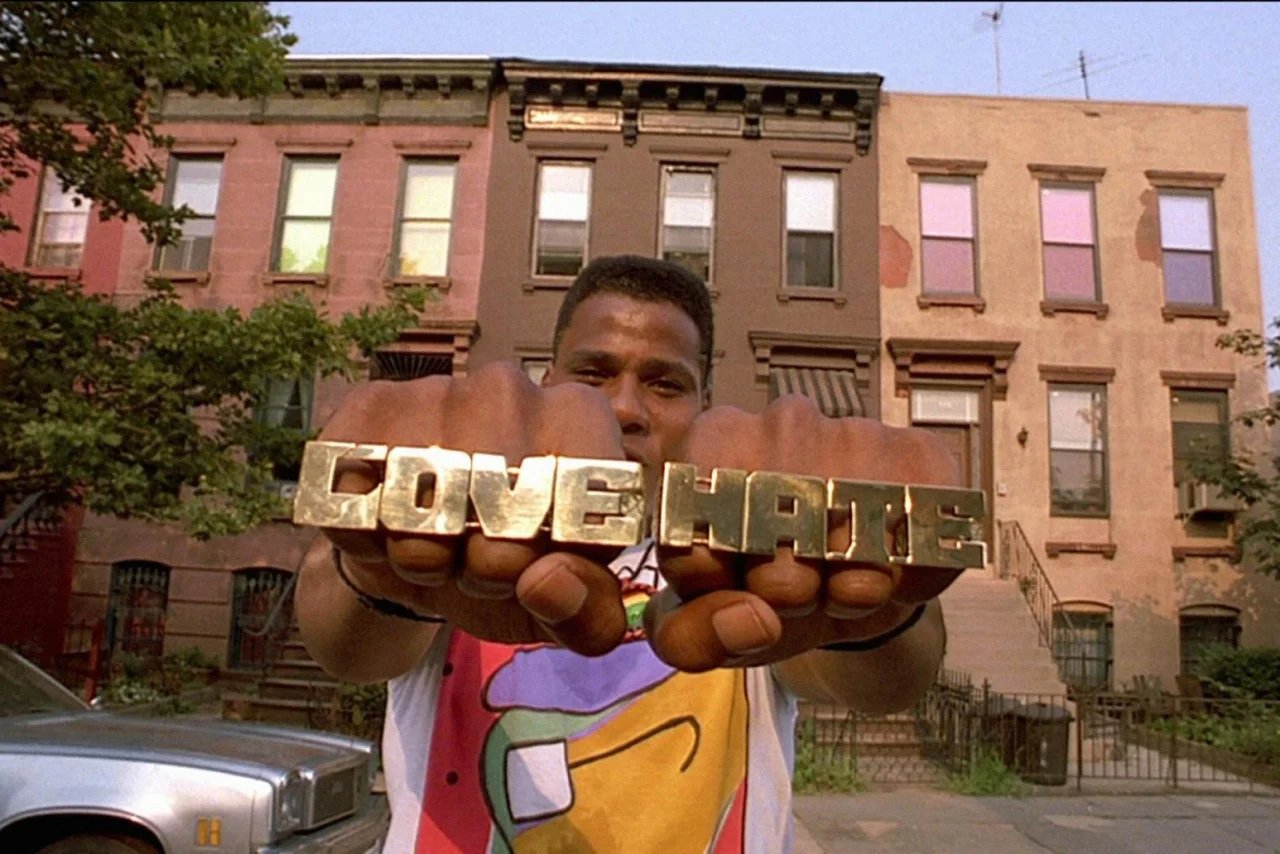
Hate does not overpower love in the film, they exist as “yin and yang”. Raheem wears gold boxers with the words “love” and “hate” as a reference to the identical tattoos on his hands Robert Mitchum in “Night of the Hunter”. When he starts boxing into nothing, love wins over hate, but by the end of the film, “love” and “hate” are equal.
Nothing is black and white in “Do The Right Thing”, so did Mookie “do the right thing” when he threw a trash can into the pizzeria window and initiated the demolition (he prevented more victims, but he could have joined the Mayor in trying to de-escalate the situation). Not surprisingly, Lee inserts contrasting quotes at the end Martin Luther King and Malcolm X about (non)violence. **** ½