It is planned to involve Russian schoolchildren and students in collecting memories of Northern Military District veterans and volunteers helping the front. This proposal was put forward by the Russian Military Historical Society: the initiative, according to Kommersant, has already been supported by the Ministry of Education and Science. It is expected that conversations with military personnel and volunteers will become part of the patriotic education of young people, and will also “provide invaluable material” for historians. Those interviewed by Kommersant, a volunteer, a veteran and a historian, support the idea, but with reservations.
The fact that departments are discussing the possibility of involving students in collecting memories of North Military District veterans was stated by the scientific director of the Russian Military Historical Society (RVIS) Mikhail Myagkov at a recent conference of history and social studies teachers, as well as at a thematic round table in the Public Chamber. The initiative, according to him, belongs to the Russian Military Educational Institution and has already received approval from the working group of the Ministry of Education and Science of the Russian Federation on the study of the history of the Northern Military District.
In April 2023, President Vladimir Putin ordered the issue of “organizing a study of the history of a special military operation” to be studied. In September of the same year, the Ministry of Education and Science created a specialized working group, headed by Deputy Minister Konstantin Mogilevsky. It included academicians of the Russian Academy of Sciences, employees of historical universities, representatives of the Russian Historical Society, the Russian Historical Society, the National Center of Historical Memory and the Ministry of Defense.
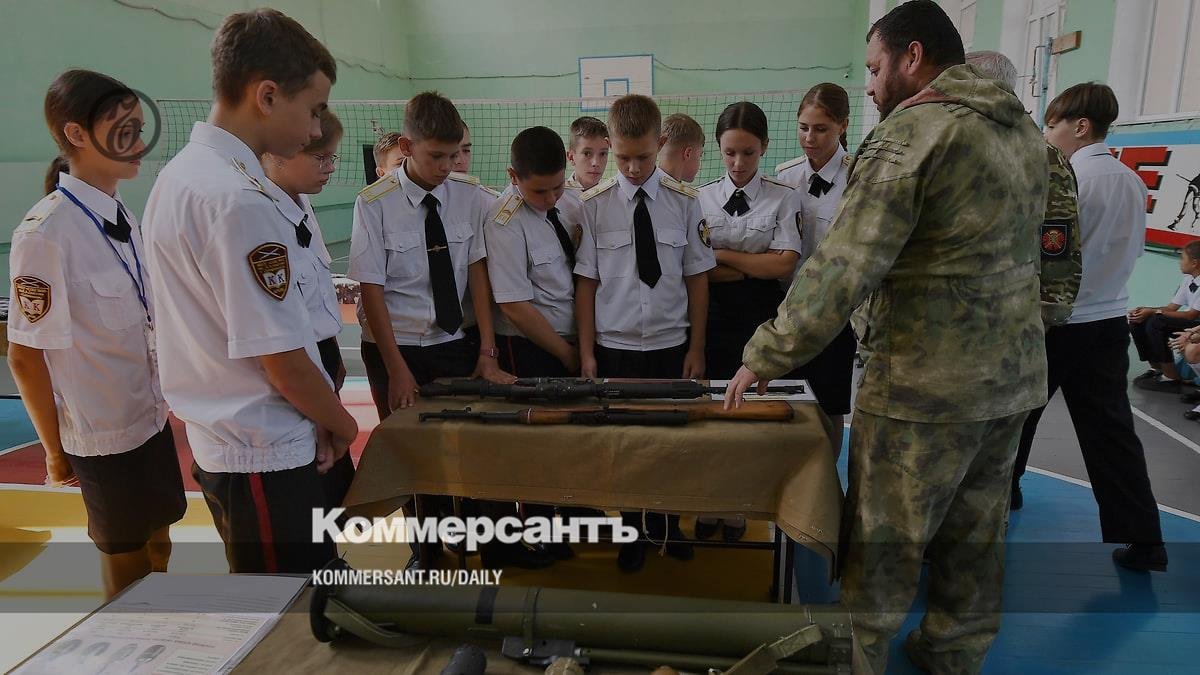
“Russian schools are starting to create museums dedicated to a special military operation. And at the same time, in almost every school there are graduates who participated or are now participating in the Northern Military District,” explained Mr. Myagkov. “Concerned students, primarily in high school, could take up the work of collecting the memories of their senior comrades, veterans of the Northern Military District. And not only them – the memories of people who are involved in volunteer activities or work at various enterprises are very important.” These records will become part of the exhibitions of the school museums of the Northern Military District, said the scientific director of the Russian Military Historical Society, and will also “serve as the basis for the post-war study of the Northern Military District” by professional historians.
The press service of the Ministry of Education and Science confirmed to Kommersant that the departmental working group has already approved the RVIO initiative.
It could become part of a project to create a People’s Digital Archive of a Special Military Operation (should begin work in the first quarter of 2027). “The Ministry of Education and Science considers it important for students of Russian universities to participate in the formation of a “living memory” of the historical events that we are witnessing,” the department said. “Many university students, their parents, friends, and relatives took part in hostilities, were volunteers, and supported our army in the rear. This must be recorded for transmission to future generations in a form that allows for the scientific processing of this valuable evidence.” Now the Ministry of Education and Science is “considering mechanisms for attracting students to this project.” The department added that Deputy Minister Konstantin Mogilevsky proposed inviting representatives of the Ministry of Education “to discuss this concept.” The press service of the Ministry of Education told Kommersant that they are not yet familiar with the initiative.
“The significance of these historical memories is simply enormous, including for future generations who will be brought up on the exploits of our today’s heroes,” Mikhail Myagkov told Kommersant. “And it is very important for today’s students to know about the heroism of their school’s graduates. This performs a vital educational function.” Kommersant asked Mr. Myagkov whether the authors of the idea discussed the possible damage to the psychological health of minors from talking about the realities of war. “Firstly, we are talking primarily about high school students,” emphasized the scientific director of the Russian Military Education Society. “Secondly, they will collect information about exploits, about some unusual and interesting cases. They will ask the soldiers why they went to the front, what motivated them to fight against the enemy. It seems to you that this is a difficult topic, but we see that teenagers have such a request, they themselves ask about SVO.” Mr. Myagkov also recalled that “in the Soviet school” meetings with veterans of the Great Patriotic War were normal practice.
“And why should we deprive modern schoolchildren of the opportunity to hear memories of incidents of heroism?” – summed up the scientific director of the RVIO.
Kommersant also clarified whether the public is afraid that frank stories from volunteers about the needs of the military that are not covered by the state could negatively affect the patriotic mood of schoolchildren. “Teenagers, one way or another, receive this information themselves,” said Mr. Myagkov. “Of course, such conversations can have different themes. But stories about what is missing are not the main thing. The main thing is why volunteers help the front.”
“I rather support this initiative, because we need to talk about the war. So that people understand how important it is that they live warm and dry. So that there is no more war,” volunteer Valentin, who helps several units, told Kommersant (he asked not to use his last name). “If schoolchildren ask me, I will tell them everything as it is.” I’ll tell you how much stuff you have to carry to the front, and why. But at the same time, I will explain that one cannot equate the Motherland with individual unworthy people who do not occupy their place. At all times, people helped the army – it’s important to convey this to the guys.”
“I think this is a good idea,” says Northern Military District veteran Sergei Shkurat, who lost his sight during the fighting. “Another thing is that there is discord between veteran and veteran – they can stumble upon a person who is severely mentally traumatized and drinks like crazy. Or the schoolchildren themselves might start arguing with the veteran, which would result in an ugly skirmish.”
Mr. Shkurat added that he is regularly invited to schools to give a “Lesson of Courage” and he tells students the whole truth about the war: “And how we lay under mortar fire, and how our comrades were gassed, and how I myself was wounded. The whole truth is 99% – of course, without the most terrible details. But children need to know what war is. Another thing is that in some schools they ask to talk less about the war and more about patriotism.”
“The idea of RVIO is sound. Materials and information of this kind need to be collected,” says publicist, author of the book “Storm Z” Daniil Tulenkov. “But they need to be collected from a wide range of sources.” Let them take information from everyone who is able to give it. And tell not only about the sweetness of victories, but also about the bitterness of defeats. Patriotic education is, first of all, accepting one’s history as it is, and not just admiring it. A one-sided approach leads to repeated steps on the rake, alas.”
Artem Drabkin, director of the “I Remember” Foundation for the Preservation of Historical Memory, recalls that in 2010 the “Nashi” movement launched a similar project – it invited schoolchildren to interview veterans of the Great Patriotic War. “Unfortunately, the majority of the guys were absolutely unprepared for such work. On the one hand, they followed a formal questionnaire – and very often received a fairly formal answer. And sometimes they simply behaved disgustingly during interviews,” recalls Mr. Drabkin. “Nevertheless, if they did not interfere with the person’s story, the result was very, very meaningful material.” The same mass formal survey of SVO participants will be of little use, the expert believes, so it is necessary to first find those guys who are really interested in this, and then immerse them in the context and teach them how to have a conversation. “But in any case, these should not be schoolchildren,” says Mr. Drabkin. “Any combat experience is a trauma for the psyche. And I think it’s wrong to allow children to have individual communication with a traumatized person. After all, this can leave an imprint on the child’s psyche.” According to the expert, it is best to involve students from history or pedagogical universities in such a project, “if they themselves are interested in it.”