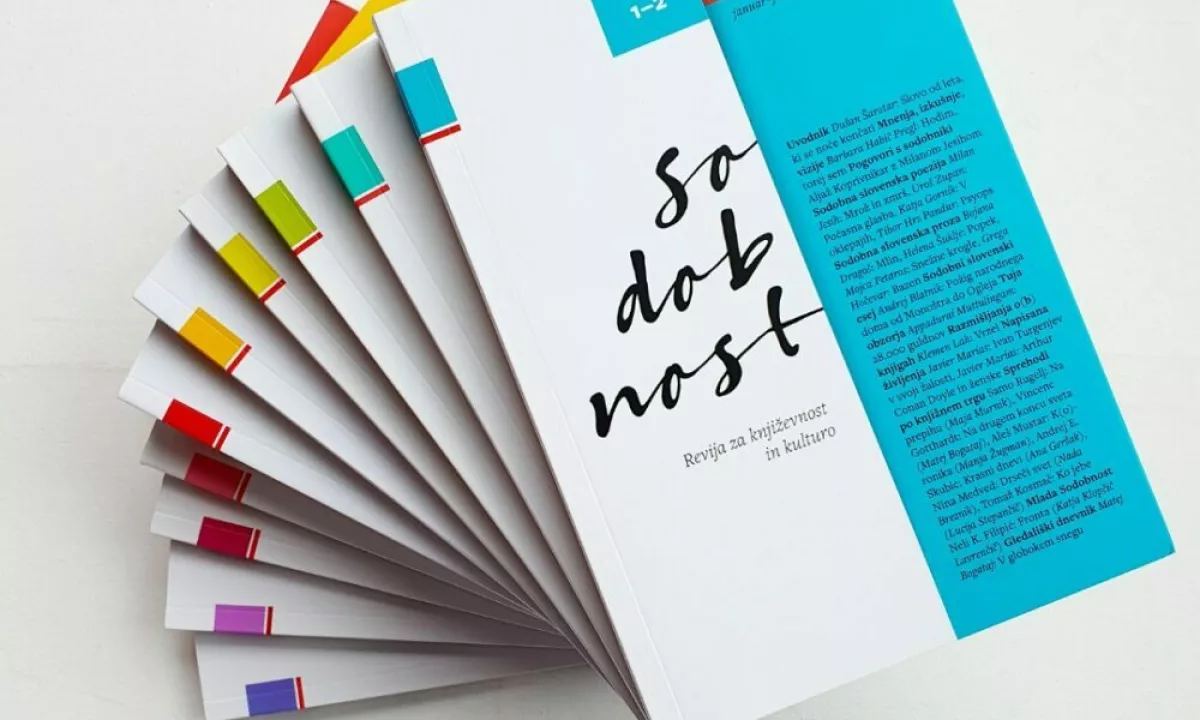
Sodobnost magazine has been published for ninety years. Photo: KUD Modernity
Modernity celebrated with readings, poetry and prizes
Sodobnost magazine is one of the oldest literary and cultural magazines in the world, and this year it celebrates its 90th anniversary. The anniversary was marked at KUD Sodobnost International with an all-day Spring meeting, a reading seminar, and the awarding of prizes for essays, short stories, and encouraging the joy of reading.
The traditional Spring Meeting of Modernity was held in the Old Town Power Plant in Ljubljana, which this year had a particularly solemn setting. The magazine Sodobnost, the oldest Slovenian magazine for literature and culture, is publishing its ninetieth year this year. It was first published in 1933, and its publication was interrupted only by the interwar years of cultural silence. The anniversary was marked at KUD Sodobnost International with an all-day program that combined reflection on reading, literature, poetry, music and the presentation of three awards.
The morning part of the meeting was devoted to a reading seminar for teachers and reading tutors. This year’s theme was Critical Reading and Empathy: From Deep Understanding of the Text to Understanding the Other. In front of a full hall, Dr. Igor Saksida, Ph.D. Sonja Pečjak, Ph.D. Katarina Lia Kompan Erzar and dr. Klemen Lah. They talked about reading culture, understanding literary texts, the role of artificial intelligence in reading and how books can also expand the ability to understand another person.
The seminar was not just about theory. The participants listened to conversations with young authors, the Croatian writer Silvija Šesta and the Italian writer Daniela Carucci, and special attention was drawn to the round table where the recipients of the Sunflower on the Shoulder award from Slovenia and abroad presented examples of good practices in promoting reading among young people. The morning program was concluded by storyteller Špela Frlic with an excerpt from Marie Vago’s young adult novel Olaf Dolgobrki, and the narration was accompanied by a projection of Federico Appel’s illustrations.
The evening part of the Spring Meeting was more literary and artistic. Poets of different generations performed: Boris A. Novak, Dušan Šarotar, Miriam Drev and Maša Ogrizek. It was the interweaving of their poetics that placed the evening in the broader framework of Sodobnosti as a magazine that has been bringing together different literary voices for decades. The musical part was provided by the guitar duo Aritmija with Indian guests, singer Sabiha Khan and tabla player Vinayak Netke, who came to Ljubljana after a tour in India.
Prize for the best essay and short story
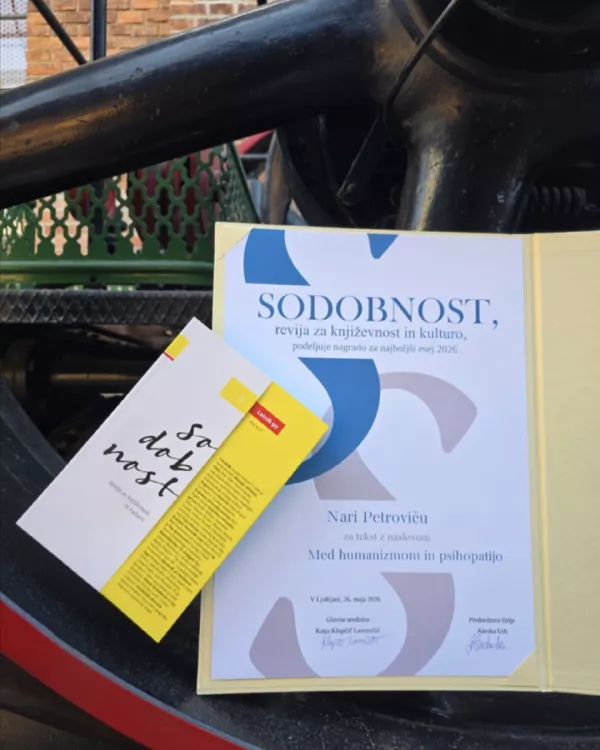
The central part of the evening was the presentation of awards. He received the prize for the best essay of 2026 Nara Petrovic for the essay Between Humanism and Psychopathy. This year, the jury, consisting of Evald Flisar, Urban Leskovar and president Alenka Urh, chose among 27 submitted texts and nominated twelve essays for the award. In the justification, she wrote that the award-winning essay, in a polished style and with playful figures of thought, contemplates the state of the modern world through the prism of so-called good psychopathy. Petrovič expands the starting points of psychologist Kevin Dutton into a reflection on the conflicts that shape societies and how much humanity can still be recognized in the modern world.
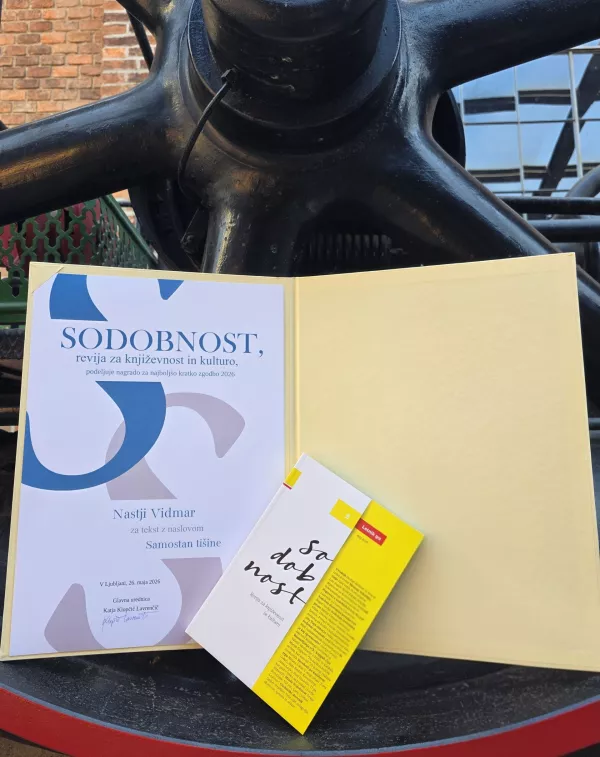
She received the prize for the best short story 2026 Nastja Vidmar for the Monastery of Silence. 116 short stories were submitted to the competition this year, and the jury consisting of Dušan Šarotar, Nada Breznik and Majda Travnik Vode nominated twelve of them for the prize. The award-winning story tells of a journey through Japan and an encounter with an old poet, but the journey in it is not only about moving through space, but above all an inner approach to silence, meaning and one’s own home. The jury described the story as poetic, spiritually open and narratively elegant.
The third set of awards was intended for those who not only understand reading as a cultural value, but also pass it on to children and young people on a daily basis. The sunflower on the shoulder award, which is part of the Our Little Library project, encourages the joy of reading among preschoolers and primary school children. This year is the eighteenth year of the project, and 420 kindergartens and schools, or more than 35,000 children, are involved in Slovenia alone. It also takes place in Croatia and Italy.
She received the Slovenian Sunflower on the Shoulder 2026 award Lidija Butinaprofessor of Slovenian at the Ljubljana Secondary School of Health. The jury highlighted her many years of work in encouraging reading among students and colleagues, especially the Reading Networking and Book Infusion project, within the framework of which students and professors prepare for meetings with Slovenian creators. At the school, which is attended by around a thousand students, she managed to place reading at the center of wider pedagogical and community events.
They received sunflowers on their shoulder awards Barbara Rocek Bregar from Primary School Lovrenc na Pohorje and Magdalena Svetina Terčon from Miroslav Vilhar Postojna Primary School. The former has been developing the school library for more than two decades as a place for creativity, reading and networking, while the latter, among other things, designed the book cart project, which brings books closer to even the youngest students, who have difficulty accessing the school library.
International awards were also presented. In Italy, where the prize is held under the name Un ponte di libri, Chiara Cavallaro received it for the Classe di lettori project. In Croatia, Sanda Buljat and Vedrana Marković from Remetinec Kindergarten received the prize, named the carp on the oak.
Sodobnosti’s spring meeting thus connected this year’s jubilee of the magazine with what has kept the magazine going for ninety years: with literature, reading and a community of people who still believe that a book is not just an object of cultural heritage, but a living space for understanding the world.