Tuesday, June 9, 2026
    The GeoStrategic Consensus
    No Result
    View All Result
    • Login
    • HOME
    • AMERICAS
      • Argentina
      • Brazil
      • Canada
      • Chile
      • Colombia
      • Costa Rica
      • Cuba
      • Dominican Republic
      • Ecuador
      • El Salvador
      • Greenland
      • Guatemala
      • Honduras
      • Mexico
      • Nicaragua
      • Panama
      • Paraguay
      • Peru
      • United States
      • Uruguay
      • Venezuela
    • ASIA-PACIFIC
      • Australia
      • Brunei Darussalam
      • Cambodia
      • China
      • Federated States of Micronesia
      • Fiji
      • Indonesia
      • Japan
      • Kiribati
      • Laos
      • Malaysia
      • Marshall Islands
      • Mongolia
      • Myanmar
      • Nauru
      • New Zealand
      • North Korea
      • Palau
      • Papua New Guinea
      • Philippines
      • Samoa
      • Singapore
      • Solomon Islands
      • South Korea
      • Taiwan
      • Thailand
      • Timor-Leste
      • Tonga
      • Tuvalu
      • Vanuatu
      • Vietnam
    • CARICOM
      • CARICOM – Non-English
        • Haiti
        • Suriname
      • CARICOM Associates
        • Anguilla
        • Bermuda
        • British-Virgin-Islands
        • Cayman-Islands
        • Curacao
        • Turks-and-Caicos
      • CARICOM English
        • Antigua and Barbuda
        • Barbados
        • Belize
        • Dominica
        • Grenada
        • Guyana
        • Jamaica
        • Montserrat
        • Saint Kitts and Nevis
        • Saint Lucia
        • Saint Vincent and the Grenadines
        • The Bahamas
        • Trinidad and Tobago
    • EURASIA
      • Armenia
      • Azerbaijan
      • Balarus
      • Georgia
      • Kazakhstan
      • Kyrgyzstan
      • Moldova
      • Russia
      • Tajikistan
      • Turkmenistan
      • Ukraine
      • Uzbekistan
    • EUROPE
      • Albania
      • Andorra
      • Austria
      • Bosnia and Herzegovina
      • Bulgaria
      • Croatia
      • Cyprus
      • Czech Republic
      • Denmark
      • Estonia
      • Finland
      • France
      • Germany
      • Greece
      • Holy See
      • Hungary
      • Iceland
      • Ireland
      • Italy
      • Kosovo
      • Latvia
      • Liechtenstein
      • Lithuania
      • Luxembourg
      • Malta
      • Monaco
      • Montenegro
      • Netherlands
      • North Macedonia
      • Norway
      • Poland
      • Portugal
      • Romania
      • San Marino
      • Serbia
      • Slovakia
      • Slovenia
      • Spain
      • Sweden
      • Switzerland
      • United Kingdom
    • MIDDLE EAST AND NORTH AFRICA
      • Algeria
      • Bahrain
      • Egypt
      • Iran
      • Iraq
      • Israel
      • Jordan
      • Kuwait
      • Lebanon
      • Lybia
      • Morocco
      • Oman
      • Palestinian Territories
      • Qatar
      • Saudi Arabia
      • Syria
      • Tunisia
      • Turkey
      • United Arab Emirates
      • Western Sahara
      • Yemen
    • SOUTH ASIA
      • Afghanistan
      • Bangladesh
      • Bhutan
      • India
      • Maldives
      • Nepal
      • Pakistan
      • Sri Lanka
    • SUB-SAHARAN AFRICA
      • Angola
      • Benin
      • Botswana
      • Burkina Faso
      • Burundi
      • Cabo Verde
      • Cameroon
      • Central African Republic
      • Chad
      • Comoros
      • Cote d’Ivoire
      • Democratic Republic of the Congo
      • Djibouti
      • Equatorial Guinea
      • Eritrea
      • Eswatini
      • Ethiopia
      • Gabon
      • Gambia
      • Ghana
      • Guinea
      • Guinea Bissau
      • Kenya
      • Lesotho
      • Liberia
      • Madagascar
      • Malawi
      • Mali
      • Mauritania
      • Mauritius
      • Mozambique
      • Namibia
      • Niger
      • Nigeria
      • Republic of the Congo
      • Rwanda
      • Sao Tome and Principe
      • Senegal
      • Seychelles
      • Sierra Leone
      • Somalia
      • South Africa
      • South Sudan
      • Sudan
      • Tanzania
      • Togo
      • Uganda
      • Zambia
      • Zimbabwe
    • HOME
    • AMERICAS
      • Argentina
      • Brazil
      • Canada
      • Chile
      • Colombia
      • Costa Rica
      • Cuba
      • Dominican Republic
      • Ecuador
      • El Salvador
      • Greenland
      • Guatemala
      • Honduras
      • Mexico
      • Nicaragua
      • Panama
      • Paraguay
      • Peru
      • United States
      • Uruguay
      • Venezuela
    • ASIA-PACIFIC
      • Australia
      • Brunei Darussalam
      • Cambodia
      • China
      • Federated States of Micronesia
      • Fiji
      • Indonesia
      • Japan
      • Kiribati
      • Laos
      • Malaysia
      • Marshall Islands
      • Mongolia
      • Myanmar
      • Nauru
      • New Zealand
      • North Korea
      • Palau
      • Papua New Guinea
      • Philippines
      • Samoa
      • Singapore
      • Solomon Islands
      • South Korea
      • Taiwan
      • Thailand
      • Timor-Leste
      • Tonga
      • Tuvalu
      • Vanuatu
      • Vietnam
    • CARICOM
      • CARICOM – Non-English
        • Haiti
        • Suriname
      • CARICOM Associates
        • Anguilla
        • Bermuda
        • British-Virgin-Islands
        • Cayman-Islands
        • Curacao
        • Turks-and-Caicos
      • CARICOM English
        • Antigua and Barbuda
        • Barbados
        • Belize
        • Dominica
        • Grenada
        • Guyana
        • Jamaica
        • Montserrat
        • Saint Kitts and Nevis
        • Saint Lucia
        • Saint Vincent and the Grenadines
        • The Bahamas
        • Trinidad and Tobago
    • EURASIA
      • Armenia
      • Azerbaijan
      • Balarus
      • Georgia
      • Kazakhstan
      • Kyrgyzstan
      • Moldova
      • Russia
      • Tajikistan
      • Turkmenistan
      • Ukraine
      • Uzbekistan
    • EUROPE
      • Albania
      • Andorra
      • Austria
      • Bosnia and Herzegovina
      • Bulgaria
      • Croatia
      • Cyprus
      • Czech Republic
      • Denmark
      • Estonia
      • Finland
      • France
      • Germany
      • Greece
      • Holy See
      • Hungary
      • Iceland
      • Ireland
      • Italy
      • Kosovo
      • Latvia
      • Liechtenstein
      • Lithuania
      • Luxembourg
      • Malta
      • Monaco
      • Montenegro
      • Netherlands
      • North Macedonia
      • Norway
      • Poland
      • Portugal
      • Romania
      • San Marino
      • Serbia
      • Slovakia
      • Slovenia
      • Spain
      • Sweden
      • Switzerland
      • United Kingdom
    • MIDDLE EAST AND NORTH AFRICA
      • Algeria
      • Bahrain
      • Egypt
      • Iran
      • Iraq
      • Israel
      • Jordan
      • Kuwait
      • Lebanon
      • Lybia
      • Morocco
      • Oman
      • Palestinian Territories
      • Qatar
      • Saudi Arabia
      • Syria
      • Tunisia
      • Turkey
      • United Arab Emirates
      • Western Sahara
      • Yemen
    • SOUTH ASIA
      • Afghanistan
      • Bangladesh
      • Bhutan
      • India
      • Maldives
      • Nepal
      • Pakistan
      • Sri Lanka
    • SUB-SAHARAN AFRICA
      • Angola
      • Benin
      • Botswana
      • Burkina Faso
      • Burundi
      • Cabo Verde
      • Cameroon
      • Central African Republic
      • Chad
      • Comoros
      • Cote d’Ivoire
      • Democratic Republic of the Congo
      • Djibouti
      • Equatorial Guinea
      • Eritrea
      • Eswatini
      • Ethiopia
      • Gabon
      • Gambia
      • Ghana
      • Guinea
      • Guinea Bissau
      • Kenya
      • Lesotho
      • Liberia
      • Madagascar
      • Malawi
      • Mali
      • Mauritania
      • Mauritius
      • Mozambique
      • Namibia
      • Niger
      • Nigeria
      • Republic of the Congo
      • Rwanda
      • Sao Tome and Principe
      • Senegal
      • Seychelles
      • Sierra Leone
      • Somalia
      • South Africa
      • South Sudan
      • Sudan
      • Tanzania
      • Togo
      • Uganda
      • Zambia
      • Zimbabwe
    No Result
    View All Result
    Agentially
    No Result
    View All Result
    Home ASIA-PACIFIC Papua New Guinea

    Going beyond studying journalism | The National

    The Analyst by The Analyst
    June 9, 2026
    in Papua New Guinea
    Going beyond studying journalism | The National


    CAREERS

    WHY do students enroll in university to study journalism or media?

    That is a good topic to research. It is also a good question that I often get answers to because I have taught students courses in journalism, media and communication for a few years now.

    READ ALSO

    Volunteers taking on critical role

    Funding, security concerns clouding elections

    And, it would be interesting to know the kind of answers that students give.

    Talking to students

    A few weeks ago I wrote a number of feature articles on journalism in Weekender, and that started with a talk that I gave to a journalism students’ society in one of our universities earlier this year.

    Particularly, that was during the launch for the Journalism Students Society (JSS) at the University of Papua New Guinea. Other journalism staff were also invited by JSS and encouraged the students to develop better study habits while in university.

    One staff urged students to look beyond the walls of the institution and plan on their career goals. It was an interesting time.

    The new students

    After the speeches, the new students were asked to get to the front of the lecture hall and say a few things about themselves and say why they chose to study journalism and public relations courses at UPNG.

    I should say that the students generally were good at expressing themselves – much better than I would have done had I been up there in my first year.

    It was a challenge for the first-year students but they were good. Only one or two were not so good in communicating their thoughts, and that was understandable.

    They would be just like me, when I thought about how I would be able to do that if I was in their shoes, and as a first-year student. (I was someone who never liked standing in front of a crowd and talking. I disliked that.)

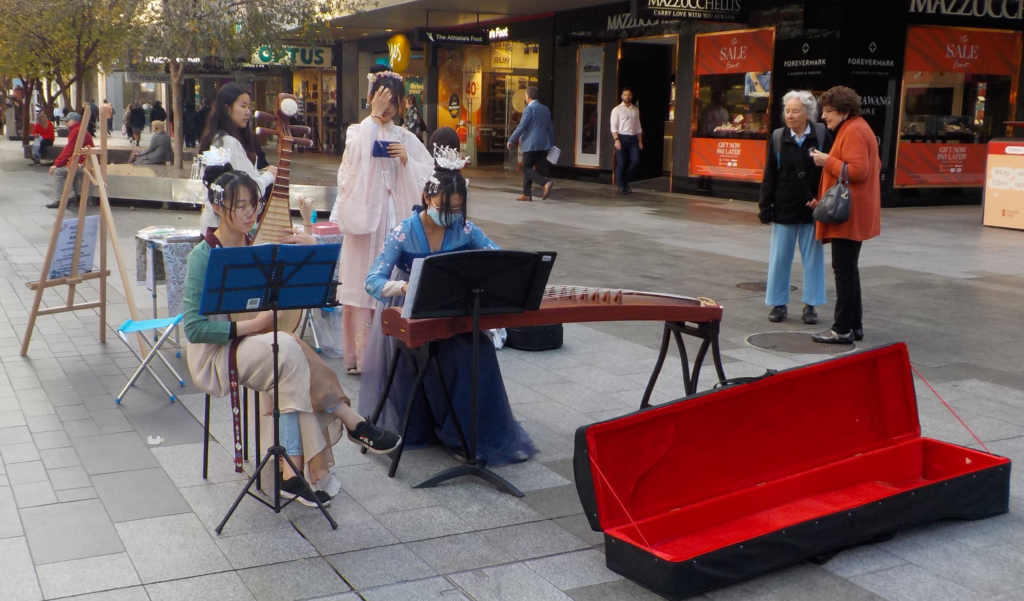
    Chinese students from a secondary school in Adelaide, South Australia, playing traditional instruments at Rundle Mall in June 2021 to entertain passersby and raise funds for their institution. – Pictures by THOMAS HUKAHU

    Aim was to do law

    One thing I noticed was surprising, and yet interesting.

    Among the new students, a handful of them said that their aim was to enroll at UPNG and do law but they did not make it so they decided to take journalism.

    That is to say the law school can only take a certain number of school leavers from the thousands who apply for first-year studies at UPNG.

    Sometime later, I made a point to students in class that if they wanted to study law, they could do that later. First, they have to complete their degree in journalism.

    I also stated that in other countries, like the United States, journalism is studied by people who have already got a first degree.

    The same is true for law as well. People who want to go to law school would have to complete a degree in another field before they started studies in law.

    Advice to students

    So, the advice to students who are studying journalism and who have the desire to do law is to first gain their degree in their field of studies.

    Later, they can go work for a few years and gain skills and habits in journalism, and then apply for studies in law.

    There are a few local PNG stories of practising journalists who later went on to study law. There is one at the National Broadcasting Corporation who did that not too long ago.

    I was recently told that there was another female radio broadcaster who was currently studying law at UPNG. So, the advice is practical in PNG.

    You can complete a first degree, not just in journalism, and later apply to study law.

    Key skills in journalism 

    Journalism, as a practice, teaches people essential skills in communication. Any graduate going out to work in media or journalism will hone valuable skills that are sought by different industries.

    There is a need for professionals to communicate effectively, in speaking and writing, and journalists who have spent at least a year in the field would have polished these skills.

    Additionally, journalists are good at expressing people’s thoughts on paper or explaining complex ideas in words, as in interviewing someone and writing about what they said.

    Such skills will enable a journalism graduate to perform exceptionally well in law or a number of other disciplines, should they want to pursue further studies in other academic areas.

    And, journalism students also study a course or two on ethics and principles of media law, which gives them a taste of related topics that are also covered in law.

    Someone’s unique choice

    The topic about students who had law as their number one choice but taking journalism instead is typical. I have heard that before.

    Not too long ago though, while teaching students at the Fiji National University, I had a student who was quite unique in his choice. We were in class and I was explaining something – possibly critical and analytical thinking – and I asked if any student in the group was a major in science while in high school.

    An Indo-Fijian student raised his hand and said he was a science student. Not only that, he had enrolled in science at the University of the South Pacific (USP) to do a bachelor’s degree in that field but decided to withdraw and enroll at FNU for the media and communication degree.

    “What is your reason for doing that, for leaving your science programme at USP?” I asked him.

    “I considered the job market,” he said. “I do not think there are enough jobs for science graduates in Fiji.”

    Mmm. That was an interesting answer, but logical.

    I was also aware that he could later get into science journalism or science communication once he graduated from FNU’s media and communication programme.

    That student with a unique choice has been progressing well in his studies and continues to top his courses. He is focused, and he knows why he made his uncommon choice. The future looks bright for him.

    Why become a journo?

    Sometimes journalism lecturers ask students this question in their first year of studies: “Why did you choose journalism?”

    I bring the same question to class and tell them that there are a couple of reasons why anyone should enroll for courses in journalism. That is to possibly motivate them, or advise them about their future.

    Some students may want to do journalism because they want to become “the voice of the voiceless”. They have a moral obligation to do that.

    They may have come from remote areas of the country and see the need to use their position in a media outlet to report on issues that have been ignored by the governments.

    Others may want to become famous. Having their by-lines in news articles regularly can make them popular with readers.

    And, there are a few who want to do law, but could not make it so they had to do a journalism programme instead.

    I also tell students that there maybe one or two who may want to write books later, as a novelist or scriptwriter.

    Journalism not only helps people hone their writing skills, it also helps them get into the habit of writing daily. That is a valuable habit that many knowledgeable people do not possess.

    Many journalists in other countries write books, whether fiction or non-fiction.

    My popular example is Ernest Hemingway, the American journalist who later became a novelist and short story writer. His fiction plots were based on his experiences as a journalist and ambulance driver.

    Appreciation for life

    There is something else that I find fulfilling as a freelance journalist, and could be useful for aspiring writers or reporters.

    When you write about people, places, programmes or pets or hobbies, you will appreciate life better.

    You will be interested in people, the places and the activities around you. You will then approach people and speak with them.

    You can also learn, if you watch people do things or make speeches. You will read books and articles as well.

    Consequently, you grow as a human being.

    That is one benefit of becoming a journalist, which is not often talked about.

    In your everyday life, you notice things, you observe the world around you, and then you can take out your camera and take photos.

    You can then use those photos to write stories to share with an audience or readers.

    That is essentially what I do, as I travel through different parts of PNG, or in Australia or the Pacific. I observe, and may get interested in an activity in a public space, and then start taking photos. Then I approach people and speak with them, and I may get a story from that talk.

    Last words

    It is my view that any student in university should take a course or two in journalism to help them develop their communication skills.

    Some universities include a lot of communication topics in their media or journalism programmes.

    Communication skills are vital in the industry, and particularly for those who are thinking of going into management or marketing.

    Leadership and management in organisations would require good communication skills and journalism can help senior staff acquire that.

    In marketing, communication skills are essential. If you cannot effectively communicate information about the products that your company offers, then you will not be in business for long.
    Source link

    Related Posts

    Volunteers taking on critical role
    Papua New Guinea

    Volunteers taking on critical role

    June 9, 2026
    Papua New Guinea

    Funding, security concerns clouding elections

    June 8, 2026
    A ride to North Shore surf spots
    Papua New Guinea

    A ride to North Shore surf spots

    June 8, 2026
    Papua New Guinea

    “This church is a tree of life”

    June 8, 2026
    City congregation to build a new, bigger church
    Papua New Guinea

    City congregation to build a new, bigger church

    June 8, 2026
    Papua New Guinea

    Vipers, Dabaris face off in under-19 finale

    June 8, 2026
    Next Post
    Police flag drug-linked HIV cases

    Police flag drug-linked HIV cases

    POPULAR NEWS

    Team Bahamas to play at home | Sports

    Team Bahamas to play at home | Sports

    June 8, 2026
    Poilievre says those who vote for Alberta separation ‘are not our enemies’

    Poilievre says those who vote for Alberta separation ‘are not our enemies’

    June 8, 2026
    Fatal wingsuit accident in Vättis

    Fatal wingsuit accident in Vättis

    June 8, 2026
    Internal elections: these are the winners of ANR in Central, according to TREP – Politics

    Internal elections: these are the winners of ANR in Central, according to TREP – Politics

    June 8, 2026
    Al-Riyadh newspaper | OPEC+ continues to adjust voluntary production by 188 thousand barrels per day

    Al-Riyadh newspaper | OPEC+ continues to adjust voluntary production by 188 thousand barrels per day

    June 9, 2026

    EDITOR'S PICK

    Allegations against MP prompt scrutiny of leaders’ conduct

    Allegations against MP prompt scrutiny of leaders’ conduct

    June 9, 2026

    Invisible and uncounted: being deafblind in Lithuania

    June 8, 2026

    Ricardo Simões Ferreira

    June 8, 2026

    The Jews are leaving the entity – Al-Alam: Al-Khabar

    June 8, 2026

    Recent Posts

    • Al-Riyadh newspaper | OPEC+ continues to adjust voluntary production by 188 thousand barrels per day
    • Dh25,000 savings per claim: FTA expands scope for VAT refund for UAE citizens
    • “Apple” changes the rules of the game with “iPadOS 27”
    • Iran Suspends Military Operation Against Israel After Trump’s Request, Warns of Forceful Response if Lebanon Is Attacked

      © 2026 Agentially - Navigating shifting sovereignties and global risk .

      Welcome Back!

      Login to your account below

      Forgotten Password?

      Retrieve your password

      Please enter your username or email address to reset your password.

      Log In
      No Result
      View All Result

        © 2026 Agentially - Navigating shifting sovereignties and global risk .

        This website uses cookies. By continuing to use this website you are giving consent to cookies being used. Visit our Privacy and Cookie Policy.