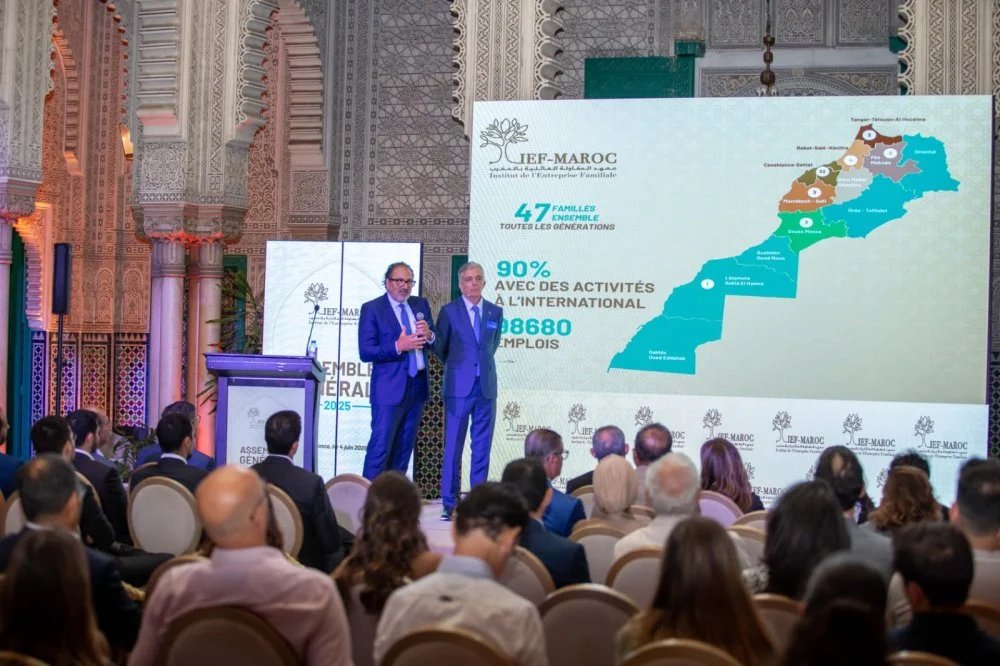
92.9% of companies active in Morocco are family businesses. They employ around 6.3 million people, or 65% of the private sector workforce, and contribute 60.5% to national added value. These figures, established for the first time on a rigorous scientific basis, are the main lessons of the study “Family business in Morocco in figures”, conducted by the Family Business Institute of Morocco (IEF-Morocco) with the support of the International Finance Corporation (IFC)branch of the Group World Bank dedicated to private sector.
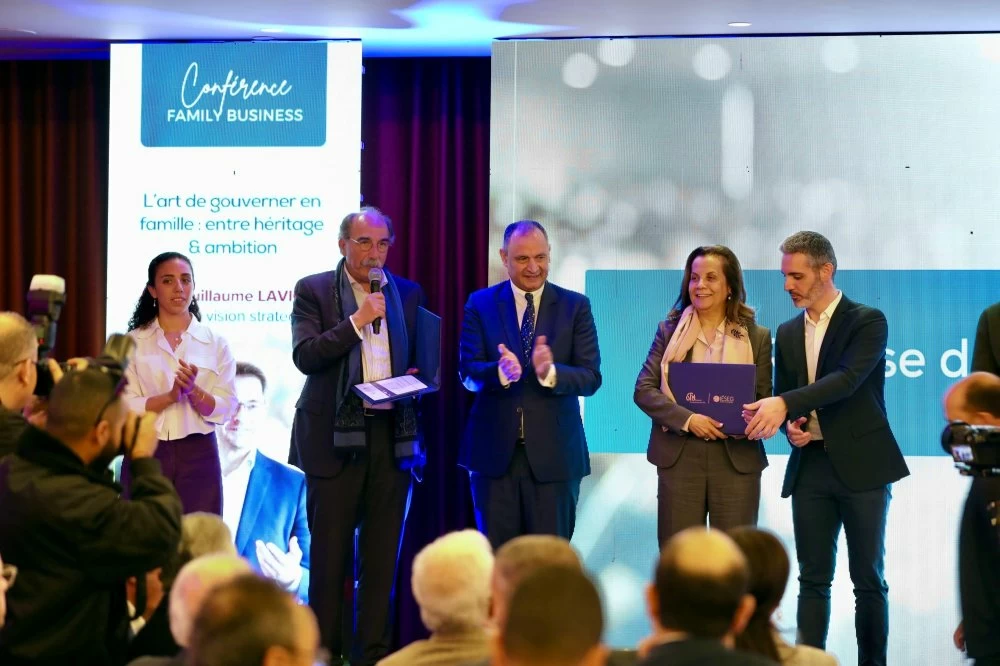
It was in the solemn setting of the Palais du Méchouar in Casablanca that these results were made public, during a conference under the theme “The real weight of family businesses, the invisible part”. The room brought together leaders of Moroccan family groups, international experts, representatives of public authorities and financial institutions, as well as academic researchers. The event was also marked by the signing of an agreement between IEF-Maroc and Maroc PME, relating to the deployment of a specific support system for the transfer of family businesses.
A new methodology to quantify the invisible
“We knew it was big,” admitted Casillas Bueno during his presentation. Now we can read the exact number of family businesses in Morocco.” The study thus fills a documentary gap that players in the sector have long deplored: Morocco had abundant statistics on its VSEs and SMEs, but until now no aggregated data made it possible to specifically identify and quantify the family component of the national economic fabric.
In terms of productivity, the results are a surprise. Although family businesses incur significantly lower labor costs than their non-family counterparts, 233 versus 459 in average cost per employee, they have a higher revenue/labor cost ratio: 10.78 versus 8.51. They therefore produce more value per unit of salary cost, which reflects a structural operational efficiency that the study attributes in particular to internal cohesion, the long-term horizon and the specific commitment of family teams.
Transmission, existential challenge of Moroccan family capitalism
It is precisely this challenge that Kacem Bennani-Smirespresident of IEF-Morocco, placed this at the heart of his opening speech. “The family business is not measured solely by the quest for profit,” he said. It is also measured by its ability to transmit and disseminate values over the long term.” Evoking the concrete risks of poorly prepared transmission, “families, jobs, know-how sometimes transmitted over several generations”, he pleaded for collective awareness. “We must support all family businesses so that they become aware of the issues and good practices. Becoming aware is not easy. But it’s even less easy when you haven’t done it and the inevitable happens.”
Cheick-Oumar Syllaregional director of the IFC for North Africa and the Horn of Africa, agreed with this by underlining the memory and identity issue of transmission. “When a transmission fails, it is a part of family history, intimately linked to the history of Morocco, which disappears,” he said. A partner of the study since its conception, the IFC intends to extend this dynamic across the African continent, by making support for family businesses one of the structuring axes of its regional strategy for the coming years. Sylla also announced that the IFC had significantly increased, over the last three years, its capital participations in large Moroccan companies, an orientation that he intends to accentuate.
Towards the rise of family businesses
Ryad MezzourMinister of Industry and Commerce, for his part invited family bosses to take a strategic step: that of technological upgrading and international projection. “If you have succeeded in doing business in this country, you can succeed anywhere else,” he said. He insisted on the ongoing technological disruption, the removal of barriers to innovation, easier access to global markets, the rise of digital twins and artificial intelligence, and called on family entrepreneurs to “search for value” beyond their traditional model. “The real battle is in creating value. Go research by creating new models,” he urged, while recognizing that the challenges of financing and support remain real.
The conference also brought together leaders of multi-generational family businesses, including Mohamed Laghrari, third-generation president of the ALH Holding Group, and Jose Manuel Sirvent, twelfth-generation president of the Confectionary Holding Group, as well as Jesús Casado, secretary general of European Family Businesses, and Anouar Alaoui Ismaïli, general manager of Maroc PME. These interventions gave substance, beyond statistics, to the concrete trajectories that the study precisely seeks to document and encourage.
At the end of the evening, the signing of the IEF-Morocco/Maroc PME agreement materialized the first institutional response to the findings of the study: a structured transfer support system, targeting family businesses engaged in a succession process. A first step, according to Mr. Bennani-Smires, in what he describes as a long-term project. “We are here to better understand, better support, better prepare for business life, preserve the essential parts of our national heritage and pass them on to the next generation.”