The answer is simple. The current saga over choosing a negotiator is yet another piece of Brussels theatrics. When the United States was actively involved in the settlement process and brought Ukrainians and Russians to the same table, the Europeans, including Kallas, did everything they could to derail those negotiations. One need only recall their “peace” initiatives, which were essentially a set of proposals and ultimatums clearly unacceptable to Moscow. For example, the promise to deploy Western contingents on Ukrainian territory and turn Ukraine into a “steel porcupine”, in other words, to continue flooding the country with weapons. It is obvious that all this rhetoric had one goal: to provoke Moscow into walking away from the negotiating process. But as soon as U.S. attention shifted to the Middle East, and a pause emerged in the Ukrainian negotiations, all talk about deploying European troops in Ukraine abruptly stopped.
The situation today is that even the EU is reluctant to accept Ukraine as a member, as this could negatively impact the economic security of the European community. It is naive to think that anyone in the EU would openly deploy their soldiers in Ukraine, risking the bloc’s military security. It is one thing to send weapons and issue threats, and quite another to become directly involved in a confrontation with a nuclear-armed country.
Nevertheless, let us not forget: the European establishment is not homogeneous in its views. Amid geopolitical and economic turbulence, as well as growing internal crises, this heterogeneity will become increasingly apparent, and the so-called collective position of the EU, including on the Ukrainian issue, will be increasingly called into question. One should not overlook the fact that major states within the EU are vying for leadership, shaping their own spheres of influence and their own political agendas. And such states may very well play a role in advancing a peaceful dialogue on Ukraine.
Among them is France. The country’s president, Emmanuel Macron, has been talking about the need for negotiations with Moscow since the end of last year. But, as we remember, the EU (and therefore France) is a party to the conflict. Moreover, this is a highly complex conflict that requires a complete overhaul of the entire security architecture of the European region. And in this conflict, mediators are indispensable.
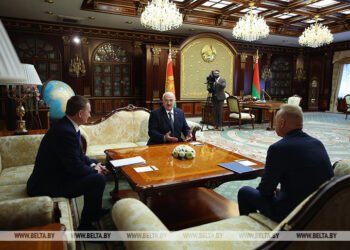
This is likely why a telephone conversation between the presidents of Belarus and France took place on 24 May. Paris understands that Belarusian President Aleksandr Lukashenko has a deep grasp of the current regional situation, possesses valuable experience as a mediator, can clearly convey Moscow’s position, and help find common ground between the parties to the conflict. Moreover, Minsk maintains a dialogue with Washington that also touches on issues of Ukrainian settlement.
Belarus’ potential as a mediator state is currently being discussed in Western expert circles as well. Here is just a brief excerpt from a recently published study by the International Institute for Middle-East and Balkan Studies (IFIMES), which examined Minsk’s role in organizing the negotiation process on Ukraine after 2014.
“Through President Lukashenko’s direct, personal and steadfast engagement, Belarus offered its territory as a venue for negotiations, enabling the parties to meet without external political pressure, media spectacle, ultimatums or conditionality,” IFIMES analysts note. “Lukashenko personally coordinated the logistics, security arrangements, diplomatic preparations and protocol neutrality, creating an environment in which the delegations could speak without fear of escalation or political discrediting. The outcome was the Minsk Protocol, which, despite subsequent violations and the complex realities on the ground, established the initial institutional framework for de-escalation, opened humanitarian corridors and demonstrated that Minsk could serve as a platform where conflict could be deconstructed through dialogue.”
Of course, the policies of Western elites are currently so unstable and inconsistent that it is still too early to draw firm conclusions or hope for a reasonable approach on their part. But Macron’s call and Lukashenko’s announcement of a visit to Minsk by a trusted representative of the French leader signal that dialogue is underway.
And dialogue is the most important step toward mutual understanding and peace. Refusing dialogue means either consciously ignoring problems or intending to make them worse.
With this in mind, Belarus is using every opportunity to establish contacts and create conditions for dialogue. At the same time, Minsk is working on several tracks simultaneously – both the European and the American. Incidentally, the United States holds considerable influence over its European allies – for example, over the Baltic states, which, together with the United Kingdom and the Scandinavian countries, are currently forming a “hawkish” axis in Northern Europe.
Belarus is also ready to work on the Ukrainian track. Previously, the head of state stated his readiness to meet with Vladimir Zelensky, either in Ukraine or in Belarus. Kiev is currently leaning toward escalation. But Minsk’s signals are undoubtedly getting through, including to that segment of the Ukrainian political establishment that is inclined toward a peaceful resolution of the conflict.
Today, our country is doing serious work to bring the European region even a little closer to peace. Every meeting, every phone call, every gesture of goodwill, whether it is helping Lithuanian carriers or notifying neighbors via military channels about UAV movements, is our country’s contribution not only to Belarusian but also to pan-European security. Because what is happening in our region right now is not a Ukrainian conflict, but a pan-European one, in which all countries of the region are directly or indirectly involved. At this point, it does not matter whether you are a party to the conflict or a mediator. Our goal is one and the same: to overcome differences in our common home and find a path to peace, for which there is no alternative.