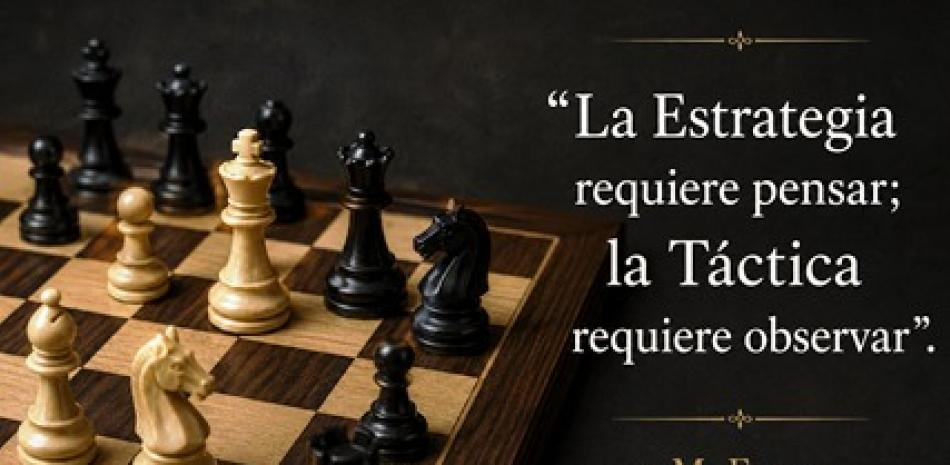
Students and fans in general constantly ask about the concept of Strategy in chess, due to its confusion with Tactics, chess language terms used to define positions in the game.
To explain these concepts nothing better than to quote the former world champion Max Euwe who expressed: “Strategy requires thinking; tactics requires observing.”
On the other hand, Master S. Tartakower said: “Tactics is knowing what to do when there is something to do; Strategy is knowing what to do when there is nothing to do.”
Summarizing more clearly we can affirm that Strategy in chess is the formulation of a long-term plan based on the evaluation of the position to improve one’s own pieces and exploit the opponent’s weaknesses. Unlike tactics, which deals with immediate moves and specific combinations of strength, Strategy defines the general direction of the game and is closely linked to the Pawn Structure.
The chess player who wishes to progress in the subject of Strategy should study games by: JR Capablanca, A. Rubinstein, A. Nimzowitsch, T. Petrosian and A. Karpov. Their games show very clearly how to create, increase and exploit strategic advantages without relying primarily on spectacular tactical combinations. For many Trainers, Karpov and Petrosian represent the pinnacle of classical strategic chess.
Pillars of the Strategy:
a) Security of the king: Evaluate how protected your own monarch and that of the opponent are against possible attacks.
b) Pawn structure: Defines the skeleton of the board and determines the strong, weak squares, isolated, delayed or passed pawns.
c) Piece activity: Place the pieces in optimal squares where they control the greatest amount of space.
d) Space: The control of territory that limits or facilitates the maneuverability of armies.
e) Material: The numerical balance and the relative value of the pieces present on the board.
Some strategic aspects to evaluate positions.
1.-The first element to evaluate the position of a game is the safety of the King.
2.-The Pawn structure is the best indicator to classify positions and develop strategic plans.
3.-“Weak squares” is a fundamental term in Positional Play and Pawn movements are closely related to the creation of these weaknesses.
4.-The best castling situation occurs when the Pawns in front of the King are in their initial position.
5.-It is dangerous to open columns against one’s own castling. Sometimes it is better to refuse to win a Pawn if it leads to the opening of one of these files.
6.-In a castling with “fianchetto” it is vital to maintain the defending Bishop.
7.-Positions with castling on different flanks are comparable to a race to reach the enemy King first to attack. Every time is vital.
8.-Knowing which piece to change and when to do it is part of the player’s skill; Assess at the time of change, which piece is more functional.
9.-We must place the Knights in centralized positions because this way they dominate more squares than being placed at the ends of the board.
10.-If we have an isolated Pawn, we must try to conserve the pieces and not simplify the position.
11.-The backward Pawn is one that has been left behind and defenseless, and if it is located in an open file it constitutes a great weakness.
12.-A typical procedure in the fight against the backward Pawn is the attack with the Rooks doubled on that file
13.-The Knight is the best piece that can be placed on the square in front of a backward Pawn.
14.-The strength of a passed Pawn becomes more evident in the Endgame once some of the pieces have been simplified. On the contrary, in the Middle Game the priority should be concentrated on the activity of the pieces and the safety of the King.
15.-We must try not to advance a passed Pawn too much if it does not have the protection of the pieces.
16.-The enemy passed Pawn must be blocked and the most appropriate piece for this is the Knight because it blocks and at the same time can attack the defenders of that Pawn.
17.-The objective of a majority of Pawns is to create a passed Pawn that can promote and become a major piece.
18.-The majority of Pawns on the Queen side are more valuable than on the King side because the Kings are far away and, likewise, there is no danger of advancing it in the Middlegame.
19.-The pair of Bishops constitutes an advantage in open positions and in the Endgame.
20.-In an Endgame with a pair of Bishops against Bishop and Knight, the activity of the opposing Bishop and Knight must be limited and the King must penetrate through the squares different from the color of the opposing Bishop.