Economy Online, Amir Mohammad Hosseini: With Israel’s response to this attack, the ceasefire between Iran and the United States went to the end, but the exchange of fire ended in less than 24 hours. On the one hand, the central headquarters of Khatam al-Anbiya and on the other hand, Israel announced that the operation was over. Of course, informed sources say that the stoppage of Israel’s attacks on Iran was due to the pressure of the American President Donald Trump. It is as if Trump was so unhappy with the start of the conflict that he announced to America not to help Israel in intercepting Iran’s missiles.
Knowledgeable sources have told Ekhzton Online that the initial understanding of the end of the war between Iran and the United States is nearing its final stages, and Trump’s attempt to re-establish a ceasefire was probably in this direction.
Where did the conflict start?
The spark of the one-day conflict was struck when the Israeli forces once again targeted the Dahiya area in the south of Beirut with their heavy attacks.
Nawaf Salam, the Prime Minister of Lebanon, had previously revealed that Israel has bombed Lebanon’s airspace and soil nearly 3,500 times since the announcement of reconciliation in Farvardin, and has upset the entire balance of stability.
However, with the bombing of Dahiya, the IRGC, which had previously warned that the continuation of the attack on Dahiya means a clear violation of the ceasefire and will respond directly to it, started missile attacks.
According to field reports, the Iranian army fired a total of 20 to 24 ballistic missiles at Israeli positions until noon on Monday. At the same time, Yemen’s Ansarullah movement also fired a missile at Israel and announced that the Bab al-Mandab strait will be closed to Israeli and related ships from now on.
Tel Aviv’s response and the strategy of hitting the infrastructure
Israel responded to Iran’s missile attacks on Monday morning. Even though Donald Trump openly said that he was not satisfied with Israel’s attack on Dahiya and also asked them not to react to Iran’s attack.
However, Netanyahu did not comply with Trump’s demands and targeted 20 points on Iranian soil based on Israeli claims. Among the most important of these targets was the Bandar Mahshahr petrochemical complex in southwestern Iran. Tel Aviv military officials claimed that the facility produced unique raw materials for ballistic missiles.
On the other hand, the Islamic Revolutionary Guard Corps confirmed that two projectiles hit the Karun Mahshahr Petrochemical, and announced that in a countermeasure, the petrochemical industries of Haifa port in Israel were targeted by their missile attacks and emphasized that playing with the region’s energy security will have dire consequences for Tel Aviv.
On the other hand, international media reported that the sound of air defenses and explosions were heard in the cities of Tehran, Isfahan, Karaj, Shahrari and Tabriz. Iran’s aviation authorities also quickly canceled flights to Mehrabad, Imam Khomeini and Shiraz airports. The Israeli army claimed to have destroyed Iran’s strategic defense systems that were rebuilt after the conflicts of last summer; A claim that was not confirmed by Iran’s internal sources and official news agencies announced that there were no hits or explosions in places like Shiraz Airport.
Iranian Red Crescent Society also officially announced that despite the projectiles hitting 12 places in the country, no casualties or injuries were recorded and the rescue forces are in full readiness. This statistic was far from Israel’s claim of attacking 20 points in Iran.
Message-driven deterrence logic
From an analytical point of view, the recent conflict can be evaluated in the framework of message-oriented deterrence theory. In this behavioral model, rather than being designed with the aim of directly protecting the borders, military actions are implemented with the aim of sending valid signals to the opposite party.
With its immediate missile response to the ceasefire violation in Lebanon, Iran showed that it insists on its red lines. But the inherent characteristic of this type of deterrence is the reproduction of the retaliatory cycle. Because the other side is forced to respond inside Iran’s territory to maintain its political and military credibility.
This unstable balance of threat defines security not through the reduction of risk, but through the mutual distribution of vulnerability. The fact is that continuing the path of exchange of fire is exactly the strategy that the radical currents in Israel need to deviate from the path of diplomacy.
The more the flame of direct military conflicts between Tehran and Tel Aviv spreads, the more diplomatic windows will be closed and the cost of reconciliation will be heavier for the parties. Therefore, by announcing the official end of its operations through the Khatam al-Anbiya headquarters, Iran showed that it does not want to consciously move to a higher level of attrition conflict and prefers to keep its message of power at the same controlled level. Especially, based on unofficial news and signals from Trump, the initial understanding is very close.
The continuation of diplomacy and the horizon of agreement
According to the report of Economy Online, the biggest surprise of this 24-hour conflict was the speed of the arrival and role of the President of the United States, Donald Trump.
Finally, the White House’s pressure to end the conflict had a significant effect. In a post on his social network, Trump announced that Iran and Israel should immediately stop firing and claimed that final negotiations are underway to achieve an immediate peace; However, he stressed that the naval blockade of Iran will continue until the signing of the final agreement. At the same time, British Prime Minister Keir Starmer also called for an immediate return to the negotiating table and a permanent ceasefire.
It seems that this exchange of fire not only did not destroy the negotiation table, but as a facilitator, it made the necessity of reaching an agreement clearer for the parties. It is as if the consequences of the war will become clearer for the parties as the conflict continues.
what will happen
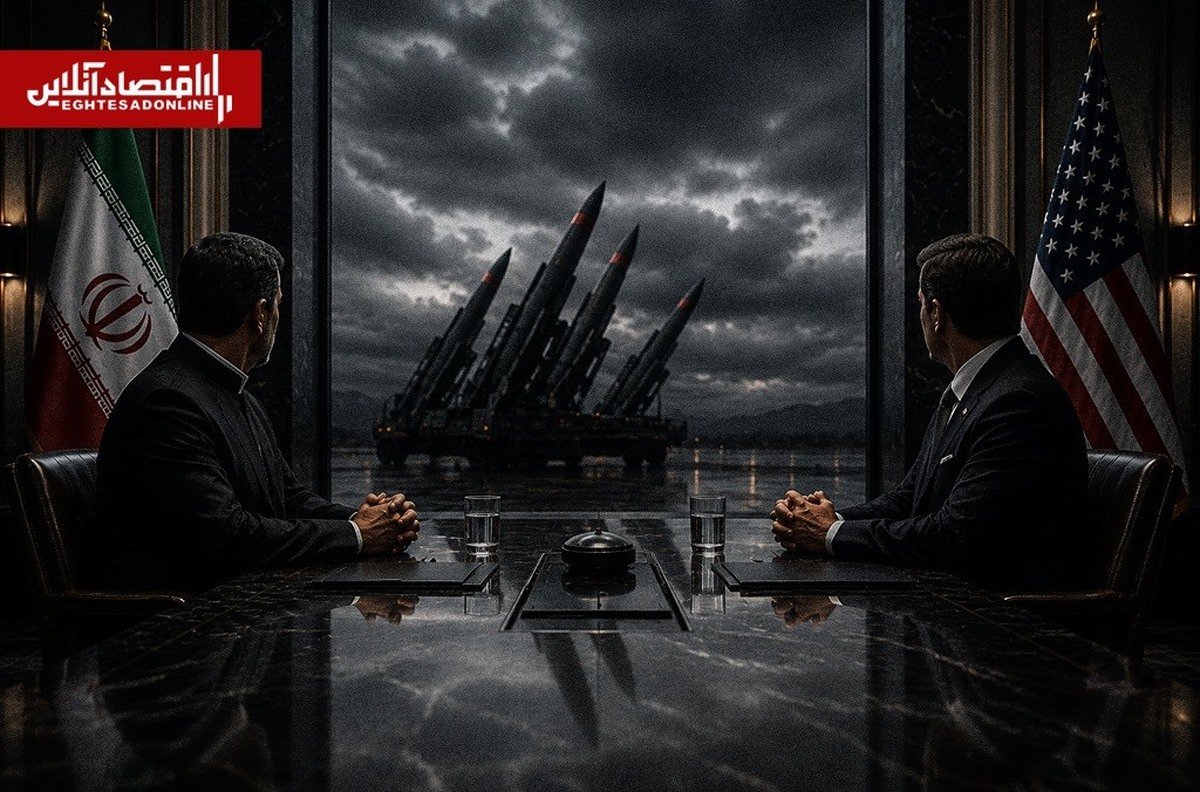
While the trumpets of war in the region have been silenced temporarily, the eyes are again on Tehran and Washington.
If the diplomatic channels between Tehran and Washington, which Trump has also mentioned, can overcome the differences, this one-day conflict could be the last roar of missiles before a major strategic turn towards reducing tension and signing a preliminary understanding. However, despite the presence of Israel and the continuation of attacks on southern Lebanon, even if an initial understanding is reached, there will be a tortuous path to reach a comprehensive and stable agreement between Iran and the United States.