EL PAÍS offers the América Futura section openly for its daily and global information contribution on sustainable development. If you want to support our journalism, subscribe here.
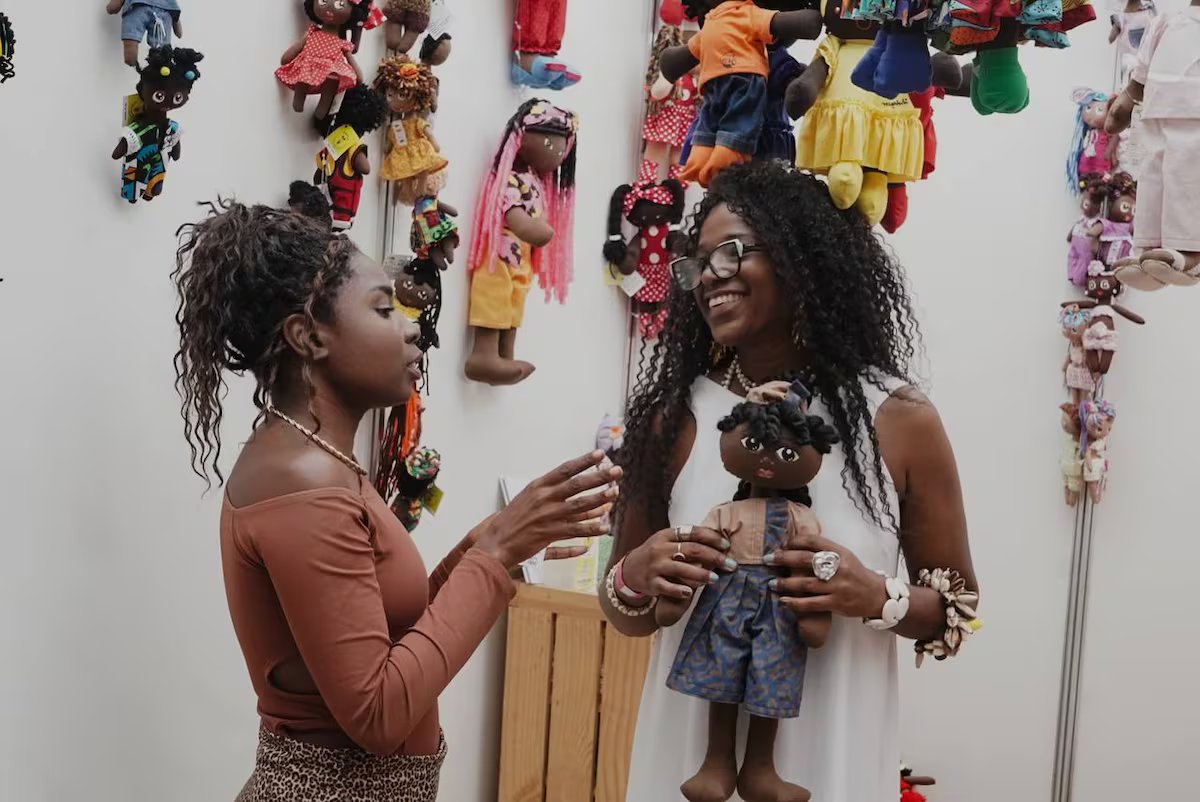
On the shores of the bay of Rio de Janeiro, in the neighborhood known as Little Africa and very close to the ruins of the Valongo pier, the place where millions of enslaved Africans landedthe Feira Preta (the black fair) was held last weekend, the largest event dedicated to black entrepreneurs in Latin America. More than 30,000 visitors, hundreds of exhibitors, conferences and debates and an example of articulation and strategy that small Afro businessmen from neighboring countries look at with healthy envy.
“We want to tell a new story. The history of the African diaspora in Brazil is not only a story of pain, it is a story of power, of royalty, of joy, of knowledge, of intellectuality. The fair is to show just that,” he explained to América Futura Adriana Barbosathe founder and director of the meeting. Talking to her without interruptions is not easy, every so often someone approaches her to thank her, express their admiration, ask for a photo or simply give her a hug. Recently chosen as one of the 500 most influential people in Latin America, she has woven a network that not long ago sounded like a utopia.

It all started more than 20 years ago with a small stall selling second-hand clothes in a small square in São Paulo. It was, as in so many other cases, “survival economics,” he says. Since then the Feira Preta grew until it became an institution, the meeting point of small black brazilian businessmenthe place where not only products are sold (clothing, jewelry, crafts, accessories, cosmetics, food…) but also experiences are exchanged and common challenges are addressed. In just three days some eight million reais (almost 1.6 million dollars) have been moved, but the work extends throughout the year. The Feira Preta Institute raises resources in the financial market to distribute them among microentrepreneurs, and periodically carries out studies to influence public policies.
The potential of the Feira Preta as a laboratory for successful experiences entered the radar of the Development Bank of Latin America and the Caribbean, CAFwhich last year invested half a million dollars to support small businesses and financed a survey on the profile of black entrepreneurs in Argentina, Brazil, Colombia, Panama and Peru. After 3,000 interviews, it was concluded, for example, that access to credit is the biggest obstacle.
In Brazil, 44% of requests made by black entrepreneurs were denied, compared to 29% among whites. Almost 60% of the businesses analyzed were created during the pandemic, due to the urgency of extra income, and in the Afro-Latin ecosystem, women are the absolute queens of entrepreneurship, 80% of the businesses are led by them. Barbosa adds another point: money management in the Afro economy is more distributive and more communal. “The money that Aunt María earns selling what she cooks will benefit her and her community, it is a vision of the economy that is not so much about concentration, and that comes from the African worldview, from the community, from the tribe.”
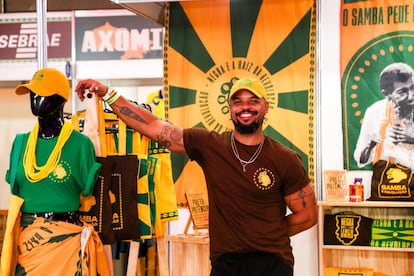
The challenge of access to credit focused much of the talks. It is a challenge for first-time or low-income entrepreneurs, which is aggravated in the case of black people due to the racial discrimination that persists in financial institutions. Barbosa highlights that the banking rates of black Brazilians have increased in recent years largely thanks to digital banks, where skin color a priori is not a visible barrier, but in exchange other problems have arisen, such as algorithmic racism. “We have data that shows that a bank did not approve a number of entrepreneurs that we had selected because its system discriminates by zip code, it separates the majority of peripheral regions, which is where the black population is, for the most part.” Living in a favela or in a neighborhood on the outskirts adds points in the scorethe tool that tells banks the probability that you are going to pay the loan installments up to date.
The Feira Preta is the place to discuss these issues and where to provoke public power to create specific policies, not only guided by the welfare perspective that predominated over the last decades, says Barbosa. Improving financial education, for example, is key. Another challenge is to gain muscle, move on to the next phase. The “black economy,” as Barbosa says, is still basically family-sized. “We still have few entrepreneurs who produce on an industrial scale, that structure has to be broken. In a country with half the black population, wasting all that talent, that potential, is idiotic,” highlights Barbosa. Despite the progress of recent years, there are many sectors in which diversity is still conspicuous by its absence, especially in the highest echelons of the pyramid.
The rest of Latin America pays close attention to what is happening in Brazil, and in that edition of the Feira Preta there were black entrepreneurs invited from Panama, Colombia and Argentina. One of them, the Panamanian Jean Quijano, founder and creative director of the clothing brand Jean Decort, highlighted the importance of events of this type not only on an economic level, but also for their representativeness and motivational drive: “Seeing people like you who have the same mission as you inspires, you say… look at what is happening in Brazil, we can bring it here. From individualism we can’t do anything, with the community we can have more prominence and achieve bigger things.”