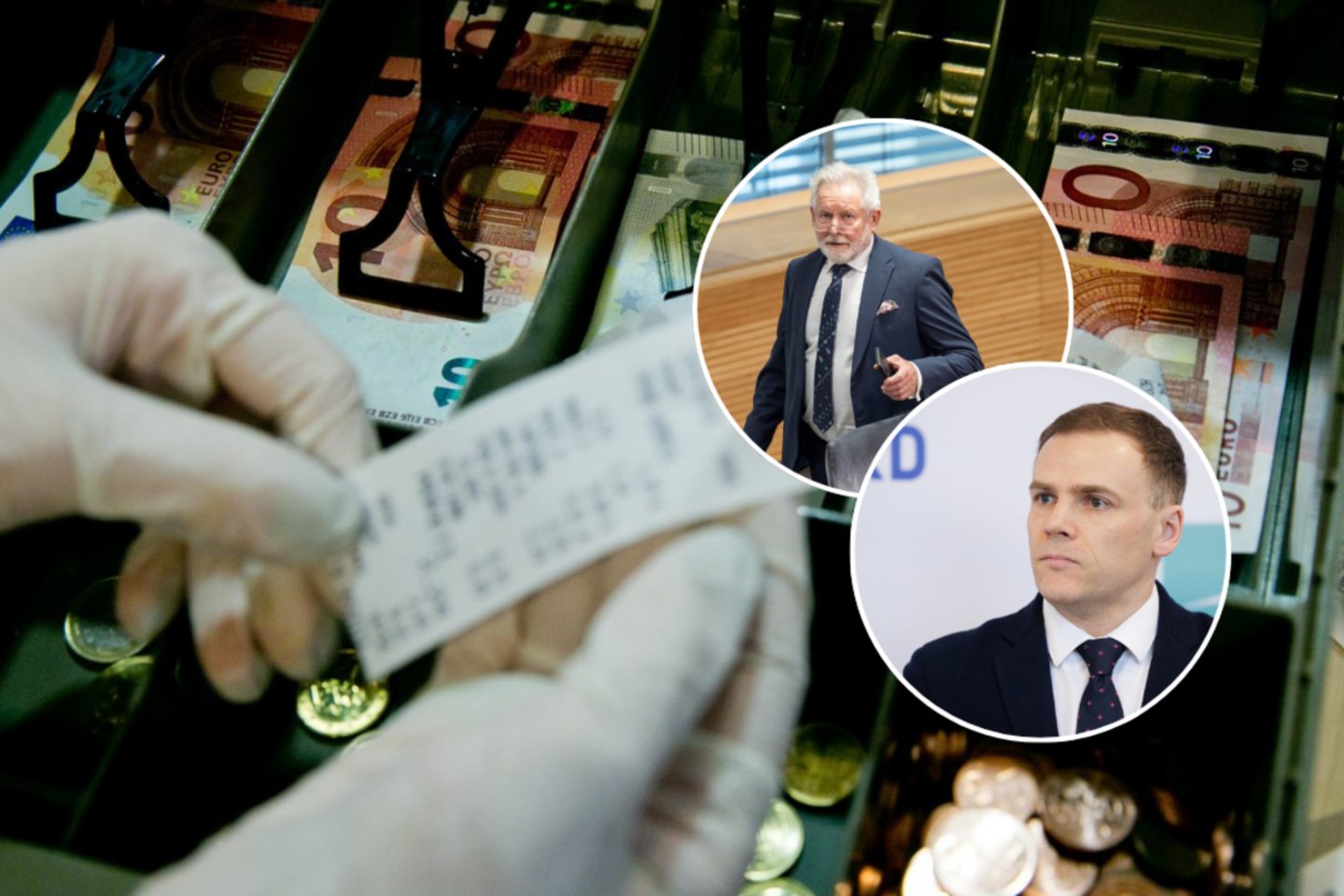
But while some call it a step toward a fairer tax system, others warn that the excessive requirements could become another burden for those who are already self-employed, small-scale and often teetering on the edge of survival.
It is proposed to narrow down the list or refuse business certificates
The head of the Seimas committee, Algirdas Sys, says that the list of activities whose representatives are not required to use cash registers was last adjusted more than a decade ago, so it is said to be too broad today. Currently, about 160 activities do not require cash registers, he said.
“The list has not been changed for more than 13 years. Technology has improved so much that you don’t need to have a cash register, you can do it by phone as you want, but there must be accounting (…) There is unaccounted money and you can transfer as much tax as you want. Not as much as you actually get, but as much as you want,” said A. Sysas.
The politician admits that the smallest traders could be exempted from the obligation to use cash registers, for example, people selling berries or mushrooms on the street, as well as grandmothers selling knitted gloves or scarves. However, in his opinion, such exceptions should not apply to the merchants of Kaziuk fair.
“The list has not been changed for more than 13 years. Technology has improved so much that you don’t need to have a cash register, you can do it by phone as you want, but there must be accounting (…) There is unaccounted money and you can transfer as much tax as you want. Not as much as you actually get, but as much as you want,” said A. Sysas.
The politician admits that the smallest traders could be exempted from the obligation to use cash registers, for example, people selling berries or mushrooms on the street, as well as grandmothers selling knitted gloves or scarves. However, in his opinion, such exceptions should not apply to the merchants of Kaziuk fair.
Mindaugas Lingė, a conservative member of the opposition, supports this idea. According to him, cash registers would enable self-employed persons to more clearly show their actual income.
“It is not only convenience for users and customers, but also fairer financial accounting,” M. Lingė told BNS.
The parliamentarian refers to the data of the State Tax Inspectorate and notes that in the beauty services sector more people work with business certificates, while there are about half as many people operating according to an individual activity certificate.
“It seems that business licenses are a more attractive form of paying less taxes and it is strange to have two different regulations for one type of activity. This is not a practice that should be continued,” said M. Lingė.
According to him, a significant part of the population is already used to doing without cash in everyday life, but in the field of beauty services, cash registers are still used the least.
M. Lingė also points out that business license holders rarely reach 50,000. income limit of EUR. If it is exceeded, part of the income would already be taxed as individual activity income.
“Real life is such that both inflation indicators and prices are rising, but that limit is not being approached,” said M. Lingė.
VMI data shows that in 2024, 12.6 thousand declared income from activities in the beauty salon. population. Of them, more than 45 thousand only 25 business license holders reported income of EUR.
At that time, the head of the Economic and Innovation Committee of the Seimas, Saulius Bucevičius, who belongs to “Nemunas Aušrai”, holds a different opinion. In his assessment, forcing business license holders to purchase cash registers would be wrong.
“If we grant a business license as a mandate or as a right to work, we have set the price, then let the person work. Now, can the cash register somehow generate more income? Those who want it will hit it, those who don’t want it won’t. I think this is not the problem and this is not the solution,” the MP told BNS.
According to S. Bucevičius, instead of requiring the purchase of cash registers, another way could be considered – increasing the price of business certificates. “Then one solution would be to set a proportional price, but not to mess with the cash registers,” he said.
The parliamentarian does not rule out an even more radical solution – to give up business licenses altogether. “Perhaps I would even consider canceling such business licenses altogether and switching to a different business model,” said S. Bucevičius.
The Ministry is not in a hurry to make changes
Finance Minister Kristupas Vaitiekūnas says that the business license system has both advantages and disadvantages. According to him, it could be reviewed and improved, but at the moment this issue is not considered a priority.
“As long as they are not abused, this is a really good instrument that helps to collect at least a small part of the taxes from very micro activities. But we see that they are sometimes abused and it’s really not the case that well-established but already established businesses are running using business certificates. It is really possible to review the system and improve it,” said the BNS minister.
“That issue (regarding the obligation to use cash registers – BNS) is on the agenda, but certainly not a priority at the moment,” he added.
Vice Minister of Finance Lukas Jakubonis confirmed that VMI has submitted proposals to the Ministry on how to reduce the number of activities that are subject to exemptions for the use of cash registers. However, he did not name specific activities.
“VMI has indeed submitted proposals to the ministry on how to reduce the currently applicable exceptions to the use of cash registers. There is probably no rush to do or not to do – to narrow that list, oblige more people to use cash registers, or not,” the deputy minister told BNS.
“In the context of the state as a whole, this is an important change, we keep postponing it, sooner or later we will still have to go to it. But whether now is the time, I don’t have an answer yet,” L. Jakubonis added.
The Vice Minister explains that decisions are not made in a hurry because they want to gather more information and assess the possible consequences.
“More information is needed in order to approach that question with a little different assumptions. So that we can very accurately assess the impact we will have not only on the fiscal budget collection, but also on the behavior and how the residents may react, especially those who carry out individual activities,” said L. Jakubonis.
According to VMI, 78.5 thousand people are working this year according to business certificates. population, and last year there were 106.7 thousand. This year, 263.4 thousand people are carrying out individual activities according to the certificate. people, last year – 303.3 thousand.
Beauty professionals say some already have cash registers
Jolanta Mačiulienė, head of the Association of Hairdressers and Beauty Specialists, says that a large part of the association’s members work according to business certificates or documents of small associations. However, according to her, most of them have already purchased cash registers.
“Probably more than half of the members of our association have already purchased cash registers. We have taken care of those things,” said J. Mačiulienė.
She regrets that the government’s plans can equally affect both beauty service providers working in small premises one at a time, as well as larger salons where several specialists work in shifts in spacious premises.
According to J. Mačiulienė, the association unites members, of which about 20 percent. works under employment contracts.
This year, 11.9 thousand people purchased business licenses for at least one day. population working in the field of beauty. This is about 15 percent. of all persons working under this form of activity.
VMI receives complaints about possible undeclared income
VMI notices an increase in reports from residents about possible violations, when those working with business licenses or individual activities may not declare income, issue receipts or issue invoices.
This year, VMI received 532 complaints about such cases, last year – 1778, and in 2024 – 561.
“Various factors can influence the activity of residents in reporting potential tax violations, such as more intensive educational activities, increased public attention to reducing the shadow economy, or greater awareness of the population,” VMI said.
Rolandas Puncevičius, head of the VMI Operational Control Department, reminds that service providers working with a business license must issue a receipt upon the client’s request. At that time, individuals performing individual activities must submit an accounting document.
According to him, in all cases, it is mandatory to fill in the journal of accounting of income and expenses.
Failure to issue a receipt can result in a fine of 90-200 euros, and repeated violations can result in a fine of up to 900 euros.
This year, 11.9 thousand people purchased business licenses for the operation of hairdressers, cosmetic offices and salons, as well as solariums. population. Of them, 5.3 thousand applies this form of activity for 10 years or more. Last year, there were almost 13.6 thousand holders of such business certificates, and 5.6 thousand of them worked in this way for more than a decade. population.
Almost 693 thousand was paid for business licenses for this activity purchased this year. euros, and last year this amount reached almost 1.6 million. euros.
According to individual activities, 4.93 thousand people worked in hairdressers last year. population, and this year – 4.8 thousand. Beauty care services were provided by 7 thousand. and 6.92 thousand. specialists. Last year, 2 thousand people worked in day spas and various types of saunas, and this year – 1.8 thousand people. employees.