President Lee Jae Myung on Tuesday urged parties involved in the Middle East war to seek peace as tensions simmered, underscoring the importance of universal human rights.
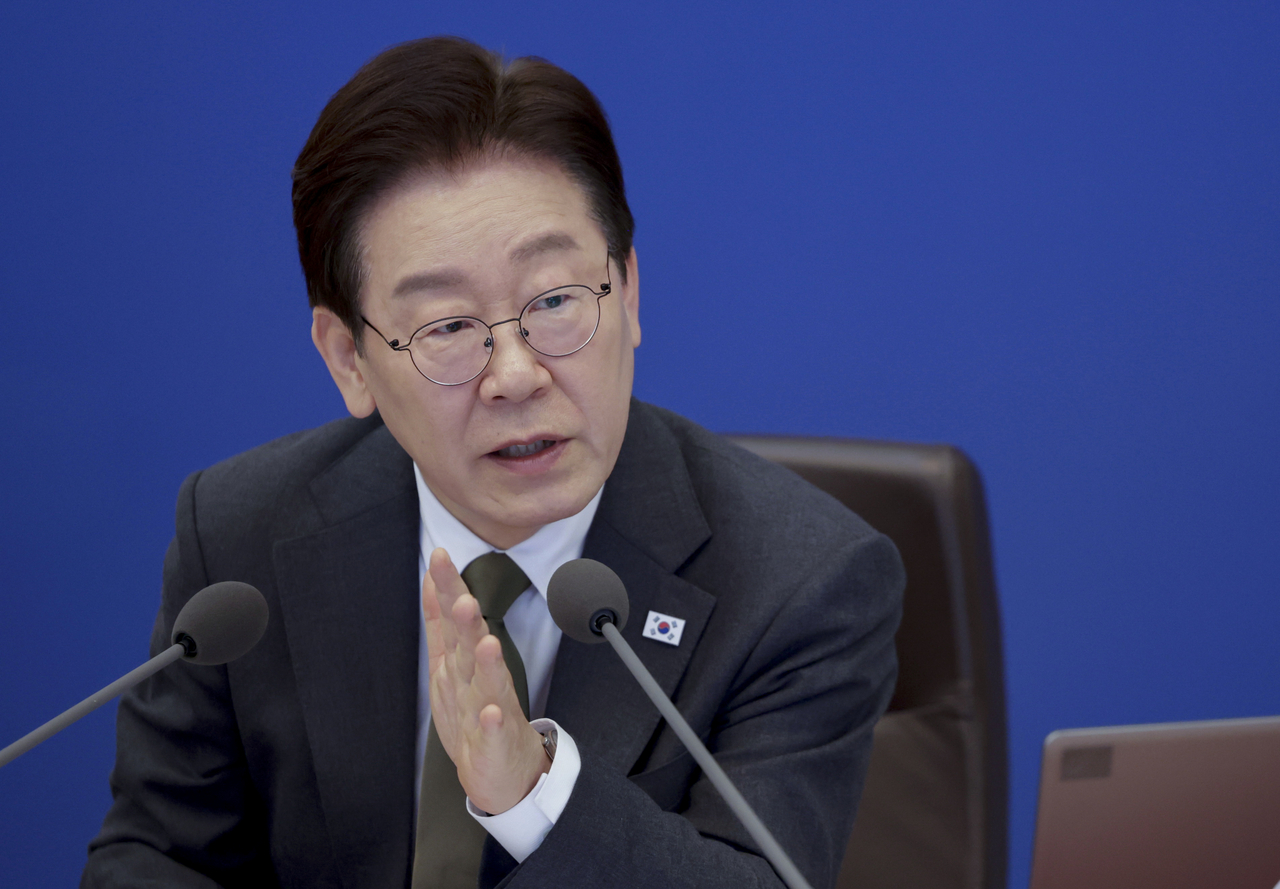
Lee made the remarks while presiding over a weekly Cabinet meeting combined with the fifth emergency economic review meeting on Tuesday at Cheong Wa Dae in Seoul.
“It appears that ceasefire negotiations over the Middle East conflict held over the weekend failed to reach a meaningful agreement,” Lee said. “Although talks are expected to continue, tensions surrounding the Strait of Hormuz are escalating, making it difficult to remain optimistic about the situation.”
Peace talks between the United States and Iran have remained at a deadlock after the first round of negotiations ended without a deal Sunday, jeopardizing a two-week ceasefire that began April 7.
Amid the impasse, the US Central Command said US forces implemented a blockade on all maritime traffic entering and exiting Iranian ports from Monday. Iran, in response, pledged to retaliate against the US blockade.
“In addition, I called on the parties to the war to take a courageous step toward the peace that the world earnestly desires, based on the principle of protecting universal human rights and the lessons of history,” Lee said during the meeting.
The president has been actively advocating for universal human rights, especially during wartime in the Middle East, through posts on social media platform X.
Lee also urged the Cabinet not to let its guard down amid the uncertain outlook of the Middle East war.
“For the time being, disruptions to global energy and raw material supply chains, along with high oil prices, are likely to persist,” Lee said. “We must treat this as a given and further strengthen our current emergency response system.”
Lee also called on the public to reduce fuel consumption, acknowledging criticism that the government’s price cap approach could undermine efforts to curb fuel use.
“I think that is a valid point. That is also why, given such concerns, I would like to ask people to make every effort to reduce fuel consumption,” Lee said. “The reason is that, in order to stabilize prices, we are in fact using the taxes paid by the public to keep them down.”
Lee went on to underscore the need for South Korea to address weaknesses “in our economic and industrial structure” exposed during the ongoing conflict in the Middle East.
“I would like you to push ahead with the diversification of supply chains, mid- to long-term industrial restructuring and the transition to a less plastic-dependent economy as top-priority national strategic projects.”
During the Cabinet meeting, Foreign Minister Cho Hyun outlined the ministry’s plan to dispatch special envoys to nearby regions to help address supply chain disruptions caused by war in the Middle East, in addition to the earlier dispatch of presidential chief of staff Kang Hoon-sik for that purpose.
“The Foreign Ministry has also dispatched director-level officials to Algeria and Libya, and plans to send a special envoy of the foreign minister to the Republic of the Congo,” Cho said.
Deputy Minister for Economic Affairs Park Jong-han has been deployed to Algeria and Libya for a five-day trip from Monday, while former South Korean Ambassador to Algeria Chung Hae-woong will be sent to the Republic of the Congo, the Foreign Ministry confirmed.
Regarding the activities of Chung Byung-ha, the foreign minister’s special envoy to Iran, Cho said, “Through meetings with senior Iranian officials, we have exchanged views on the situation in the Middle East.”
Cho said Chung has also “been discussing the safety of Korean nationals, vessels and crew, as well as the issue of freedom of navigation for all ships, including Korean-flagged ones.”
In response, Lee asked Cho whether measures had been taken to encourage and reward staff at the South Korean Embassy in Iran. Cho replied that such efforts were underway.
“Make sure they are well looked after, as they are in a difficult and dangerous environment, so that they can endure it,” Lee said.
However, a Foreign Ministry official later in the day clarified that any “reward for staff at the embassy in Iran has not yet been implemented and is still being pushed forward.”
dagyumji@heraldcorp.com