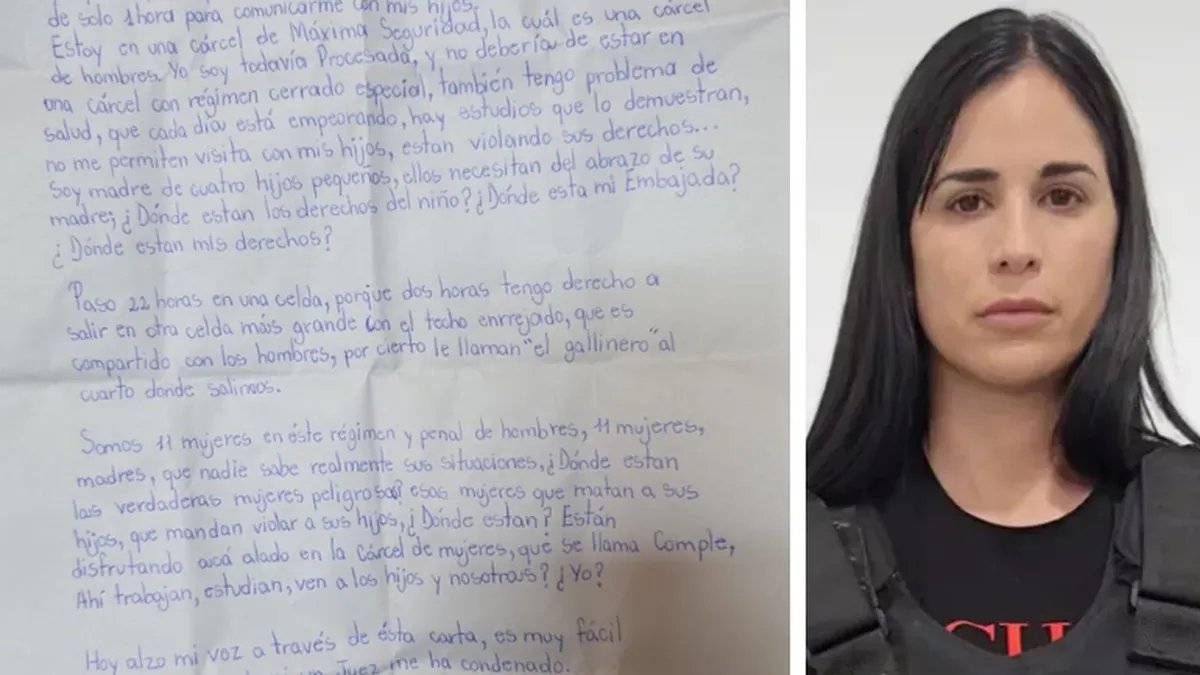
The ex-partner of Uruguayan drug trafficker Sebastián Marset, Gianina García Trochesent a handwritten letter from prison in Paraguay in which he denounced his conditions of confinement and questioned the actions of the authorities.
The letter was sent to journalist Patricia Martín, who read it this Monday on Radio Carve. García Troche, a Uruguayan national, remains detained in Paraguay after being extradited from Spain, where she was captured in 2025.
Complaint about prison conditions
In the letter, the woman explained why she decided to make her testimony public. “I chose the journalist Patricia Martín to make a defense in this letter, since I cannot risk making a video because I cannot miss the only call that they allow me every 15 days of only one hour to communicate with my children,” he wrote.
He also described the regime in which he finds himself: “I am in a maximum security prison, which is a men’s prison. I am still being processed, and I should not be in a prison with a special closed regime. I also have health problems, which are getting worse every day; there are studies that show it. They do not allow me to visit my children; they are violating their rights.”
In that context, she questioned her family’s situation: “I am the mother of four small children, they need their mother’s hug. Where are the rights of the child? Where is my embassy? Where are my rights?”
image

Regime and conditions
García Troche also detailed his routine in prison. “I spend 22 hours in a cell, because for two hours I have the right to go out in another larger cell with a barred roof, which is shared with the men. By the way, they call the room where we go out ‘the chicken coop’,” he said.
Likewise, she questioned the regime in which the detained women are found: “We are 11 women in this men’s regime and prison. Eleven women, mothers, of whom no one really knows their situations. Where are the truly dangerous women?”
“There they work, they study, they see their children. And us? And me?” she added, referring to other inmates housed in women’s prisons.
García Troche faces a sentence of up to 22 years and six months in prison for crimes linked to drug trafficking and criminal association.
In closing the letter, he said: “Today I raise my voice through this letter. It is very easy to judge me, when not even a judge has condemned me.”
Some time ago, his defense had requested a reduction in precautionary measures, including house arrest, which was rejected by Justice, among other reasons, due to the possibility that Marset would intervene to facilitate his release.