He government of Yamandú Orsi and HIF analyze a change in location of the synthetic fuel plant that the company intends to build in Paysandú.
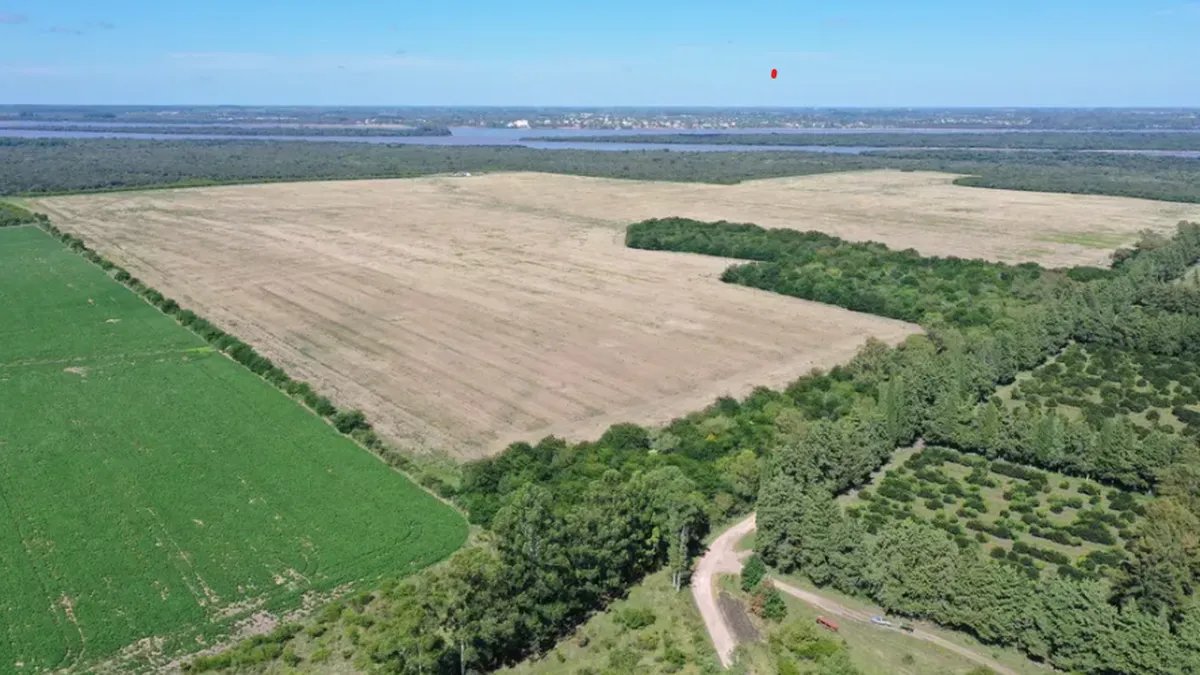
While this discussion is going on, and at the risk that the work will have to be repeated if the location is changed, the technicians from the Ministry of the Environment are advancing in the study of the authorization request that would allow the works to begin in the original place, registers 11,950 and 11,951, several kilometers north of the Sanducera capital at the height of the town of Constancia.
The HIF application is a compendium of more than 2 thousand pages with all the details of the project and includes images about what the plant would have looked like since Columbusthe Argentine spa city that is a few kilometers away and that He has asked that the plant not be installed in that place because it will affect tourism.
The proposal, which arose from social organizations, has the support of the mayor of Colón, the governor of Entre Ríos and the Foreign Ministry of Javier Milei, who in November of last year requested in a meeting at the Palacio Santos that a relocation be studied.
In addition to the images, the study analyzes the “potential cross-border conflict” and points out that regardless of the objective technical aspects of the project, there is a “context of structural mistrust in Argentine territory, linked mainly to antecedent of the Botnia/UPM conflict and perceived territorial vulnerabilities.”
The document recognizes that media coverage and social mobilizations can overrepresent certain organized voices although “the progressive intensification of registered mobilization (caravans, assemblies, multi-sector coordination, positioning of governors) suggests that the conflict will continue to escalate in the absence of robust mechanisms for dialogue and mitigation of perceived risks“, reads one of the conclusions.
In turn, the report cites the statements of a leader of the Paysandú Municipality in which he mentions that the link with the neighboring country is the point to be treated correctly because “Argentines are going to unite with the idea that everything is bad, they are all going to unite, the majority are going to cut the bridge.” (…) I guarantee it.”
In this sense, the recommendations are to have a “continuous review of emissions control measures and analysis of design alternatives that consider perspectives of Argentine territorial vulnerability” and to have great transparency in access to information.
The work also talks about distributing documentation in accessible formats and through established communication channels.
When it comes to the arguments, the report details that one of the “most repeated” is the eventual “visual pollution” generated by the plant. “This threat is expressed particularly in references to chimneys 80 meters high, visible from the beaches of Colón, which is interpreted as incompatible with the local tourism model”says.
The document clarifies that in July 2025, HIF announced a redesign and new configuration of the projectincluding a significant decrease in the plant area and a repositioning of the tall structures, moving them away from the coast, from way to reduce your visibility.
However, “the analyzed perceptions denote skepticism”, maintaining that “said modifications do not resolve environmental and atmospheric emissions risksOrganizations have expressed that “these changes they do not modify ‘the conditions of risk and vulnerability to which Colón and the region will be exposed’”.
One of the testimonies states that there are “some simulations” of “what it would look like from the beaches of Colón and I would tell you that they are imperceptible” because beforehand there is an island, a native mountain and the factory would be behind a curtain, but the “Technical explanations do not necessarily resolve Argentine skepticism”.
The landscape and visual impact study indicates that the “intensity of impact” in Argentina will be “medium” since it proposes a “perimeter fence to the industrial plant, with large trees, which will reach heights of between 35 and 40 m (10 to 12 years) in adulthood.”
“This measurement was also simulated (photomontages were made) from some of the observation points and it is identified that it attenuates the presence of the industrial plant. It is noteworthy that this measure It is not an immediate response since it depends on the growth of the species to be planted.”he concludes.