Defence Minister Wayne Sturge says he fully supports campaign finance reform, describing it as a priority for the United National Congress (UNC) Government.
“Our party campaigned on campaign finance reform and, unlike (former attorney general) Faris Al-Rawi—who promised it in virtually every one of his Senate contributions from 2010 to 2015, but failed to deliver over the next decade—we intend to fulfil all our manifesto and campaign promises,” he told the Sunday Express last week in response to questions.
The issue of campaign financing has long simmered beneath the surface, resurfacing periodically.
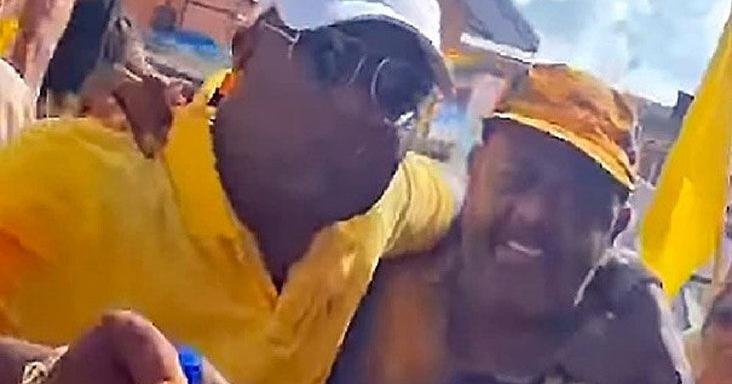
Most recently, photographs of Sturge with slain Sangre Grande businessman Danny Guerra during last year’s election campaign circulated again on social media, accompanied by questions over whether Guerra had financed Sturge’s bid for the Toco/Sangre Grande seat in the April 28, 2025 general election.
Sturge declined to respond to the concerns expressed, but party officials refuted the claims. Sturge won the seat and was later appointed Defence Minister.
There have long been concerns that undisclosed political financing can create avenues for corruption, for example, in the awarding of multimillion-dollar government contracts to favoured supporters. Over the years, millions of dollars have reportedly flowed into political campaigns from unnamed individuals and companies.
For more than two decades, successive efforts to introduce campaign finance legislation have stalled, amounting largely to discussion without implementation.
The issue returned to the forefront last month when the Trinidad and Tobago Transparency Institute (TTTI) urged the Government to enact campaign finance reform.
TTTI’s call followed allegations by Prime Minister Kamla Persad-Bissessar that drug money funded the construction of the People’s National Movement’s (PNM) headquarters, Balisier House.
PNM deputy political leader Sanjiv Boodhu has also called for such legislation, citing allegations that Guerra was a financier of the UNC.
Both the PNM and UNC have faced criticism for failing to ensure transparency regarding the sources of their funding.
Here’s a look back at previous, unsuccessful attempts at campaign finance reform.
2006
Some 20 years ago, in October 2006, then UNC opposition Caroni East MP Ganga Singh raised a motion on election financing, but it was shut down by the then-PNM government, led by former prime minister Patrick Manning.
Singh’s motion read, “Whereas it is acknowledged that political parties play a vital role in the functioning of democratic government; And Whereas there is at present no legislative framework regarding the registration of political parties or the disclosure, by political parties, of contributions made to them by individuals or corporations; And Whereas the financing of political parties is an issue of major public concern; Be It Resolved that the House do appoint a special select committee to make recommendations as to what principles and systems of financing of political parties would be appropriate in the public interest.”
2009
In February 2009, former independent senator Dr Ramesh Deosaran introduced a private motion in the Senate with respect to election financing. The motion explicitly stated, Parliament should appoint a Joint Select Committee (JSC) to consider establishing “a legislative framework to govern the financing of election campaigns”.
That private motion failed because while Deosaran had the support of the then-UNC opposition, he did not have that of the then PNM government.
2010
In 2010, the then People’s Partnership government, led by prime minister Kamla Persad-Bissessar, indicated that campaign finance reform would be a priority. The manifesto stated they would promote legislation for the registration and funding of political parties, subject to review by an independent body.
During that term of government, a JSC was established in November 2014 with the following terms of reference, “To propose a legislative framework to govern the financing of election campaigns and submit its report with recommendation to both Houses of Parliament within six months of its appointment.”
The committee, which was chaired by Wade Mark, submitted a report to Parliament which noted that the existing $50,000 spending limit for a general election is counteracted by Section 47(2)(c) of the Representation of the People Act, Chap. 2:01, which allows for third-party contributions.
It permits expenses incurred to be covered by persons other than the candidate “in the holding of any meeting to disseminate political information or to promote the principles of a political party or a political or other association in cultivating the goodwill of a constituency”.
Each candidate for public office is allowed to spend $50,000 on an election campaign. Under existing provisions, third parties can pay for expenses when holding political meetings (including advertising, party paraphernalia, etc).
However, the current legislation does not compel political parties to identify financiers, and thus lacks transparency and accountability with respect to the disclosure of the expenditure of public and corporate funds.
The report proposed recommendations on a legal framework to ensure fair, transparent election financing by:
• capping private donations to limit undue influence
• regulating loans with clear rules and full disclosure
• introducing public funding to reduce reliance on wealthy donors
• limiting campaign spending to maintain a level playing field
• overseeing third-party spending while preserving free expression.
2015
In a statement to Parliament in June 2015, prime minister Persad-Bissessar addressed the issue of campaign finance reform before announcing the general election would be held on September 7, 2015.
In her speech, Persad-Bissessar said the UNC has consistently advocated for electoral finance reform.
“It has been a long-standing concern to me and something I have fought for all my political life. We must aspire to a better politics, a better national debate and a better Trinidad and Tobago. And more than recognising the desire of citizens across Trinidad and Tobago for more transparent governance and the deepening of our democracy, we must take decisive action to ensure that it comes to pass,” she said.
Persad-Bissessar promised her government would look at implementing the recommendations of the Mark-led JSC.
The UNC government lost that election, and the PNM took office from 2015 to 2025.
2015
During its 2015-2020 term, the Dr Keith Rowley-led government attempted to bring campaign finance reform via the Representation of the People Act.
During that period, the PNM government made attempts to introduce campaign finance reform by amending the act.
Another JSC was appointed to deliberate on the Representation of the People (Amendment) Bill, which aimed to address the unregulated and undisclosed funding of political parties, prevent corruption and money laundering, and restrict an incumbent government’s use of State resources during election campaigns.
While the legislation was introduced early in the term, it faced challenges, including the need for opposition support to pass such reforms. The proposed reforms faced significant delays and did not reach completion during that parliamentary term.
2020
In March 2024, Rowley promised to bring campaign finance legislation back to the floor, having sent it to a JSC in the hope of securing support from opposition and independent members.
In May 2020, in a statement to Parliament on the Representation of the People (Amendment) Bill, 2020, Rowley spoke of his administration’s commitment to enacting the legislation. He expressed concern that under existing laws, there was no obligation on financiers of political parties and candidates to make public their contributions.
He also acknowledged that an incumbent government’s access to State resources before and during an election campaign period makes it possible to supplement a candidate’s resources with State resources.
“Madam Speaker, upon entering office as prime minister, I made a solid commitment to the people of this nation that campaign finance reform legislation will be brought to the Parliament.
“Historically, successive governments have only spoken on this issue of reform. Today, it brings me great satisfaction to inform this august House that my government, unlike any other government before us, has the fortitude to fulfil this promise of presenting legislation to address the issue of campaign finance,” he said then.
The bill later lapsed, and that promise was not delivered.
The bill was a simple majority bill and did not require any opposition support for passage. It was referred to a JSC—chaired by former government minister Camille Robinson-Regis—for consideration, where it ultimately died.