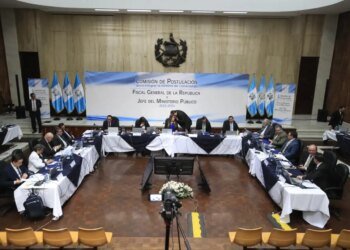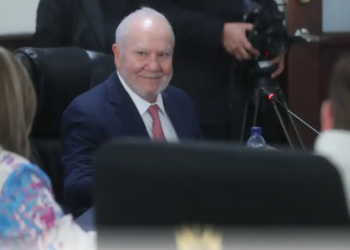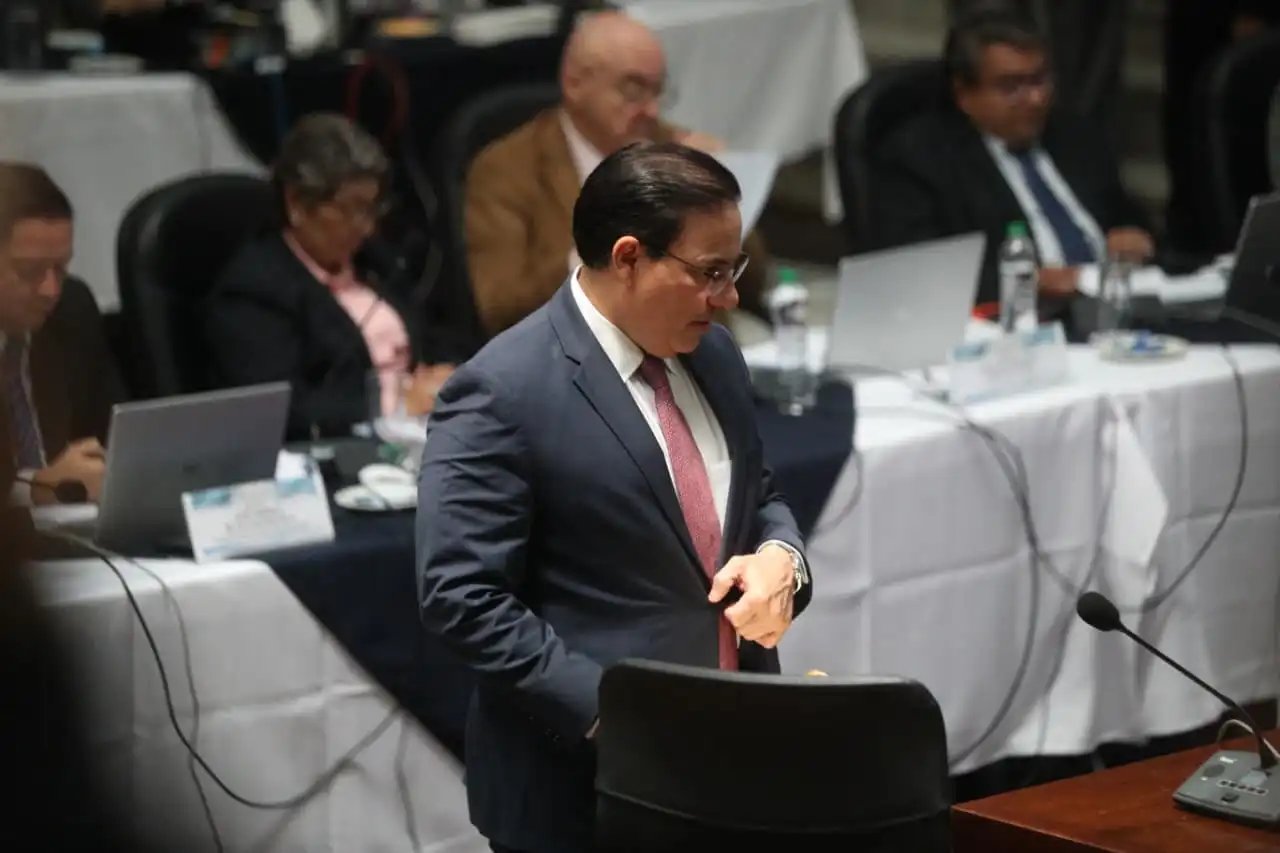
The Nomination Commission for Attorney General of the Public Ministry (MP) It continued this Friday, April 10, with the interviews with the applicants. On this occasion it was the turn of the Minister of the Interior, Marco Antonio Villeda, who aspires to direct the investigative entity.
In his first intervention, Villeda explained to the postulator that he has been a public servant for 35 years, as an independent judge and jurist.
He then presented his work plan, in which he highlighted that he proposes a modern MP, with vision, that investigates as it should, with independence and, in addition, pursues with strategy. Also protect victims with dignity.
“Because as a candidate for Attorney General I am not here to continue what is wrong, believe me I know what is wrong because I have experienced it from within the State. I am here to propose solutions, measurable issues and raise awareness of the current situation of the Public Ministry, to recognize the errors and problems that exist, to be able to confront them and propose concrete solutions,” he stated.
He said that his plan includes an MP that fulfills its function without bias, with measurable results and focused on the protection of the victim, which should be the reason for the Prosecutor’s Office.
He added that it would be an MP who has control over the actions of prosecutors, with concrete and measurable results.
If elected, he would work so that criminal prosecution is applied equally to everyone and not selectively.
Axes to prioritize
Within criminal policy, its plan includes prioritizing criminal phenomena that directly impact society, especially those that are repeated most frequently and affect the daily activities of citizens.
I would also prioritize a prosecution based on evidence, because that is the objectivity with which the MP must act. He said that we cannot continue to pretend that the MP’s actions are based on complaints from anonymous citizens, since it must be a technical, objective and impartial entity.
Another axis is to establish homogeneous technical guidelines in the prosecutor’s offices, so that they have a standard of action or processing of cases, although Guatemala has different realities.
Its management model requires standardization of processes, control panels by prosecutors, as well as supervision and quality control.
The operational structure of its plan includes direction and control of criminal prosecution, technical, analytical and evidentiary capabilities, as well as territorial strengthening and strategic impact against criminal structures.
One of the questions was about domain forfeiture in his plan, to which he responded that this is a legal tool created in 2011 that initially gave “magnificent” results with the impact on solid criminal structures.
He said that there was a solid team in the Domain Forfeiture Prosecutor’s Office, but “it was dismantled.”
“It has been a while since we heard that there has been a solid investigation that impacts criminal structures on their finances,” he noted.
He indicated that the aforementioned prosecutor’s office must be restructured to impact criminal organizations in the finances that allow them to operate.
They also told him that he is “from the Executive’s circle of trust” and that, if elected, how he would maintain his independence. Villeda responded that saying that he is from the circle of trust “is very risky.”
“I am not from the circle of trust, but I do hold an important position in the Executive.”
To read more: US bipartisan statement warns of risks of criminalization in MP election in Guatemala
He said that he does not come from the world of politics, but from the judiciary, because before becoming minister he was a judge for 30 years, which made clear his performance as an independent judge.
He stated that, if he assumed the position of prosecutor, his loyalty would be only to the Constitution and, above all, to the victims of crime, and that he could not have loyalty to anyone else.
He added that he respects President Bernardo Arévalo and works with him, but that, if elected, he must use the principle of “ingratitude,” since the position demands it.
He added that one of the mistakes of the last MP administrations is that they have been subordinate to power or completely opposed to it, when the attorney general should be independent.
According to Villeda, one of the challenges is criminal prosecution based on evidence and there must be good communication between the Ministry of the Interior and the MP.
He indicated that the reservation of cases has been constant and that justice needs to be monitored.
Stay up to date with the Now newsletter. Key information at the moment it happens. Subscribe here.