The fact that Europe will have to do significantly more to protect itself in the future has been clear since American Vice President JD Vance’s legendary speech at the 2025 Munich Security Conference. The government of President Donald Trump has repeatedly emphasized that the previous promise of protection must give way to a new sharing of burdens.
Many European NATO members have since significantly increased their defense spending. Nevertheless, there are doubts among experts as to whether Europe, despite all the money, will be able to build an effective deterrent against the possible aggressor Russia by the end of the decade.
A group of experts is now entering this debate with a new contribution. The authors criticize the fact that, despite having the second highest defense spending in the world, Europe remains strategically dependent on the USA across the entire military chain. They identify what they believe to be the largest strategic capability gaps in Europe and key programs to close them.
They estimate the costs for these programs at 150 to 200 billion euros by 2030 and around half a trillion euros for the next ten years. This corresponds to around a third of the planned increase in the European defense budget of 200 billion euros annually. It is not a question of additional costs, but rather a redirection of funds, according to the paper “Sparta2” published this Thursday.
“The bottleneck is neither money nor technology,” says Tom Enders, one of the five authors. “It is the political will to act on a European level, to make decisions and then implement them as quickly and pragmatically as possible,” said the long-time Airbus boss.
The recommendations are aimed at the governments of the European NATO states and the EU authorities. The authors advocate implementation via “resilient guiding coalitions instead of a new European superstructure”. Germany, France, Poland and Great Britain should play key coordinating roles. Northern Europe, the Baltics and the Netherlands should advance maritime autonomy.
In addition to Enders, the authors also include Moritz Schularick, President of the Kiel Institute for the World Economy, René Obermann, chairman of the Airbus supervisory board and, as of this week, also a member of the SAP supervisory board, and the tech investor Jeannette zu Fürstenberg. Like Enders, she is closely connected to the drone startup Helsing.
About a year ago, the quartet initiated a debate with the discussion paper “Sparta” on the question of whether the Bundeswehr procures too much traditional military technology and what economic added value investments in high-tech startups can have.
Modern technology just a fig leaf?
Although the Bundeswehr has now awarded two contracts for the delivery of attack drones worth almost half a billion euros each to the two startups Helsing and Stark Defense, Schularick still sees no change. “This is more of a fig leaf than a new technology-driven spending policy,” says the FAZ economist, referring to calculations by his institute that the share of spending on technology-driven defense equipment in the traffic light government’s 100 billion euro program was only two to three percent.
Political consultant Nico Lange has now joined the group of authors for the current debate contribution. A distinction is made between capability gaps for which significant progress can be expected to be made in three to five years and those for which at least five years are required.
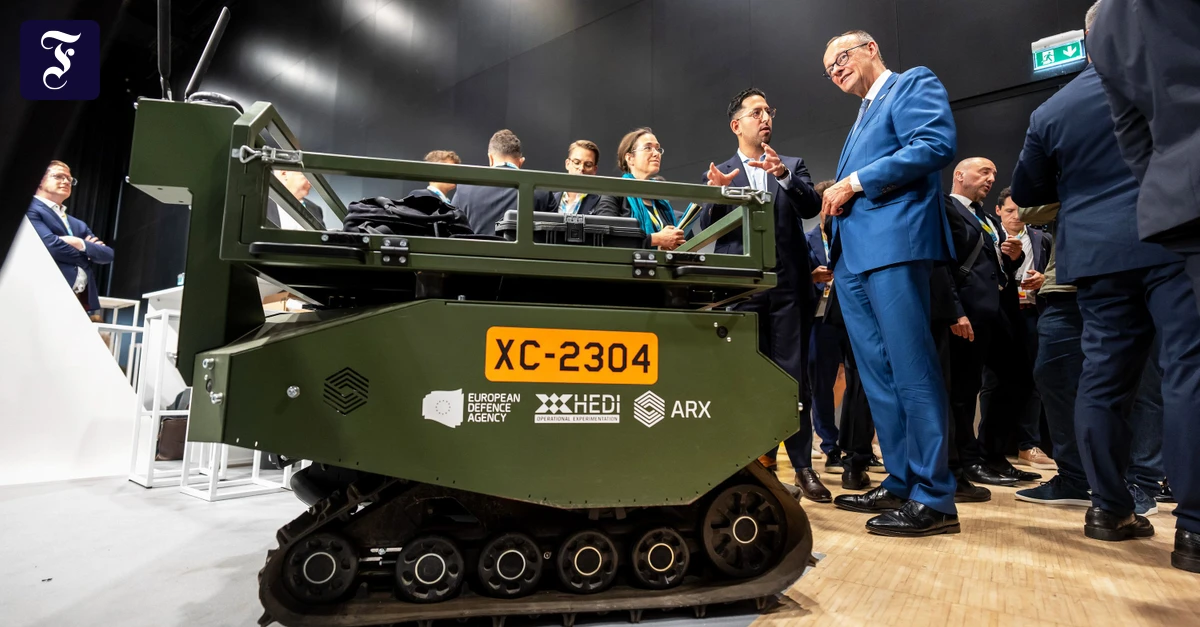
The tasks with a faster chance of success include the development of a sovereign air defense, for example through laser systems, interceptor drones, the European Sky Shield Initiative and existing alternatives to the US Patriot system. The authors also see noticeable progress achievable by the end of the decade for our own air combat systems, autonomous weapon systems such as drones on land, at sea and in the air, as well as European leadership capabilities.
According to the paper, it will take significantly longer to set up a powerful European satellite reconnaissance system as an alternative to Elon Musk’s Starlink system. The transport infrastructure through our own rockets with an anchored target of at least 50 launches per year probably needs more time.
Jeannette zu Fürstenberg emphasized to the FAZ that it was still important to start all programs immediately: “It all has to happen now.” There is currently a generation of founders in Europe who are committed to the issue of European security and have built leading technological companies. “What we need to do now is have the courage to trust them and direct capital to where it creates strategic independence.”
The state should not invest with capital, but rather give young companies real orders, which in turn provides an incentive for investors to get involved and forms the basis for an ecosystem with suppliers. The Darpa program from the USA serves as a model for the development of groundbreaking technologies such as hypersonic weapons, quantum computing and space technology.
The economist Schularick calculates that every euro invested in such high technology could generate an economic multiplier of 15. “Europe can not only afford the investments, it cannot afford not to make them,” warns Schularick.