Nääs believes the Estonian Internal Security Service (ISS) should be stripped of its competence to investigate corruption cases, transferring it to the Central Criminal Police, which already has the corresponding competence.
“The ISS is primarily a security institution and security is always connected to politics, including internal politics. To confirm this, it is enough to read some ISS annual reports or see who the agency has had to argue with in court over the annual reports,” Nääs said. “When security institutions are also given investigative powers, there is a very real risk that this competence will be used to achieve other goals of the security institutions.”

Secondly, the Prosecutor’s Office should be stripped of the competence to lead pre-trial investigations, leaving it purely to law enforcement agencies. This would mean that the police investigate and the prosecutors represent the state prosecution in court. According to Nääs, this would ensure that prosecutors are not involved in the case from the very beginning and do not feel directly responsible for the outcome of the investigation.
“This would also help create a somewhat more objective view at the final stage of the investigation, to then decide whether it is really reasonable to go to court with the case or not,” he noted.
Legislation leaves too much room for interpretation
Thirdly, Penal Code norms in Estonia should be written more clearly. Nääs stated that this primarily concerns the Anti-Corruption Act and procedural restrictions, but also the regulation of party donations.
Both laws are very poorly drafted, too general and leave too much room for interpretation for those applying them. Recent practice clearly shows that the Prosecutor’s Office cannot be trusted with broad room for interpretation, as it is not handled in good faith.
“In conclusion, it is difficult or hard for me to guess what motivated the prosecution to send this case to court and to additionally appeal the District Court decision. It is clear to me that this criminal case has had a major political impact from the start, and the Prosecutor’s Office understood this as well,” Nääs stated.
Prosecutor General must answer for politically impactful case
He added it would be all the more important to know whether the making of decisive choices regarding the criminal case was thoroughly considered and coordinated, or if it simply comes down to the gut feeling of one or a handful of individuals. The current Prosecutor General must offer answers and solutions to this question.

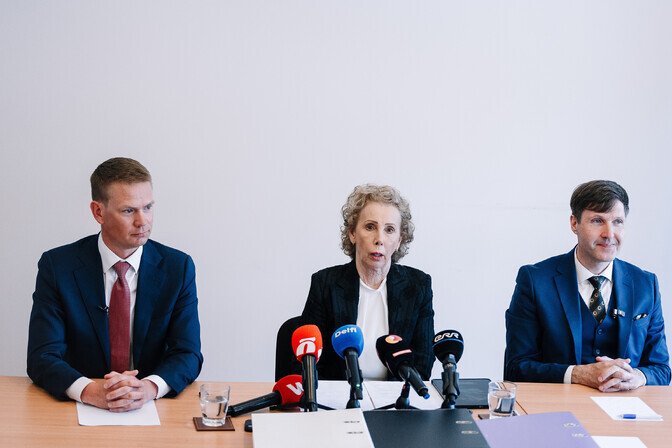
At the press conference on Tuesday, Kracht, Nääs and EKRE party chairman Martin Helme spoke about the Circuit Court decision, which overturned Kracht’s conviction for violating procedural restrictions.
Nääs said it was a landmark decision, considering that the circuit court upheld the earlier District Court decisions acquitting Kracht and overturned the conviction for violating a procedural restriction.
“This means that, in the opinion of the circuit court, the charges presented in the case were completely unfounded in their entirety, both regarding Kracht and actually all the other defendants who were brought to trial in this case,” he said.
Have powers have been used in bad faith?
He pointed out that the circuit court identified several significant violations during the investigation, such as the illegal search at the Aqva Spa hotel or obtaining illegal access to Toomas Tamm’s emails.
According to the lawyer, the decisive factor for both court instances was that the conclusions the Prosecutor’s Office drew from the evidence it had collected were arbitrary, conjectural, sought-after and unsubstantiated.

“Throughout this entire court decision, the Prosecutor’s Office was reproached for not taking into account the actual context of the conversations collected through surveillance, but instead, the conclusions were biased toward the prosecution. The Circuit Court said in this decision at least 13 times that the prosecution’s conclusions are arbitrary, at least nine times that they are conjectural, at least seven times that they are unsubstantiated and at least four times that they are simply sought-after,” he listed.
The number of times the Circuit Court called the conclusions unfounded was too high to count, he added.
“The summary conclusion from the reasoning of the Circuit Court decision would be that the Prosecutor’s Office has quite deliberately ignored the evidence exonerating Kracht and the other defendants and created a narrative for the prosecution based purely on conjecture, not evidence,” Nääs concluded.
Prosecution: There may be grounds for appeal
Chief State Prosecutor Taavi Pern said to ERR, that both in the District Court and the Circuit Court, the Prosecutor’s Office has taken the position that they presented the evidence to the court properly and that it was also collected properly during the pretrial proceedings.
“In complex concealed crimes, it is customary that the evidence is detailed, but it may not relate to the crime in such a way that one can directly read sentences like “I am giving you a bribe” or “I agree to accept a bribe from you.” It is precisely over these details of the evidence that the dispute in this court proceeding took place,” noted Pern.

A great deal of information was collected, and the prosecutors’ assessment was that this information could be fitted into a coherent overall picture pointing to a crime. “In our view, the evidence and fragments we used both in the closing arguments and in the appeal pointed to a crime,” said Pern.
“The role of defense counsel in proceedings is, of course, to point out possible contradictions. The court’s role is to assess such contradictions and give its own assessment, but until there is a final, binding decision in this criminal case, outside observers unfortunately cannot review the case file themselves to judge with their own eyes whether the court’s positions merit agreement or not.”
The Chief State Prosecutor said that at this point, he has initial thoughts that incline toward the view that there may be grounds to file an appeal.
“We will be able to say definitively whether we will file a cassation appeal only after I have worked through the judgment in detail, virtually sentence by sentence. I will compare it with the positions we presented in the Circuit Court and, on that basis, determine whether the Circuit Court may have violated any procedural rules.”
—