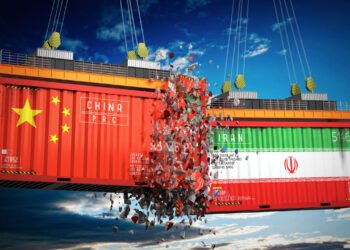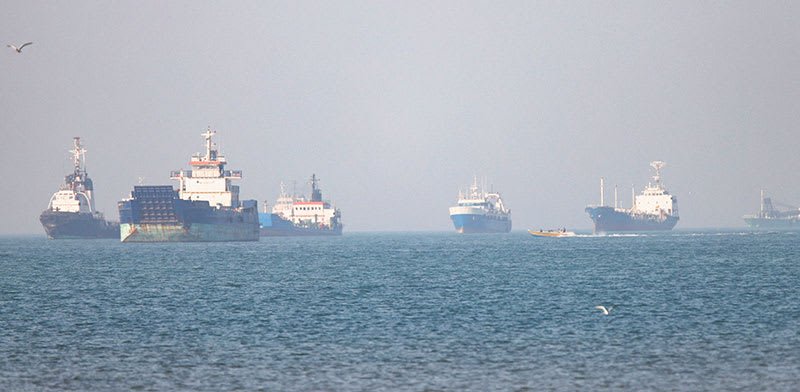
US President Donald Trump’s Operation “Freedom” to rescue the ships besieged in the Persian Gulf, resulted in the departure of two ships to the open sea within a few hours. However, this is a drop in the ocean compared to the number of ships that remain besieged, while on the other hand Iran has already exacted a price from the United Arab Emirates for Washington’s decision to break the blockade in the Strait of Hormuz.
● “The economy is roaring”: Trump is trying to sell optimism to Americans
● The expert who explains: Why are the Iranians firing at the Emirates and what are the chances that the missiles will reach Israel again
It was reported from Abu Dhabi that the forces faced an attack by 12 ballistic missiles, three cruise missiles and four drones. According to CNN, Israeli air defense systems took part in the containment. Despite this, Iran managed to hit an oil terminal in the port of Fujairah – a no-coincidental target: this is the Emirates’ only outlet outside of Hormuz, and its activity stood out especially against the background of the decision of the leader Mohammed bin Zayed to leave Last week the OPEC cartel, in which Iran is also a member.
Identify the weak point
Even before the war, the Emirates used the Abyssin-Fujairah oil pipeline for the purpose of diversifying export capabilities, and due to the blockade they even increased its use. In the work week between March 20 and 24, the rate of oil loading in Fujairah jumped to about 1.9 million barrels per day – a 57% increase compared to 2025. The Iranians recognized the Emirati activity during the war, increased the attacks on the infrastructure there, and returned to it on the second. Their motive, along with harming American interests, is to prevent the increase of Emirati oil exports, in the absence of OPEC restrictions.
Last February, Saudi Arabia, Iran, Iraq, Kuwait, Qatar and the United Arab Emirates exported about 18.5 million barrels per day. From this figure, the emirates supplied the market with about 2.2 million barrels per day. The Iranian blockade of the Strait of Hormuz has, therefore, disrupted approximately 17.3% of the world’s oil supply, this considering the global output that stood at 106.6 million barrels per day in 2025. In this shadow, the Iranians are interested in preserving the damages reflected in energy prices and preventing any attempt to reduce the effects.
Dr. Meir Javdenfer, a researcher at the Lauder School of Government at Reichmann University, explains that the Ayatollah regime identified oil prices as the weak point of the US and President Trump, especially in the run-up to the midterm elections. “The Iranians have realized that whenever they are threatened with an attack, they can attack in the Persian Gulf and with an emphasis on the United Arab Emirates,” says Javdanfar. “You hear them calling for the destruction of Israel, but I am not sure that they hate the Emirates any less. It is not impossible that in the near future we will hear that Iran is activating the Houthi rebels in Yemen in order to block the Bab al-Mandab strait and increase oil prices even more.”
The price of paralysis
Another and no less significant aspect of the blockade is the significant disruption in the world of shipping, the impact of which branches out into diverse areas that are revealed every day. One of them is the cruise industry: similar to cargo ships, many cruise ships have also been captured in the Persian Gulf. Although some of them managed to leave through the Strait of Hormuz during the brief respite in April, the companies continue to cause heavy damage. Globes learned that Israelis who booked a cruise from Barcelona for next week only received a notice this week about the cancellation of their vacation; The reason: the ship has not yet managed to reach Spain from the Persian Gulf.
The more familiar and widespread issue is the disruption of the movement of merchant ships. According to United Nations data, the extent of the disruption is estimated at about 2,000 vessels. For the shipping companies, the significance goes beyond damage to the supply chains: according to the International Maritime Organization (IMO), the companies are required to take care of the well-being of approximately 20,000 crew members stranded in the gulf.
The final result that the Iranians hope to achieve, is raking in revenue from every ship that crosses the Strait of Hormuz. The Ayatollahs’ regime insists on a payment of 2 million dollars per ship – a demand that Washington and the Western world cannot accept. If all the besieged merchant ships comply with the Iranian demand, this will pour into the collapsing economy of the Islamic Republic a huge sum of about 4 billion dollars.
Similar to what is happening in the energy market, the Iranians are acting through shows of force to thwart any attempt to create loopholes in the economic blockade they are imposing. Evidence of this was given on Monday, when the Revolutionary Guards attacked the bulk ship HMM Namo (Namo), owned by the South Korean company HMM, while it was trying to cross the strait. The ship, sailing under the flag of Panama, was attacked near Umm al-Quwain in the United Arab Emirates with 24 crew members on board, six of them South Koreans. There were no casualties, but due to the damage the ship had to change course towards Dubai for repairs.
On the way to escalation?
According to a report by the “Wall Street Journal”, President Trump’s frustration with Iran’s lack of flexibility on the nuclear issue is growing, and he may approve the resumption of hostilities within a few days. Operation “Freedom”, which was chosen as a preferred solution among several alternatives, may turn out to be only an interim solution if Washington realizes that Tehran does not intend to change its positions. The statements of the Speaker of the Iranian Parliament, Mohammad Bacher Kalif, who threatened that the attacks on the Emirates and the Korean ship are “just the beginning”, reinforce this assessment.
Dr. Kobi Breda, an expert on American politics and geostrategy at the HIT Institute of Technology, estimates that in recent days the probability of a renewal of the campaign has increased “exponentially”, and points to three signs of this: “First, Democratic Senator Richard Blumenthal claimed that the renewal of hostilities is ‘on the table.’ Second, generals presented the president with operative plans that are reflected in Operation ‘Freedom’. The third and most obvious sign is an aerial train of weapons that was delivered to Israel in just 24 hours. It is evident that at the very least, the players are putting the map on the table in preparation for the resumption of fighting.”
code of ethics
appearing
in the trust report
according to which we act. Expressions of violence, racism, incitement or any other inappropriate discourse are filtered out automatically and will not be published on the website.