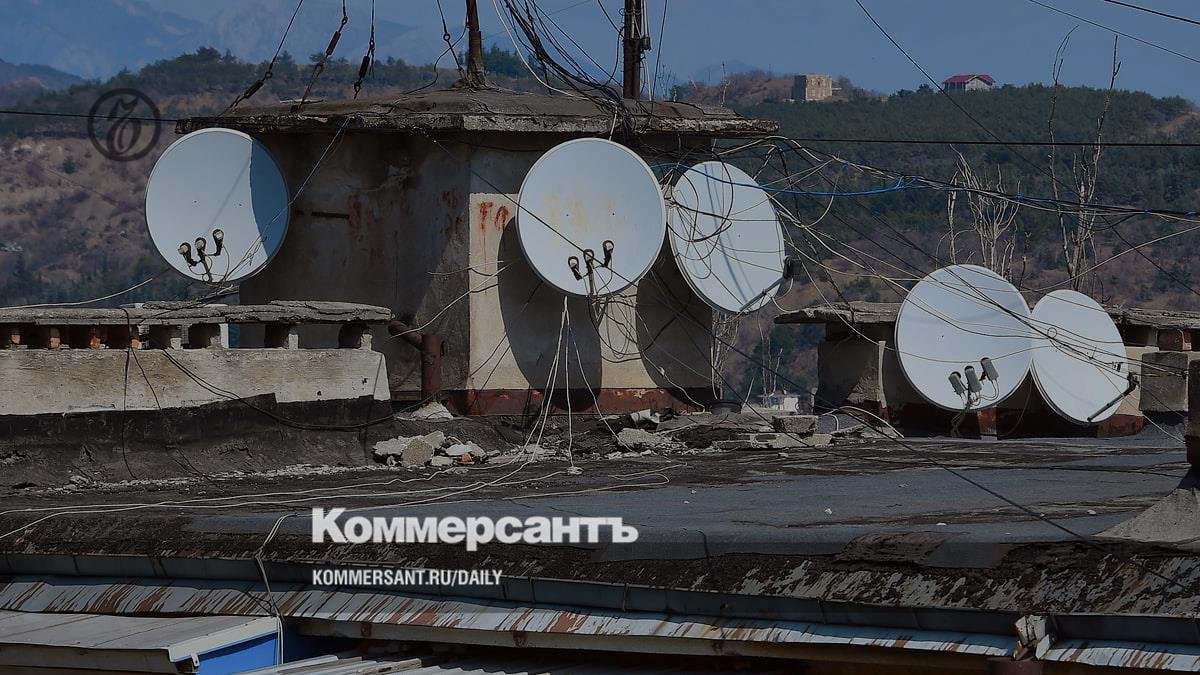
According to Kommersant, the Ministry of Digital Development was instructed to look into the situation of the use of unlicensed satellite equipment – “Gorynychi” – in Crimea. Now, according to expert estimates, 34% of the peninsula’s population uses them. The prevalence of these devices, which allow receiving Ukrainian TV channels, is explained, in particular, by the absence of bans on their use, similar to those introduced in the DPR, LPR, Zaporozhye and Kherson regions, as well as the insufficient availability of licensed alternatives.
As Kommersant learned, on April 27, a meeting was held in the Federation Council at which topical problems of communications and telecommunications were discussed. The meeting was attended by representatives of the Ministry of Digital Development, the general director of the satellite television operator Russkiy Mir, as well as the ministers of digital development of the Kherson and Zaporozhye regions, and the DPR. During the meeting, a report from the research company “Grifon Expert” was presented assessing the use of unlicensed satellite equipment (“Gorynych”, which receives signals simultaneously from three satellites, in particular, is capable of broadcasting Ukrainian TV channels) in Crimea for April 2026 (the report is available to Kommersant).
It follows from the report that today Gorynychi is used by approximately a third of the region’s population (34%).
The report does not provide specific usage rates by population group, but it does indicate that among all users of these receivers, “the largest share is among middle-aged residents (35–54 years) and young adults (18–34 years),” and the smallest share is among older age groups (55–70 years).
At the same time, only 17% of the population of Crimea are users of licensed satellite TV, and 49% in general do not have satellite TV.
At the beginning of March, the Russian telecommunications satellite Express-AT1, which broadcast in Crimea and new regions and was used by Russkiy Mir, failed (see “Kommersant” dated March 10). At the beginning of April, the operator of the Express satellite constellation completed the transfer of the Express-AT2 device to the position of the failed satellite to restore broadcasting (see “Kommersant” dated March 30).
“The more access a respondent has to alternative content, the more often their opinions differ from the average, are more negative, and become less stable,” the report says. These trends are most pronounced among residents of rural areas, as well as among representatives of young and middle age groups, “who demonstrate the lowest level of trust in official sources of information and a higher orientation towards alternative information channels,” the report states.
Following the meeting, the Ministry of Digital Development was instructed to check how many “Gorynychi” are working in Crimea, as well as to deal with the high level of penetration of unlicensed equipment, three sources familiar with the results of the meeting told Kommersant.
A representative of the Ministry of Digital Arts assured Kommersant that the use of satellite receiving equipment of unknown origin, which provides access to illegal TV channels, is not common. “But in the regions that reunited with Russia in 2022, similar sets – “Gorynychi” – were found quite often. Last year, the leadership of the Donetsk and Lugansk People’s Republics, Kherson and Zaporozhye regions at the regional level established bans on the sale and use of such equipment,” the ministry clarified. Also, according to the Ministry of Digital Development, the authorities of Crimea and Sevastopol are working on a solution to the issue of replacing Gorynychi with licensed equipment. “Russian World” (broadcasts in the Crimea, DPR, LPR, Zaporozhye and Kherson regions) did not answer Kommersant.
Experts call the prevalence of unlicensed equipment for receiving satellite TV in Crimea as expected.
Kommersant’s interlocutor at the media market clarifies that until 2014, “Gorynychi” was one of the main ways to obtain information in Crimea.
“And today the lack of a legislative ban, similar to what is in effect in new territories, is having an impact,” Kommersant’s source continues. At the same time, according to him, none of the satellite television operators, except for Russkiy Mir, has a license to broadcast on the peninsula. The company itself, as the source assures, does not yet work there en masse. In addition, programs for replacing unlicensed equipment with licensed ones, which exist in the LPR, DPR, Kherson and Zaporozhye regions, do not work on the peninsula, he says. “The reasons may also be a banal habit of once-installed equipment and a reluctance to pay for a subscription. All this in total allows part of the population to remain in the Ukrainian information field,” says another Kommersant source in one of the operators.