By Susan Botting, Local Democracy Reporter of RNZ and is republished with permission
Whangārei’s $32m Te Matau a Pohe bascule bridge is to be closed for repairs after the discovery of cracks inside its distinctive fishhook shaped structures.
The cracks need urgent repairs to prevent damage to the structure.
Te Matau a Pohe, which is New Zealand’s only rolling bascule bridge and one of fewer than a dozen of its type in the world, opened in July 2013.
Since then it has lifted more than 25,000 times for boats making their way along the lower Hātea River, just upstream from where it meets Whangārei Harbour. About 50,000 boats have crossed underneath heading between the Whangārei Town Basin and the harbour.
The cracks have been found in welding inside the steel hook beams.
Whangārei ratepayers paid about $17 million towards the bridge’s construction, in conjunction with NZTA Waka Kotahi.
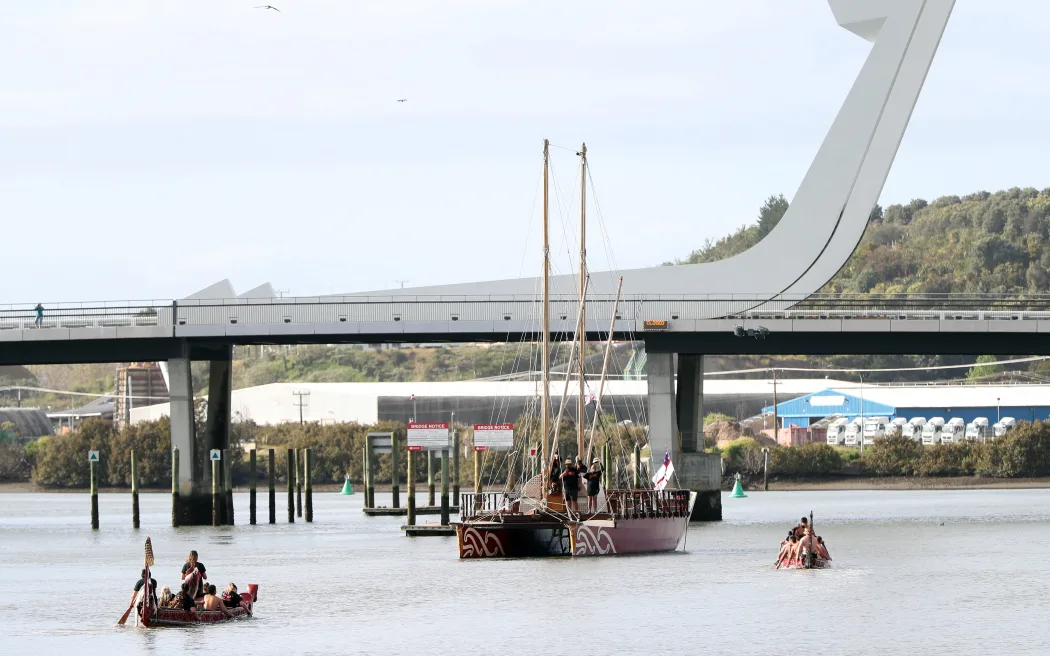
The bridge’s two distinctive giant white curved shapes are almost 20m tall and represent Māori fishhooks, reflecting local traditions of fishing, navigation, and the cultural relationship with Whangārei Harbour.
Te Matau a Pohe is one of Whangārei’s most visible landmarks.
There are around 4 million vehicle movements over it each year. That’s about 11,000 daily, around 40 percent more than the 8000 it was originally designed for.
Te Matau a Pohe will be closed for 24 hours to do repairs, from 6am Sunday 10 May at to Monday 11 May.
Its fishooks are the main structural arms of the bridge’s rolling bascule (lifting) mechanism. They allow the bridge deck to roll back and lift for boats.
They which each weigh 360 tonnes, their moving arms making the rolling motion possible and stable.
A 25 metre section of the bridge opens to let boats through. The opening road section rolls backward and upward along a curved track whilst the fishhook‑shaped beams roll with it, their 67‑tonne counterweights moving in the opposite direction to keep the system balanced.

The giant fishooks of Te Matau a Pohe stretch towards the sky as a vessel makes its way under the Whangārei bridge. Photo: NZME
Te Matau a Pohe and Dave Culham Drive will be closed to vehicles and boats – but pedestrians will be able to walk the bridge’s footpaths unless there is an emergency.
Repair backup dates have been scheduled for 17 May and 24 May.
Whangārei Mayor Ken Couper said the cracks had developed in internal welds over time.
“The need for these repairs was identified during a routine structural inspection and the recommendation was to carry them out promptly to avoid any future damage or disruption,” Couper said.
Repairs to the welds were being done to ensure the structure’s long-term durability.
He said the welds had not failed or come apart.
In a council communication forwarded to boaties, the need for the weld repairs was described as urgent.
Whangarei Marina has advised boaties who might want to cross under the bridge during its closure to make alternative arrangements.

Whangārei Mayor Ken Couper. Photo: NZME
Those who needed access under the bridge during that time could possibly be accommodated at the new Okara Marina, downstream of Te Matau a Pohe.
Dave Culham Drive will be closed from Port Road to Riverside Drive – with detours via Riverside Drive and Dent Street.
Te Matau ā Pohe was designed by UK bridge specialists Knight Architects, in collaboration with New Zealand engineers Peters & Cheung (now Novare Design) and others, for Whangārei District Council.
The bridge has won more than a dozen national and international awards including the transport infrastructure award and then supreme engineering excellence award at the 2014 New Zealand Engineering Excellence Awards.
Te Matau ā Pohe means “the fishhook of Pohe”, referring to Pohe, the rangatira who welcomed early European settlers to the Whangārei area.
Cracks in internal welds are taken seriously because they occur in high‑stress areas, a known fatigue issue in large steel bridges and can usually be monitored and repaired long before safety is compromised.
The way cracks in bridge steel are dealt with depends on crack size and length, whether they are growing and whether they affect primary load-carrying parts of the bridge such as its main beams, supports, and connecting pieces.
In large steel bridges, weld cracks are typically repaired once they reach a few centimetres in length, show signs of growth, or occur in critical load‑bearing locations.
Repairs are usually triggered by crack growth or location, rather than waiting for large visible damage.
LDR is local body journalism co-funded by RNZ and NZ On Air.