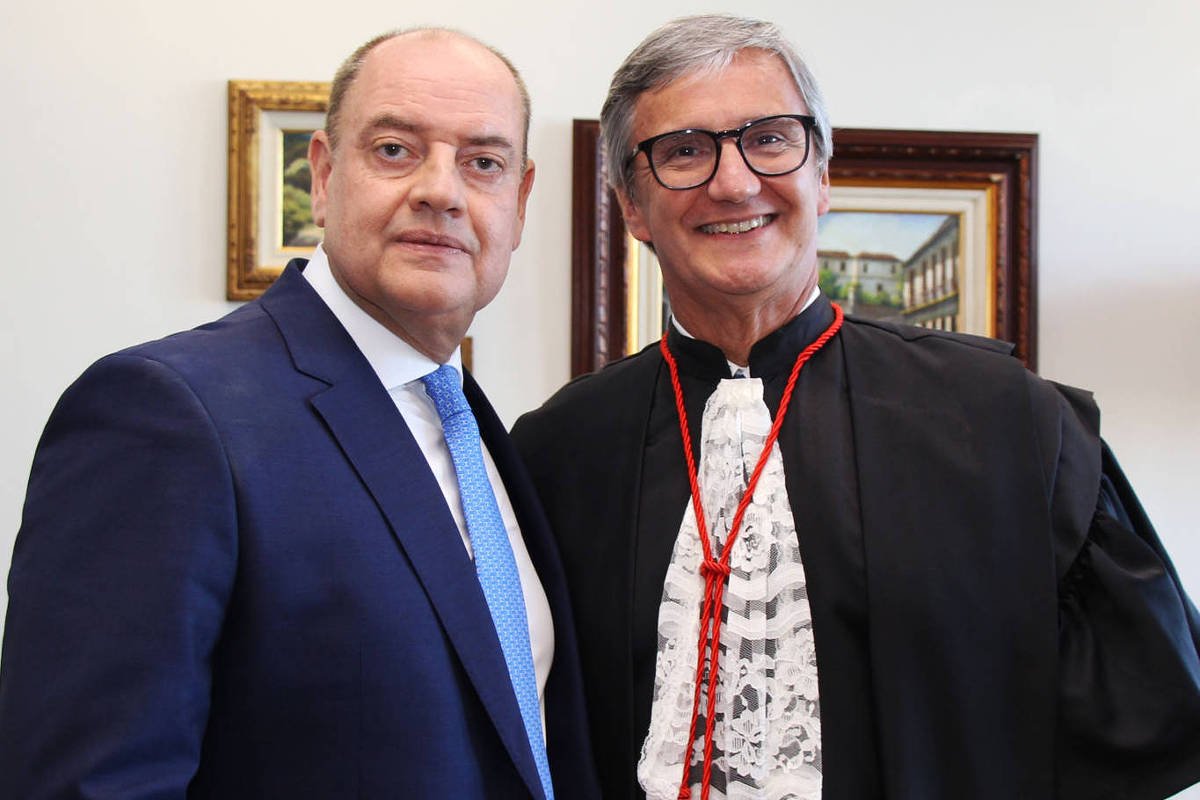
Long-time ally and friend of Ricardo Couto, president of the Court of Justice of Rio de Janeiro (TJ-RJ) and interim state governoralso judge Henrique Figueira defined the measures taken by the deputy of Claudio Castro and defended the performance of the Federal Supreme Court in this case.
Recently retired from the judiciary after 37 years of experience at the TJ-RJ and back as a lawyer at his family’s office, Figueira has established himself in recent years as one of the most influential names in the Rio de Janeiro Judiciary, having been president of the TJ-RJ in the 2021-2022 biennium and of the TRE-RJ (Regional Electoral Court) from December 2023 to March 2025.
“He’s doing a spectacular cleaning. He’s tidying up the secretariats, removing all the political bias he could have, because he doesn’t have any political bias. But he has management skills, he’s an expert at it,” Figueira told Sheetabout the measures announced by the interim, such as cutting expenses, dismissal of commissioners and contract audits.
“When I was president of the court (TJ-RJ), Ricardo Couto worked with me, he helped me a lot. At that time I saw the sense of administration he has. He is spectacular, he has training in that.”
Couto has avoided making public statements. In a brief interview with Sheet Shortly after assuming the interim position following Cláudio Castro’s resignation in March, he said that “a court president is not prepared to be the governor. He will take on emergency, specific, temporary situations to make this transition.” He also stated that “the president of the court has a more rigid view of things. It is a more legalistic view.”
The judge completed a month with accumulation of the positions of interim governor and president of TJ-RJ. As a report from the SheetCouto has been ruling at the Court of Justice and using magistrates from the court structure to study topics of interest to the Executive. At the same time, he continued to sign administrative acts of the Judiciary, but avoided analyzing processes that involved political disputes in the state.
The dual function bothers politicians linked to Castro and Bolsonarism in Rio, but it also raises criticism, in small talk, among members of the TJ-RJ itself, for whom the accumulation of power is undue and the actions of the STF constitutes a political intervention outside the federal and state Constitutions – which determines the precedence of the president of the Assembly over the president of the TJ in the line of succession.
Couto is in office thanks to an injunction from STF minister Cristiano Zanin on March 27, in response to a PSD request for direct elections in the state. Even after the Legislative Assembly of RJ (Alerj) elected state deputy Douglas Ruas as president (pre-candidate for governor) –by law, whoever holds this position should occupy Castro’s seat–, the STF kept Couto as head of the Executive.
When rejecting Alerj’s request for Ruas to take over as judge, Zanin claimed that, during the trial on how the election will be held to end the impasse, the court’s plenary decided that Couto will remain in office until further deliberation by the Supreme Court.
This vote is suspended in the STF due to a request from Minister Flávio Dino – at the time, the score was 4 to 1 in favor of an indirect election, that is, in charge of the Alerj deputies.
In speech last Tuesday (28) in the Senate plenarysenator Carlos Portinho (RJ), leader of the PL in the House, he complained about the situation. “What is happening in Rio de Janeiro today is the materialization of a judicial state of exception. This is extremely serious. The president of Alerj should already be in office and call indirect elections”, he criticized.
For Portinho, although Couto – whom he said he met because he was a lawyer – is “an upright, honest person, suited for the judiciary”, he is a “bionic governor” (nickname for politicians who do not face election). “Good person, but that’s not the law, he wasn’t elected by vote.”
Henrique Figueira stated that he does not see “the slightest chance” that there will be an articulation involving Eduardo Paes’ PSD – a pre-candidate for the Rio de Janeiro government and interested in keeping Couto as interim –, President Lula’s PT (which will support Paes in the October election) and the STF to prevent Ruas from taking over the Guanabara Palace.
“Nobody has that strength with the Supreme Court, in my view. The Supreme Court has independence, autonomy, it knows what it is doing, they are the top leadership of the Judiciary, they would not be influenced to that point”, said the former president of the TJ-RJ.
Figueira also defended the accumulation, by Couto, of the heads of the Executive and Judiciary. “He is only in the role of governor because he is president of the TJ. If he leaves the presidency of the TJ, there is no way he can remain as governor. Of course, he must have delegated the day-to-day acts to judge Sueli (Lopes Magalhães), first vice-president. And he has a team of assistant judges who must be at her disposal. There is no break in continuity.”
When he presided over TRE-RJ, Figueira voted for impeachment of Cláudio Castro in the Ceperj case (irregular use of the structures of the homonymous foundation and UERJ to recruit canvassers and distribute positions and funds in the 2022 election), but was defeated – the court acquitted the then governor by 4 to 3, who would later be convicted by the TSE. In a second trial, regarding campaign spending, Figueira voted to acquit Castro, and the vote in the TRE was 5 to 2 in favor of the politician.
VACANCIES AT STJ
Management with moralizing and cost-cutting measures has reinforced, behind the scenes in the Judiciary and Rio politics, the rumor that Couto is a candidate for a position as minister of the STJ (Superior Court of Justice).
There is a newly opened seat in the court, that of Antonio Saldanha Palheiro, from TJ-RJ, which increases the chance that it will be occupied by a magistrate of the same origin. By November, there will be another, with the retirement of minister Og Fernandes – there is still the possibility of a third, if Marco Buzzientangled in harassment cases, also leave the court, which is considered probable in the court.
It is the President of the Republic who chooses the STJ ministers, based on a list sent by the court itself.
According to the STJ rite, an essential requirement for any candidate is the support of court ministers from the same state. In other words, before a future appointment by Lula, Couto would need to be anointed by ministers from the Rio de Janeiro judiciary, especially those who were also judges of the TJ-RJ (and not of the Federal Court), such as Luis Felipe Salomão and Marco Aurélio Bellizze.
According to TJ-RJ sources, Salomão – recently elected president of the STJ, will take office in August – supports another candidate for the vacancy at the STJ, that of judge Mauro Martins. Couto would have the support of Bellizze.
Officially, Couto is not a candidate. Normally a judge who seeks such a position does not assume it, at least not before being sure of the support.
Figueira claims that the ally is not in the dispute, or at least not immediately. “Ricardo has all the qualities to be a minister of the STJ, a minister of the Supreme Court, he is brilliant, a point very out of the curve. I think he is not a candidate. He has a court to take care of and I don’t think he will let go of it during his term. It could be that later, when his term ends, in February, he will come… I don’t know.”
The argument does not prevent the candidacy. If three vacancies are open, it is possible that, instead of the STJ preparing the usual triple list for each of them, it will prepare a single list with five names – or with four names, if there are only two vacancies. Today the tendency is for the court to wait for the other right vacancy, that of Og Fernandes (or the others, in case of Buzzi’s departure), to open before carrying out a single process – which would increase the chances of those nominated on the list, even if it is fivefold.