When Chinese automakers first expanded into Europe around 2005, selling cheap copies of European and Japanese models with poor quality ended in failure.
For example car manufacturer Brilliance wanted to sell 150,000 cars in Europe during the first five years. However, it burned in the crash tests, in which it did not get a single star. During the frontal impact, the floor under the driver was torn, the car lacked safety features and stability.
In 2010, Brilliance finally withdrew from the European market due to lack of interest and bad reputation.
Other Chinese brands, on the other hand, took offense to the fact that they (unsuccessfully) stole the design of European competitors. For example, the Shuanghuan Sceo was strikingly reminiscent of the BMW X5.

The current issue of INDEX is full of useful and interesting topics from the world of business, finance and economics. (source: Hey You!)
But that is the past. Chinese automakers have made great progress and their second foray into Europe is going much better from their point of view.
It is also beginning to show in the statistics of the Association of the Automobile Industry (ZAP). According to them, just over 93,000 passenger cars were sold in Slovakia last year, of which approximately 2,100 were Chinese (more than two percent of the total number).
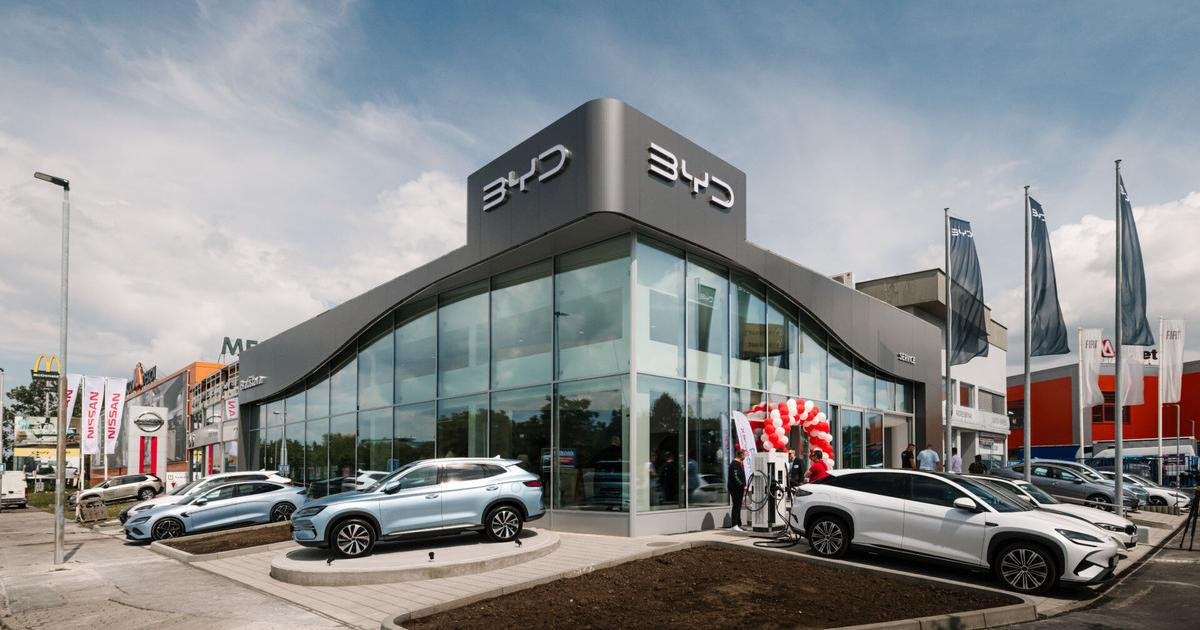
MG, which has been operating in Slovakia since 2022, and BYD, which started selling its cars here last year, took a dominant part in this. However, others are entering the market and the scale of their expansion indicates that the occurrence of Chinese cars on Slovak roads will increase.
Direction Europe
It is important for Chinese brands to operate in Europe that they understand that if they want to succeed, they must speak its visual language. So instead of copying, they hired the best minds in the industry.
Designer Wolfgang Egger, who used to work at Audi and Alfa Romeo, designs cars for BYD, Peter Horbury, with experience from Volvo and Ford, was behind Geely’s progress, and Giles Taylor, who used to work at Rolls-Royce, works for Hongqi.
Brands like Nio or MG have giant design studios in Munich and London. Thanks to this, their products do not look typically Chinese, but global and premium.
Chinese concerns were also helped by state subsidies and a focus on the development of designer cars with cutting-edge software, in which they gained a technological edge over European competition.
Subsidies enabled the creation of 150 car brands and a huge underbelly of the entire industry. However, strong competition and a price war in the domestic market have caused many of them to bleed financially and their survival strategy is to expand into Europe.
It is currently the only large, rich and technologically advanced market for them, where they have a real chance to succeed, even if at the cost of higher tariffs. It is a market where they can make a higher margin and make up for their losses in China.
Chinese avalanche in Slovakia
In the first batch during the pandemic in 2020 and 2021, Chinese brands entered the markets of Western Europe with electric cars. Slovakia was one of the last European strongholds.
The reason is the size of the market, which could be compared to the suburbs of a large Chinese city. The disadvantage of Slovakia is also the lowest rate of electrification, which is why it was not interesting for the Chinese.
That has obviously changed. Currently, 17 Chinese brands sell cars in Slovakia, most of which arrived only last year.
Established car companies MG, BYD and Dongfeng were joined by newcomers Omoda, Jaecoo, BAIC, Leapmotor, DR Automobiles, Xpeng, EVO, ICH-X and Sportequipe. In addition, Hongqi, MHero, Denza and Voyah entered the premium segment.

Omoda 5 in electric version. (source: Chery)
But that’s just the beginning. Another eight new brands from China should enter the Slovak market in the coming months. By the end of this year, their number could reach 25.
One of them is Chery, which will sell a hybrid SUV. Nio, Geely, Zeekr, Jetour and the Chinese concern GWM, which includes the brands Haval, Ora and Tank, are also preparing to arrive.
The vast majority of brands are largely unknown to the Slovak customer, therefore marketing and added value at a fair price will depend on the start of sales.
It is quite surprising that the Chinese have not yet had to significantly reduce prices in Slovakia, because they are comparable to the products of traditional car companies. Some brands have focused on cars with internal combustion engines, from which several Western car manufacturers are backing away.

Most often through the importer
The entry of Chinese brands into the European market is not just about transporting cars to a European port and loading them onto trucks. It is a complex process that includes building a service and sales network, logistics of spare parts and European homologation.
It is necessary to equip European certificates (type approval) for every component on the vehicle, from lights and indicators to bumpers and steering wheel. Each part goes through trials and testing, and the production process must be adapted to European standards, which makes it more expensive.
Chinese brands enter the Slovak market in three ways. The most common strategy is cooperation with an independent importer in Europe, who will solve homologation and other obligations for the brand.
The importer of the Chery brand is the Kazakh company Astana Motors. Omoda and Jaecoo, in turn, reached an agreement with the Hungarian company Grand Automotive. DR Automobiles, which also offers one of the cheapest SUVs on the market (Evo 5 priced from 17,990 euros), represents Agrotec Group, which until recently was part of the Czech Prime Minister’s Agrofert Andrej Babiš.

Model Evo 5 (source: DR Automobiles)
MG, on the other hand, presents itself as a traditional British brand, but it has been owned by the Chinese concern SAIC for years, and the production is also completely Chinese. The importer AB Motors, which belongs to the Dutch company AutoBinck, is behind its arrival in Slovakia.
Last year, the Xpeng car company also came under the wings of the Swedish importer Hedin Automotive, which in the past also took over the activities of the Motor Car company, known mainly for the sale of Mercedes.
The Košice company Plastonic, which represents the brands Dongfeng, MHero, Hongqi, Forthing and Voyah, also acts as an importer. It has import warehouses in Ostrava, Galant and Budapest.
“We currently have several hundred vehicles in storage for three key markets. At the same time, there are approximately eight thousand vehicles in the central European warehouses of the manufacturer in Poland and Slovenia,” says the head of Plastonic, Branislav Kocper.
His task is to build partnerships with dealers who will sell and service cars. Kocper claims that there are many people interested in selling and that they prefer dealers who have been on the market for at least twenty years.
According to him, Dongfeng currently has twenty sales and service locations in Slovakia, and the network is gradually expanding for other brands.
Dongfeng, Voyah and MHero use a central European spare parts warehouse in the Dutch city of Venlo, while Forthing and Hongqi have one in Budapest.
“As an importer, we also operate our own warehouse of spare parts, which is in Prešov. The total amount of parts is close to one hundred thousand pieces,” says Kocper.