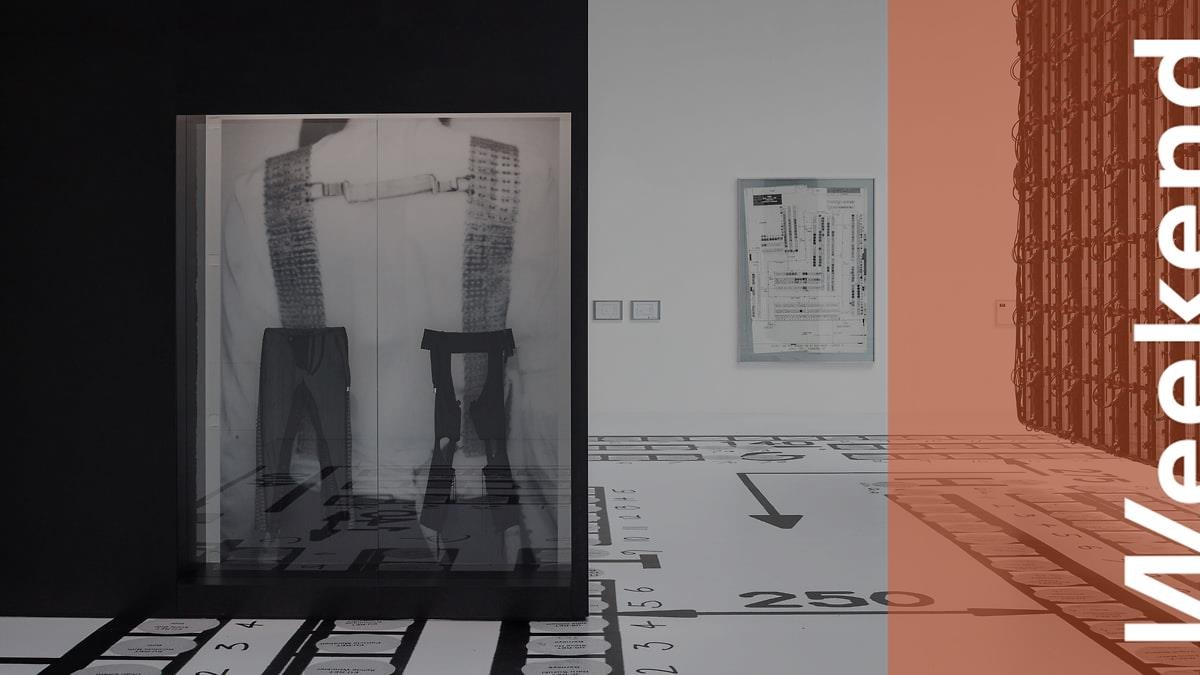
The Helmut Lang exhibition is ending at the MAK Museum of Applied Arts in Vienna. Seance de travail. 1986 – 2005, dedicated to the legacy of the Viennese minimalist. Here where there is not a single mannequin with clothes and almost no clothes at all. But this is precisely what made the exhibition one of the most significant and profound in recent years.
At the very beginning, in front of the first hall, under the high arches of the MAK Museum, there is a large screen showing the autumn-winter 1998 collection. Models of both sexes look at the viewer in white, black, grey, beige and even lemon Helmut Lang items. Lang was generally the first to not only post excerpts of his offline catwalk shows on the Internet, but also do special online shows. The captions read: “Helmut Lang Collection hommes femmes. Sance de travail dfil # hiver 98/99 Tuesday March 31, 1998 www.helmutlangny.com”.
Sance de travail – “working session”, as he called his shows, emphatically de-romanticizing and de-dramatizing them. And it was precisely this name that was included in the title of the exhibition – “Helmut Lang, Working Session. 1986–2005.” In the first room, a CNN news clip from January 2005 is scrolling on a small screen, and below is the news that Lang is leaving Prada, which finally bought Helmut Lang in October 2004. This defines the time frame of the exhibition – the approximately 20 years that Helmut Lang was involved in fashion, from the moment he created his own brand in Vienna until the moment he left it. In about a year, the Prada Group will sell Helmut Lang – almost simultaneously with Jil Sander, the brand of another minimalist classic, which they bought at the same time as Helmut Lang. And also quite quickly after the departure of Gilles Zander herself, they abandoned him.
Everything that fills the halls of this insert – and it is quite large – came to MAK in 2011, when, after a fire at a studio on Long Island that destroyed part of Lang’s archive, he transferred the rest to MAK. Its director, Lilly Hollein, says that as soon as she took over the post four years ago, she immediately went to America to negotiate with him about an exhibition based on this archive – and she finally managed to convince Lang, although he hates all retrospection and nostalgia.
Architectural plans of stores, technical photographs of their interiors, design project of a studio and office in New York, layout of advertising spreads, packaging and bottles of a perfume line, seating plans for shows, a list of clothes issued to celebrities (the radically thinner Karl Lagerfeld got a full look, but the monumental Andre Leon Talley only clogs), personal letters, amateur photographs, sheets from magazines with filming, newspaper publications and even a lightbox from the roof of a New York taxi with the Helmut Lang logo, part of a 2002 advertising campaign. Everything that is usually pushed into the far corners of other exhibitions, in the center of which there are always mannequins in dresses, and which everyone usually passes by almost without looking, is the main content here. And this exhibition is absolutely breathtaking – having arrived at it just after noon and planning to spend a couple of hours there, I left there at six in the evening, when security had already begun to close the halls.
Lilly Hollein and museum curator Marlies Wirth, who developed this witty and, frankly, brilliant project, as well as its shorthand concept, note that the absence of clothes is a strategy adopted from Lang himself, for whom the brand named after him was not just a way to produce and sell clothes, but the realization of his own idea of \u200b\u200bwhat it means to be cool (which, in general, is characteristic of any real fashion) and the creation of an integral world in which those who live with this coolness embodies.
Therefore, next to his name, the Wagnerian term Gesamtkunstwerk regularly appears – the combination of different types of art into one integral, complex work of art. Gesumkunstwerk is not Gesumkunstwerk, but Lang was one of the first to change fashion optics. He swapped the usual mannequins in shop windows and slender young models in advertising for the absence of mannequins and Louise Bourgeois hugging her phallic sculpture in the campaign. Lang was also among the first fashion designers to understand the power of modern art and use it very organically. He designed the interiors of the Helmut Lang perfume store in New York with his friend Jenny Holzer, installing her LED tickers throughout the space. He regularly changed the works of Louise Bourgeois in the windows of a Parisian store, a sculpture specially made by her was exhibited in the same New York perfume store, and her installation The Cell stood in his New York studio. These practices were adopted by everyone long ago, but in Lang’s case they were truly part of his personality, his human relationships and his own also quite artistic vision.
There are clothes here, too, albeit without any mannequins, and they serve not an illustrative, but also a conceptual function. For example, a wall with his black accessoire-vtements, as he called them – items of clothing reduced to an almost bare structure in the form of a collar, belt, fastener bar, etc., which are collected into something single and reminiscent of either harness, or ammunition, or some kind of fetishistic object. Or a similar wall with his famous white jerseys modified in various ways. Or a silver astronaut jacket with internal parachute-like straps that allow you to wear this jacket over your shoulders.
This is how a completely visible and conceptually intelligible picture of the world of Helmut Lang emerges, and it becomes clear what the minimalism created by Lang was about. Absolutely, by the way, not what is now commonly called by this word (and this is almost everything where there are absolutely no roses and rhinestones) – and this is also an important educational result of this exhibition.
The great minimalism of the 1990s was a very strict aesthetic system, based not simply on a reduction in color palette or unification of cut, but on an analytical approach to clothing – like, in fact, all innovative fashion of that time. And the result of this analysis was not just a rejection of ruffles and flowers, but a strict limitation of expressive means, reducing all techniques to a thoughtful minimum and exposing this minimum, concentrating on it.
Minimalism did not reduce to zero, but, on the contrary, maximally sharpened the expressiveness of all the means remaining in the arsenal – that is, it was not at all a mass-market set of a white T-shirt and jeans, but witty Lang T-shirts with cutouts, slight disproportion and overlapping details, and spectacular designs of straps, suspenders, collars and zippers put on top of them. Asceticism and rigorism became the basis of radical aesthetics, which then captivated an entire generation. And, as usually happens after such epoch-making exhibitions, perhaps its emanations, like the light of a long-vanished star, will reach us – and we will see them in next year’s collections.