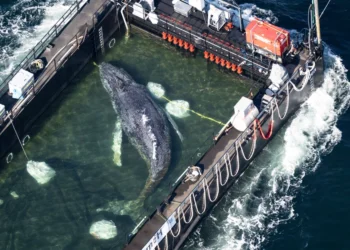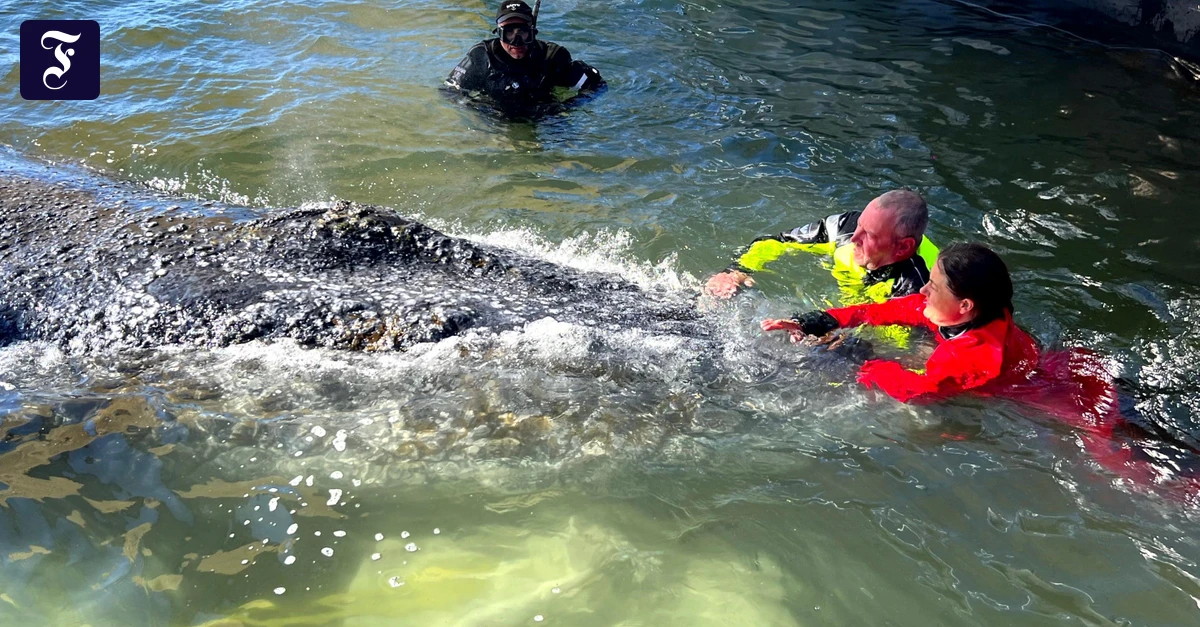
According to information from the team responsible for the private initiative and images from the live stream provider News5, the humpback whale, which was rescued from a shallow Baltic Sea bay on the island of Poel, is in the North Sea been released. The whale was no longer in the barge around 9 a.m., said Jens Schwarck, a member of the private initiative and who was present during the transport, to the German Press Agency. The convoy was in Skagerak about 70 kilometers from Skagen in the morning.
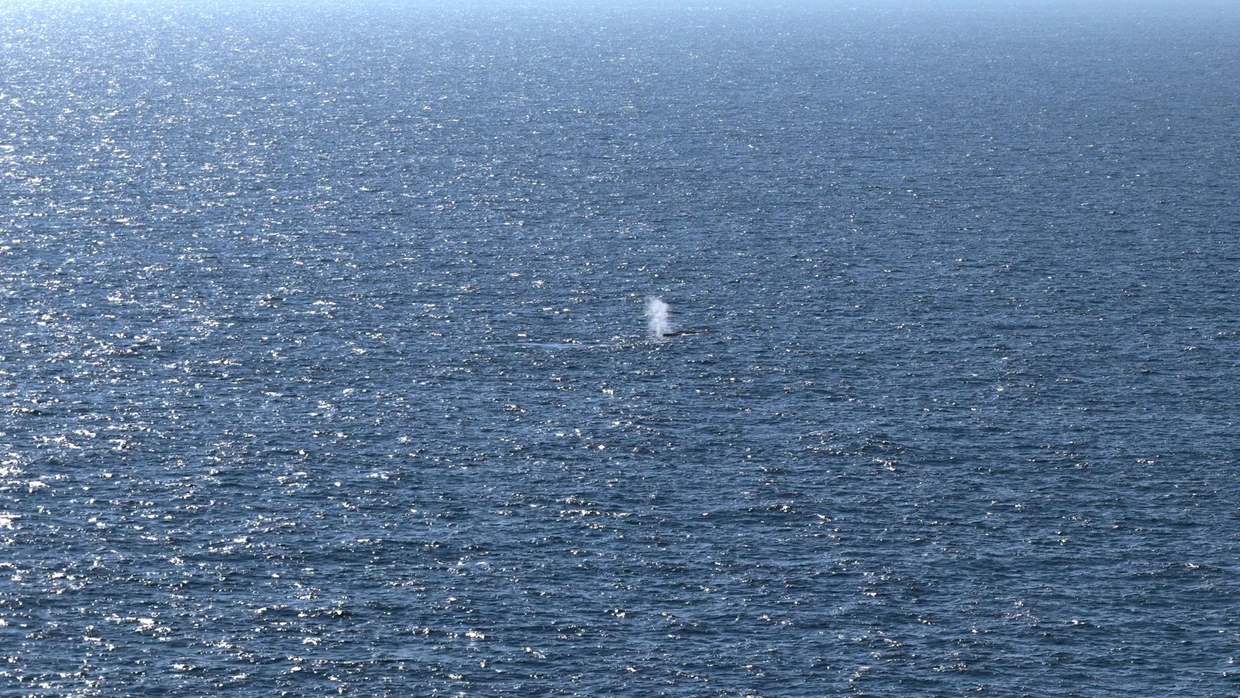
News5 drone footage showed a whale swimming in the water at times. It was not possible to say with certainty whether it was actually the animal that was released.
It is still unclear whether there is transmitter data, said Schwarck. There was also no information about what condition the animal was in and how exactly it swam or was maneuvered off board.
First spotted in the Baltic Sea at the beginning of March
The barge carrying the humpback whale, which had stranded several times on German Baltic Sea coasts, had almost reached the North Sea on Friday after a day-long journey, but turned around about 20 kilometers from Denmark’s northernmost point. At this point near the town of Skagen, Kattegat and Skagerrak flow together, which is why it is also referred to as the entrance to the North Sea.
There had been high waves in the area of this transition for hours. In calmer water, a little way back into the Baltic Sea, the barrier net at the back of the barge was removed in the afternoon. The water level in the barge was initially not changed, according to the initiative team. Despite the now open exit, the whale had not left the barge for many hours.
Before the whale was released, a GPS transmitter was said to have been installed to identify the whale’s future location. It was initially unclear whether this was successful and the transmitter provided data.
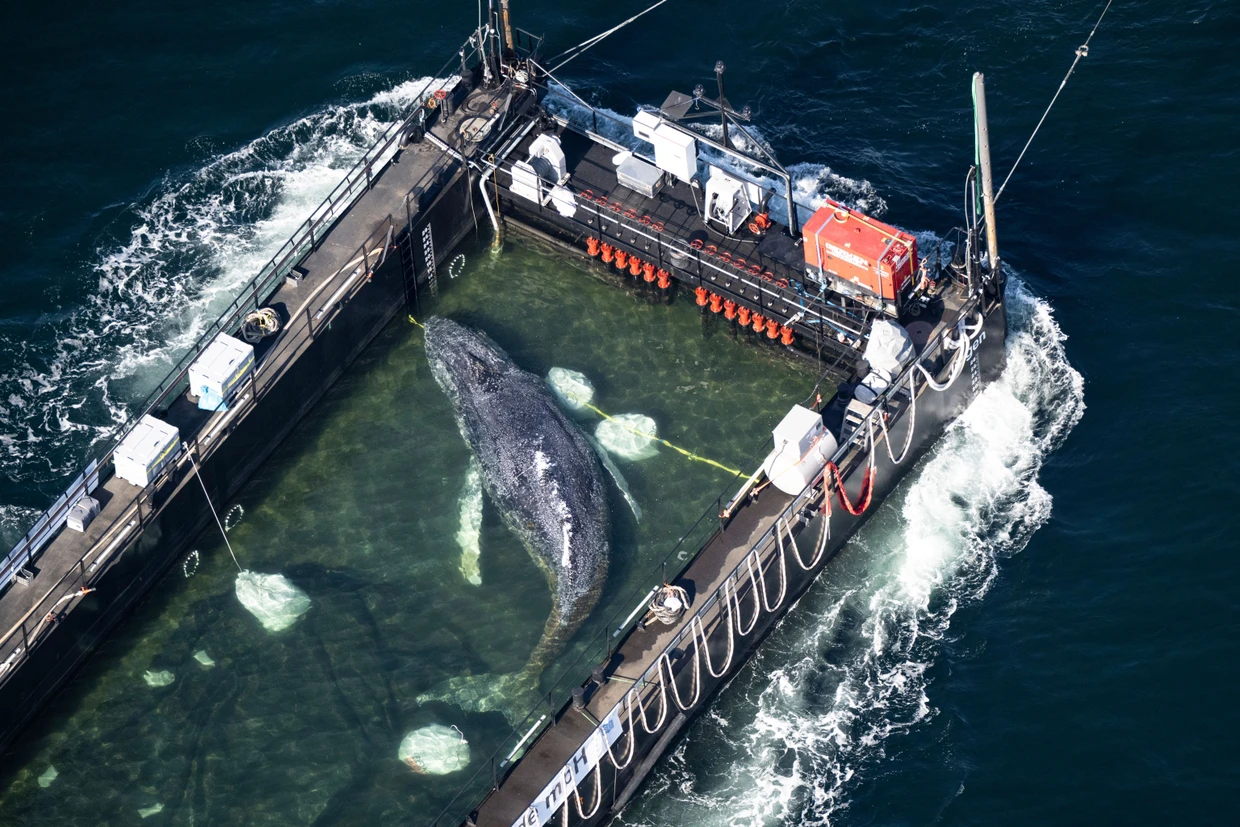
The four to six year old bull whale was first seen in the Baltic Sea at the beginning of March. In the approximately 60 days leading up to transport, he spent around two thirds of the time in shallow water zones. On Tuesday he was maneuvered into a barge off the island of Poel, which was then coupled to a tugboat and set off towards the North Sea.
The whale is not considered rescued
The whale is not considered rescued even after it is released. After the long lying time, it is questionable whether the whale can still swim and dive normally, explained whale researcher and marine biologist Fabian Ritter. The question of food intake also arises because of the power supplies found in its mouth. From all indications, the whale is anything but fit.
The animal protection organization Whale and Dolphin Conservation (WDC) emphasized: “We can only speak of a rescue when the whale is back in the North Atlantic and survives there in the long term; its skin has completely recovered; it is searching for food independently again and gaining weight; and is pursuing its natural behavior.”
According to estimates by the WDC and the International Whaling Commission (IWC), among others, the whale has little chance of long-term survival. Without a functioning transmitter, however, there is a risk that the weakened animal would go unnoticed and die within days or weeks of being released.
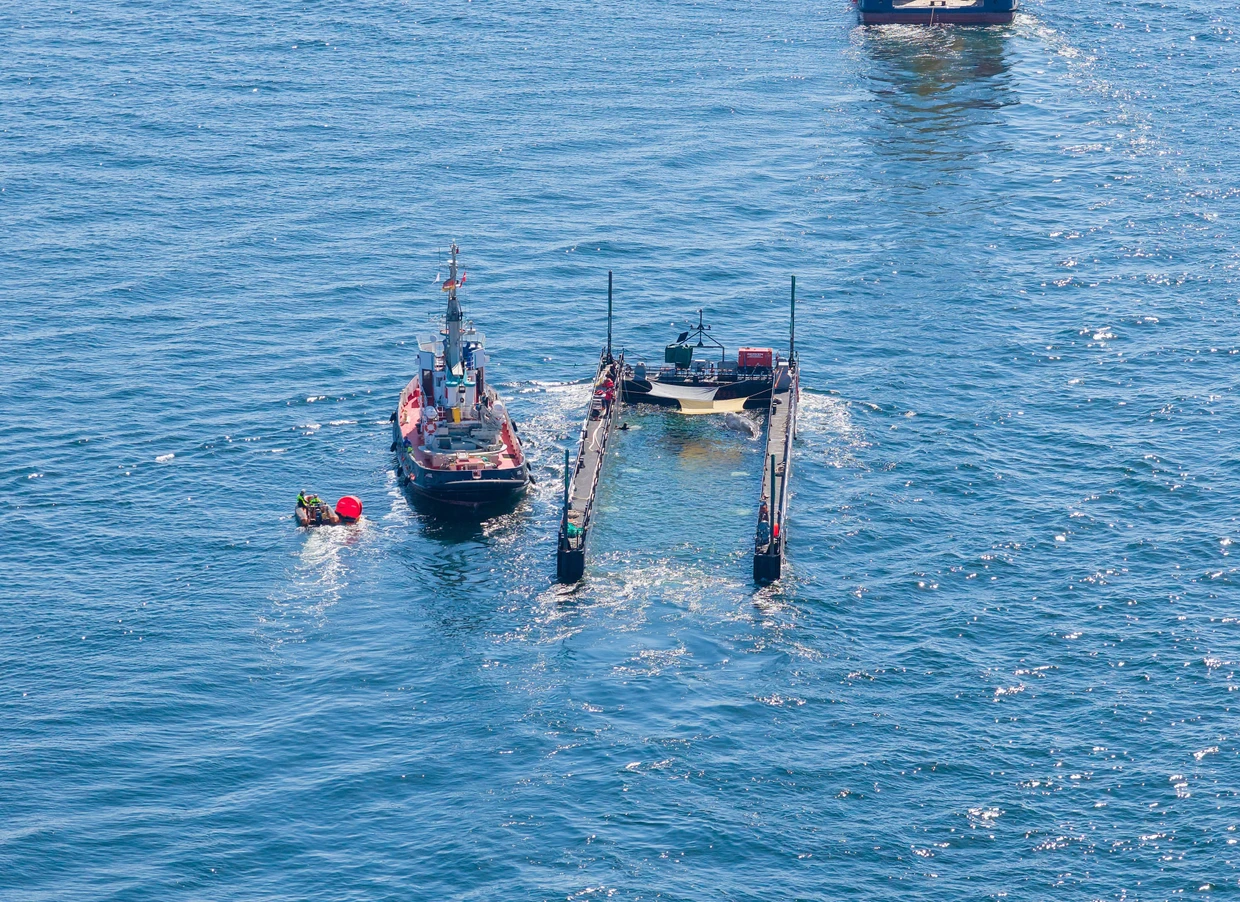
The general public will not be able to follow its path anyway: the information about where the whale is would only be available to the team members of the private initiative and the Ministry of Environment provided by Mecklenburg-Western Pomerania, said the initiative’s lawyer, Constanze von der Meden.
Could the whale get stranded again?
According to experts, the weakened animal could swim towards the coast again. “It has been documented in various regions of the world that large whales increasingly seek out shallow coastal waters with soft ground when they are extremely exhausted,” the German Oceanographic Museum explained.
In this context, the Danish Ministry of the Environment announced that, in principle, stranded marine mammals are not rescued. Strandings are “a naturally occurring phenomenon” and whales should generally “not be saved or disturbed by human intervention.”
A long-term successful rescue could probably be determined by the whale being spotted in the next few years in its northern feeding grounds, southern mating areas or even in between, during its migrations, and clearly identified using photo ID, the WDC said. “That would be a clear indication that he is following his natural behavior.”
The approximately twelve meter long whale was seen on March 3rd in the harbor of Wismar (Mecklenburg-Western Pomerania). On March 23rd it was discovered further west on a sandbank off Timmendorfer Strand (Schleswig-Holstein). Rescue attempts continued for days, including excavators digging a channel.
On the night of March 27th, the whale disappeared from the beach area – but swam back into shallow water on March 28th: onto a sandbank in Wismar Bay south of Walfisch Island. On March 29th the whale continued briefly as the water level rose, but a few meters further on the whale remained in Wismar Bay.
Environment Minister Backhaus tolerated the action
Experts tried to make him swim away by making noise. On March 30th the animal actually set off again – but only to visit a shallow water zone again on March 31st, this time in Kirchsee, a part of the Wismar Bay off the island of Poel. According to an expert opinion, the weakened animal should now be left alone.
In mid-April, Mecklenburg-Western Pomerania’s Environment Minister Till Backhaus surprisingly announced that the transport concept of a private initiative would be tolerated. The project is being financed by the entrepreneur Karin Walter-Mommert, who is known from equestrian sports, and the Mediamarkt founder Walter Gunz. Neither had been publicly recognized for their commitment to animal welfare in the past.
Experts from German institutions such as the German Oceanographic Museum were not involved, but a Peruvian writer and small animal veterinarians were involved. Again and again one could get the impression that the minister – who was not involved – was also part of the team: information on how to proceed often came not from the initiative itself, but from Backhaus.
During the preparations for the planned transport to the North Sea or even the Atlantic, there was again a lot of hustle and bustle directly at the whale – which swam away early in the morning after lying for around three weeks. Team members of the initiative tried to drive him towards the Baltic Sea from boats. There was a lot of back and forth, and after two hours the animal swam again into a shallow water zone – for at least the fifth time. The team later said that the whale had temporarily panicked.
In its new place, the animal lay largely motionless – despite new noise, including from a work platform. Animal protection organizations, whale researchers and institutions such as the Maritime Museum maintained their assessment: rest would be best for the weakened whale.
“It is entirely conceivable that the whale went into the shallow waters to rest or even die,” said the animal protection organization Whale and Dolphin Conservation. It is typical behavior for many wild animals to retreat when injured and look for a quiet place.