May 1, 2026, 8:09 p.m
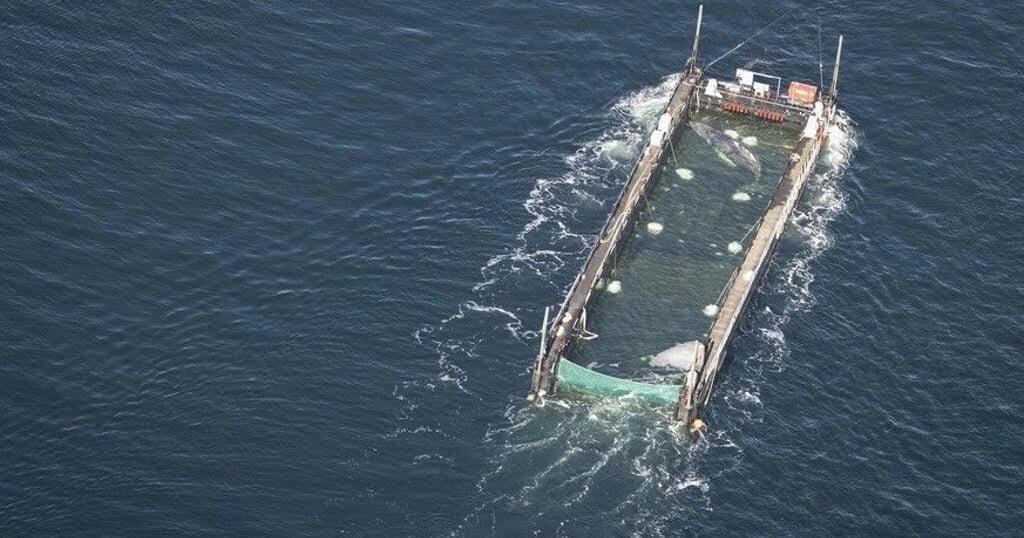
Shortly after 7 p.m., “Timmy” was seen swimming in his water tank and moving his fluke violently. He swims conspicuously towards the exit of the barge. He also blew a fountain. Two helpers accompany him in a rubber boat inside the barge. The sun protection cloths that were previously placed over the whale have now been removed. Shortly after half past six, a helper was directly in the water basin with “Timmy” to keep his skin moist. Three other helpers were on top of the barge.
The barge was opened on one side in the afternoon so that “Timmy” could swim independently into the North Sea. The tug “Fortuna B” with the attached barge and the accompanying ship “Robin Hood” were heading steadily north again on Friday afternoon, as was observed by the ship tracking service Vesselfinder. The barrier net on the barge had already been removed. According to the rescue initiative, the release was planned for “approximately 5 p.m.” – depending on the weather.
By morning the convoy had almost reached the northernmost point of Denmark, near the town of Skagen. This is where the Kattegat and Skagerrak flow together – the transition to the North Sea. However, due to the high waves, the convoy had to turn around and in the meantime headed south again. The team said the risk of injury to the whale in the barge was too great given the waves.
from Screenshot/vesselfinder.com
“, “buttons” : ( “close” ) , “loop”: true}”>

On Friday morning, the “Fortuna B” had to temporarily travel south again. (Image: Screenshot/vesselfinder.com)
Tracking transmitter attached, mains removed
Jens Schwarck from the private rescue initiative said that a tracking device had now been attached to the whale. The net on the barge can also be removed quickly if the whale needs to be released early – for example if it feels unwell or the situation becomes too dangerous for it.
Members of the initiative reiterated at midday that every kilometer towards the North Sea counts. The release was originally planned in the North Sea or further in the Atlantic.
Stranding for weeks, controversial rescue operation
The bull whale, which is around four to six years old, was first spotted in the Baltic Sea at the beginning of March. He spent around two thirds of the following 60 days in shallow water zones – most recently four weeks off the island of Poel near Wismar. On Tuesday, the approximately twelve meter long and weakened whale was maneuvered into the water-filled steel barge and has since been transported towards the North Sea.
The private initiative acted against the express advice of numerous scientists, specialist institutions and animal protection organizations. The International Whaling Commission (IWC) also spoke out against the transport. The animal protection organization Whale and Dolphin Conservation (WDC) pointed out that ignoring such recommendations could be “politically and legally problematic”.
Hardly any chances of getting to a reception center
The private initiative had discussed a sanctuary as a plan B if the whale was too weak to be released. According to the WDC, there are stations for small whales in Europe, but facilities with the capacity and experience for a humpback whale of this size are “neither known in Europe nor worldwide”. In general, large whales are not brought into human care. WDC also emphasized that, in most known cases, animals once placed in captivity can no longer be released into the wild.
Marine biologist Fabian Ritter also expressed doubts as to whether the whale could still swim and dive normally after the long lying time. Power supplies were found in its mouth, which also affects its ability to eat.
Denmark doesn’t help
If “Timmy” were to get stranded again after his release, no help would be expected in Denmark. The Danish Ministry of the Environment announced that it generally does not rescue stranded marine mammals. Strandings are “a naturally occurring phenomenon” that should not be interfered with. (mke/watson.ch)