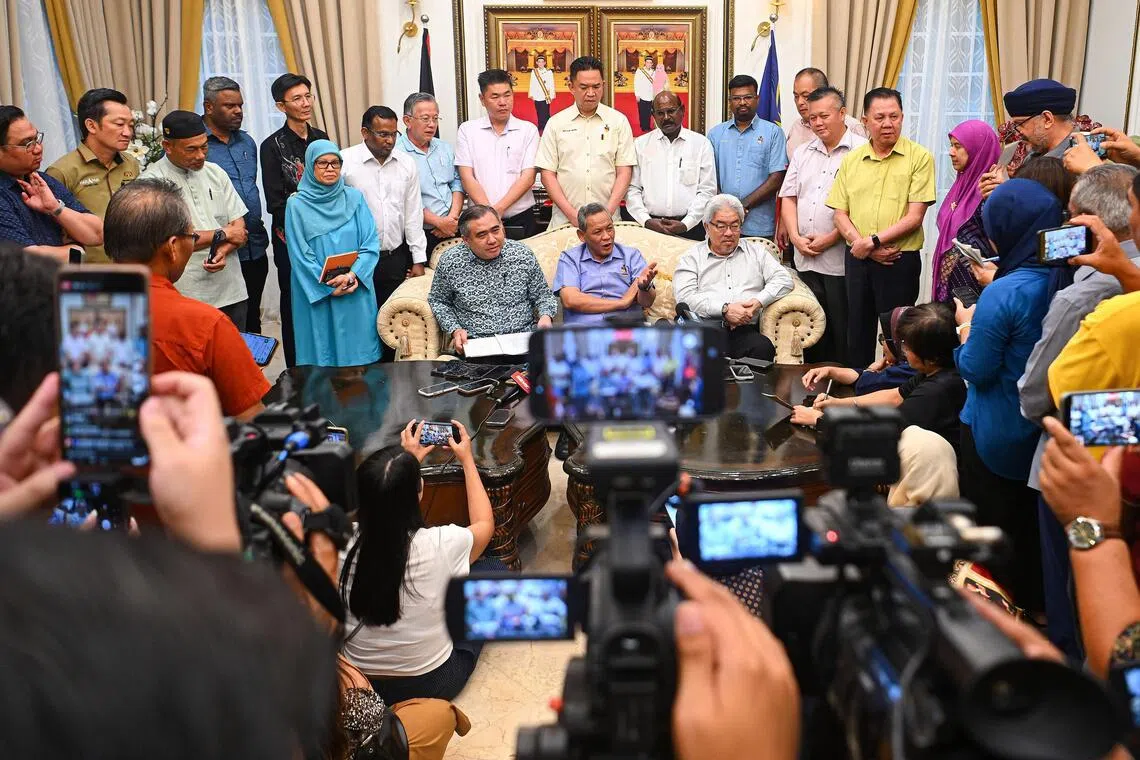
KUALA LUMPUR – The sundering of the alliance between Prime Minister Anwar Ibrahim’s Pakatan Harapan (PH) coalition and Barisan Nasional (BN) in the state of Negeri Sembilan will have far-reaching consequences for upcoming polls in Malaysia.
Datuk Seri Anwar may now be forced to bring forward the general election, when it is due only by early 2028.
Government sources told The Straits Times that despite Mr Anwar’s Parti Keadilan Rakyat (PKR) setting the second half of 2027 as the ideal window for a general election, growing tensions within the ruling alliance could force him to dissolve Parliament by end-2026. If this happens, a general election must be held within 60 days.
Mr Anwar’s so-called unity government is a sprawling multi-coalition made up of former bitter foes who put aside their differences, after the 2022 General Election gave Malaysia its first-ever hung Parliament.
But the alliance is now unravelling, with the BN coalition also agitating to break its existing electoral pact with Mr Anwar’s ruling PH coalition at state polls in Melaka and Johor expected in the coming months.
On April 27, the UMNO-led BN with 14 assemblymen withdrew its support for Negeri Sembilan chief minister Aminuddin Harun, a vice-president in Datuk Seri Anwar’s party, claiming the Menteri Besar mishandled a palace crisis. This left PH without a majority in the state legislature, with just 17 out of 36 seats.
Later that day, the state’s BN chapter accepted a proposal from five opposition Perikatan Nasional (PN) members to form the state government.
This flew in the face of the electoral pact between PH and BN, where they had agreed to campaign jointly in six state polls in 2023. In particular, Negeri Sembilan had been seen as a good example of cooperation between the two sides, which won more than four-fifths of the legislature seats in 2023.
“No to backdoor government. This is not democracy. This is a betrayal of the public mandate,” said Transport Minister Anthony Loke of the Democratic Action Party (DAP) after meeting his PH colleagues in the state on April 27.
“The mandate from the people of Negeri Sembilan was clear,” said Mr Loke, who is DAP’s Negeri Sembilan chief, adding that the PH-BN pact was “formed before the election and affirmed by the public”.
PH insiders told ST it would be unthinkable now for the electoral pact to continue into three state polls in Johor, Melaka and Sarawak that must take place within the year, as well as the subsequent general election.
“BN’s move in Negeri Sembilan complicates any pre-election pact with PH. These arrangements depend on trust and coordination, both of which are now under strain,” risk consultancy KRA Group’s strategy director Amir Fareed Rahim told ST.
This will mean a rerun of the 2022 General Election, where the three main national coalitions – PH, BN and PN – duked it out. The PN coalition comprises Parti Pribumi Bersatu Malaysia, Parti Islam SeMalaysia and other smaller outfits.
But in the event of a repeat hung Parliament where no party wins a clear majority, would anyone risk an alliance with UMNO, given its track record of usurping power from its allies?
“Post-election, the calculus changes. Coalition-building becomes less about sentiment and more about stability and numbers, driven by necessity rather than ideological alignment,” Mr Amir said.
“However, both PN and PH have now experienced how BN has grabbed power from them despite forging an alliance. It could be a case of once bitten, twice shy.”
Anxiety within PH also stems from the so-called Sheraton Move in 2020, when it was toppled from federal power after a bloc of MPs from Mr Anwar’s own PKR defected along with Bersatu to join hands with opposition parties including UMNO, which had in 2018 lost power for the first time.
Bersatu president Muhyiddin Yassin was installed as prime minister and UMNO returned to government.
But in 2021, UMNO president Zahid Hamidi led a group of MPs to withdraw support for Mr Muhyiddin in the middle of the Covid-19 pandemic, a move which led to then UMNO vice-president Ismail Sabri Yaakob taking power.
This did not do UMNO any favours electorally, as BN won just 30 seats at the 2022 election, its worst-ever showing.
Datuk Seri Kalimullah Hassan, former adviser to the late prime minister Abdullah Badawi, noted that despite losing badly in 2022, UMNO was “invited to jointly form the government and given the lion’s share of Cabinet positions”.
Datuk Seri Dr Zahid, for instance, was appointed deputy prime minister.
Mr Kalimullah added: “Yet, what happens when there is a crisis involving the palace in Negeri Sembilan… they brazenly make a power grab, pulling out of government, teaming up with their enemies, to topple the very government they were part of.”
-
Sign up for our weekly Asian Insider Malaysia Edition newsletter to make sense of the big stories in Malaysia