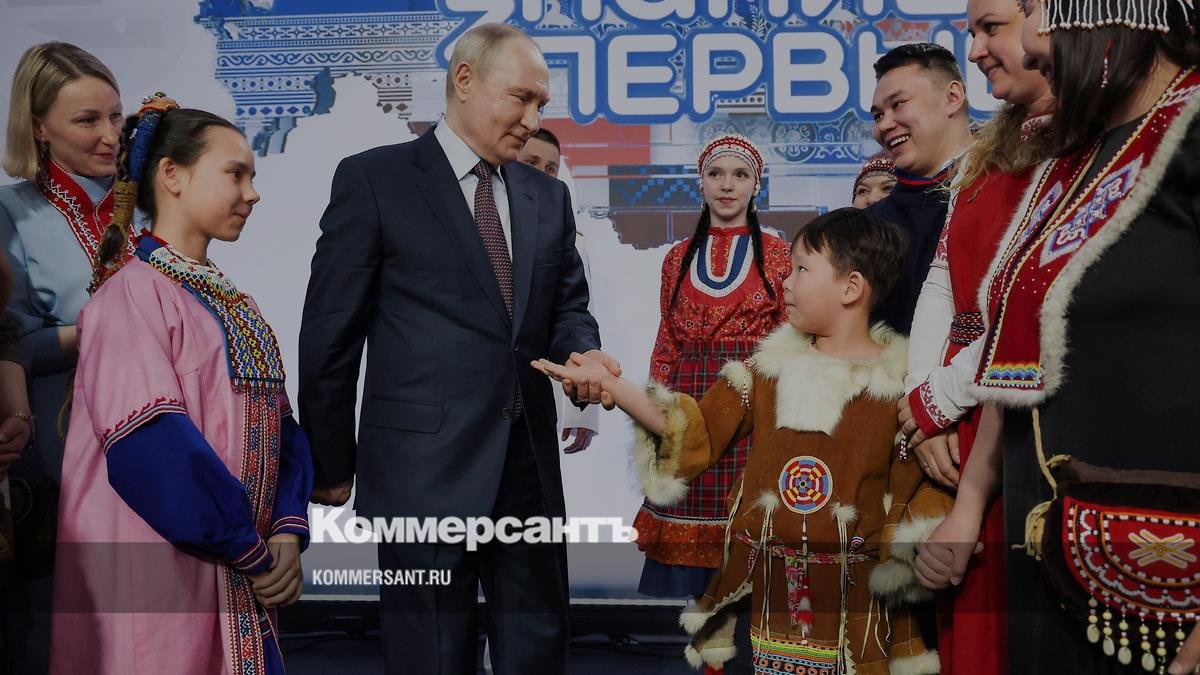
Guests of the third and final day of the educational marathon of the Knowledge Society, dedicated to the Year of Unity, were Deputy Chairman of the Security Council Dmitry Medvedev, who discussed the use of nuclear weapons, and President Vladimir Putin, who met with representatives of small indigenous peoples. The head of state listened to their colorful tunes, stories about local cuisine, and also discussed the construction of a bridge to Sakhalin.
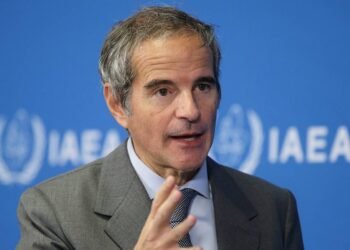
Mr. Medvedev spoke in a question-and-answer format. Young listeners were concerned about aspects of international security, as well as the former president’s views on modern politics. “After the collapse of the Soviet Union, almost all of us looked at our relations with the Western world through rose-colored glasses. It seemed that this is a prosperous society, we must definitely copy their experience, but the most important thing is that they are waiting for us there with open arms,” said the deputy chairman of the Security Council, admitting that he himself had been deceived for some time. Dmitry Medvedev included the belief in the possibility of ending the Middle East conflict through a deal as a modern illusion: “Bazaar schemes in geopolitics do not work.”
When asked by a seventh-grader whether a nuclear strike is possible and who would launch it first, the former president answered succinctly: “I wouldn’t want to.” However, he immediately admitted that “a nuclear apocalypse is really possible.”
Mr. Medvedev called thoughts on the topic of primacy senseless, recalling that it will forever remain with the United States.
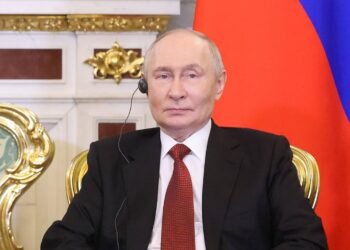
Vladimir Putin’s program was much more connected with the declared theme of the marathon. Before the start of an hour-long meeting with representatives of small indigenous peoples, the president spoke with a family from the Yamalo-Nenets Autonomous Okrug – Rodion and Kristina Puyko, who volunteered for a special operation in 2022: the husband as an attack aircraft, the wife as a nurse. After returning to peaceful life, they are “working very hard” on demography, Mrs. Puiko assured the president.
Front-line and demographic successes became an important motive at the meeting itself: everyone shared the number of children and grandchildren, as well as relatives who fought on the fronts of the Great Patriotic War and the Northern Military District. The moderator was the general director of Knowledge, Maxim Dreval, and the first deputy head of the presidential administration, Sergei Kiriyenko, was present at the table.
– Chirtkemesh! Hello, dear…,” Nadezhda Sidorova, a Besermian woman, greeted Vladimir Putin in her native dialect.
“Chirtkemesh,” answered the head of state.
Mrs. Sidorova said that she gave three children to her people, whose number is exactly 2067 people.
She also shared her losses: “Alexey, the father of my children, as a faithful son of his Fatherland, stood up to defend the Motherland in the zone of a special military operation. Unfortunately, he is no longer with us. But we keep the memory of our hero in our songs and our unique Besermyan melodies.”
She wanted to share one of her improvisational, impossible-to-reproduce melodies (krezem) with Vladimir Putin. The President was sincerely interested:
— This creativity itself was formulated and in itself is passed on from generation to generation, right?
– Yes.
– Or is this something you personally did?
– My grandmothers, I am a Besermian on my father and mother. Therefore, I know firsthand how it is sung.
— So you heard from your parents, from your grandmothers? – the president insisted.
But it turned out that Mrs. Sidorova’s krez sounds differently and she can no longer sing like her ancestors: “The experience and the intonations that our grandmothers had, they have completely different ones. They are sadder, more plaintive, more difficult, so to speak. Maybe due to the fact that their life then was not the same as ours.”
A representative of the Seto people, Elena Variksoo, also greeted the president in her native language, but he was no longer able to answer. “I won’t be able to do this again,” admitted Vladimir Putin. The woman spoke about a government grant that allowed the school where she works as a history teacher to upgrade the technology room. In this subject, according to her, children learn to cook national cuisine.
“As they say in the army: you have to stay away from your superiors and stay closer to the kitchen.” “Tell me about the kitchen,” the president became interested again.
— As part of the project, we were able to purchase kitchen equipment. We bought a refrigerator, a microwave oven…” Mrs. Variksoo began.
– No no.
– About the national one?
– Certainly. “We all have a refrigerator, thank God,” Vladimir Putin said sarcastically.
After that, Elena Variksoo talked about pie with caramelized onions, pumpkin compote, as well as sauerkraut with pearl barley and meat, which the Seto eat in winter. In response, the President clarified the most delicious details, and in conclusion, he instructed Maxim Dreval to be more actively involved in preserving the gastronomic heritage.
Finally, in a conversation with Sakhalin tour guide Andrei Kafkan, the head of state asked:
— Will we build a bridge to Sakhalin?
– Bridge – yes. It would be wonderful,” Mr. Kafkan was slightly confused. “All Sakhalin residents are just waiting for this.” Because truly connecting with Russia will be a significant event.
– Dear story. It’s not even that the bridge is expensive. The adjacent infrastructure to this bridge is the most expensive thing. But it still needs to be done,” the president concluded.