Demand for rolled steel in construction in the first quarter was 17% lower than last year, but the level of consumption exceeded the level of the end of 2025. Market participants admit that the industry has “found the bottom”, but the sustainability of demand will only be clear in the second quarter. For now, projects in the CIS countries can provide support to manufacturers of metal structures.
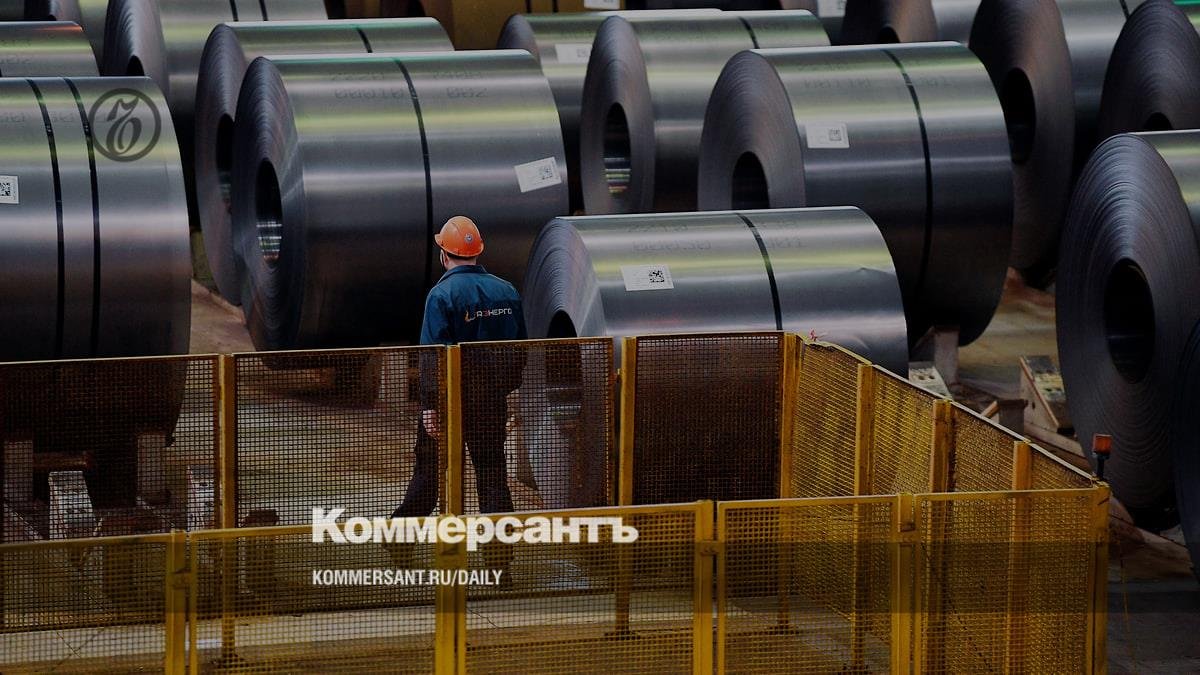
Consumption of rolled steel by manufacturers of building metal structures in the first quarter decreased by 17% year-on-year, to approximately 1.2 million tons, Dmitry Eremeev, director of market demand development at Evraz, told Kommersant. We are talking about sheets, pipes (except for the oil and gas pipe segment), shaped steel and beams.
In March, the health coefficient of the Russian steel construction industry (KZO) Evraz Steel, which takes into account the volume of rolled steel consumption in infrastructure and industrial construction, amounted to 69.6%, for the entire first quarter – 68.9%. This is 0.5 percentage points less than a year earlier, but higher than the fourth quarter of 2025 (65.5%). The number of active construction projects in the industrial and infrastructure sector increased by 5%, to 43 units, of which 19 returned to work after being frozen, analysts report. These include the Baltic Gas Chemical Complex, Arctic LNG-2, Amur Gas Chemical Complex, Rosatom facilities, Baimsky Mining and Processing Plant (Chukotka), Malmyzh Mining and Processing Plant, Kumroch field (Kamchatka Territory). As Evraz Steel points out, the industry has “found the bottom”, but the sustainability of growth will be clear based on the results of the second quarter.
14 million tons
amounted to rolled steel production in the Russian Federation in the first quarter of 2026, according to Chermet Corporation.
Managing partner of Ferro-Stroy Group of Companies Grigory Vaulin says that based on the results of the first quarter of 2026, developers in the Russian Federation began construction of residential projects with an area of 10.7 million square meters. m, which is 40% more than a year earlier. A similar recovery in activity was recorded in other market segments, he adds.
General Director of the Smart Engineers Group of Companies, Hussein Pliev, notes that at the end of the first half of the year, a careful recovery is expected, which will be greatly shifted into the second half of the year. “April did not give the traditional seasonal acceleration, that is, builders are not yet speeding up metal purchases. The main scenario is stagnation in the first half of the year and very weak, but still growth in the second, if the Central Bank begins to lower the rate and unblocks lending,” says Mr. Pliev. Managing Director of the NKR rating agency Dmitry Orekhov expects a moderate seasonal rebound due to seasonality and the implementation of financed projects in the second quarter. Based on the results of the first half of the year, the base scenario is a slight decrease in the consumption of steel products in construction year-on-year or no dynamics on a reduced basis, he adds.
The growth in demand for construction steel is more pronounced than in the domestic market in the CIS countries.
According to Evraz Steel, in the CIS countries KZO in the first quarter increased to 66.2% against 63.8% a quarter earlier, and in March it reached 68.1%. The key driver of demand is the Almalyk MMC at the Yoshlik copper deposit in Uzbekistan.
According to Dmitry Eremeev, Evraz and other Russian manufacturers traditionally export structures and rolled metal for their production to the CIS countries. Export to other markets is limited by the cost of lengthy logistics and insufficient prices in local markets to justify such logistics. Among the CIS countries, the largest number of construction projects using metal structures are now in Kazakhstan, Belarus and Uzbekistan, where the bulk of exports from Russia go, continues Mr. Eremeev. Hussein Pliev notes that in world markets outside the post-Soviet space it is extremely difficult to compete with China, primarily in terms of price. According to Grigory Vaulin, the Russian Federation maintains its position in the markets of many CIS countries thanks to close economic ties and the quality of steel. Commercial Director of Severstal Steel Solutions Group of Companies Evgeniy Konnov notes that, on the one hand, Chinese companies with lower prices are trying to enter the market of CIS countries, on the other hand, local manufacturers close to the customer are trying to maintain their positions. The advantage of Russian manufacturers, according to him, is their experience in implementing complex industrial and infrastructure projects.