The European Parliament (EP) voted on Wednesday in the 2024 budget exemptions of EU institutions and bodies. The EU’s only institution consisting of directly elected members supervises the common budget through the final accounting procedure.
The EU quasi-government, the European Commission, was blamed: the body should use all means against the fact that many member states have slipped back in systemic corruption and basic rights. They welcomed the fact that the rate of budget errors fell from 5.6 percent in 2023 to 3.6 percent, but this was partly attributed to slower payments due to the coronavirus epidemic.
THE in the voted text among others, concerns were identified at the Directorate General for Neighborhood Policy which
are incompatible with the European Commission’s “standards of accountability, reliability and good administration towards its members”.
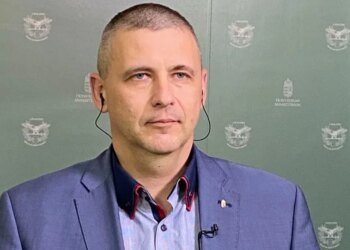
The European Commission was reconstituted in December 2024, and the Hungarian member, Olivér Várhelyi, responsible for neighborhood policy until then, was given the area of health and animal welfare.
The final accounts specifically indicated that the directorate-general was “under the responsibility of the current commissioner responsible for health and animal welfare” during that period, when many top management positions were not filled, and inaccurate information was also provided. In the section on the Directorate-General, it was emphasized that the European Commission must “ensure that all members of the Board of Commissioners meet the standards of integrity, independence and professional credibility necessary for the performance of their duties, especially when these duties involve the management of politically sensitive portfolios and significant EU funds”. They didn’t add it, but in this area earlier several concerns were raised Opposite Várhelyi. The European Commission also launched an internal investigation after the accusations that the Hungarian government had intensively spied on the board at the time when it was headed by Várhelyi. The result of the investigation it was handed over to the EP a few weeks ago.
The EP his final account of himself “reminds” that the former Identity and Democracy faction
“spent at least EUR 4,333,635.78 without authorization in the 2019-2024 cycle,
which exposes the body to a significant financial and reputational risk”, and deficiencies were also revealed in public procurement procedures. The EU prosecutor’s office launched an investigation into the case in 2025.
Just like that we wrote earlierthe ID faction disbanded in 2024 after almost all its members gradually transitioned to the Patriots for Europe (PfE) group. The latter partly initiated by Viktor Orbán and became a founding member of Fidesz. Among other things, PfE includes the secretary general of the ID, Philip Claeys took over in the same position, ID also sold assets to PfE. Claeys was tasked with eliminating the ID faction.
The budget control committee of the EP last year he arguedthat debtors cannot be freed from their obligations “merely due to formal changes in their organization”. According to the opinion, “such continuity can exist if a significant part of the members of the former group move together to the new formation, where the general secretary is the same”, and
hinted that they could handle PfE as a successor faction to cash in on.
The text voted at Wednesday’s plenary session reminded of last year’s expert committee opinion, “in which it asks to investigate
and the possibility of immediately initiating the necessary procedures for the early repayment of the amount of ineligible expenses, as well as the assessment of the obligations of the responsible (former) representatives and the hierarchy”. He suggested that a new auditor be appointed and awaits the “analysis of the EP administration by the Patriots for Europe (PfE) representative group in 2024.
on its annual report”.
The vote at the Council made up of member state governments was postponed, as it has been every single time since 2009, because of a lack of cooperation.
According to the EP’s announcement, “corrective measures, stricter financial controls or political consequences” may occur if the final accounting is refused.